
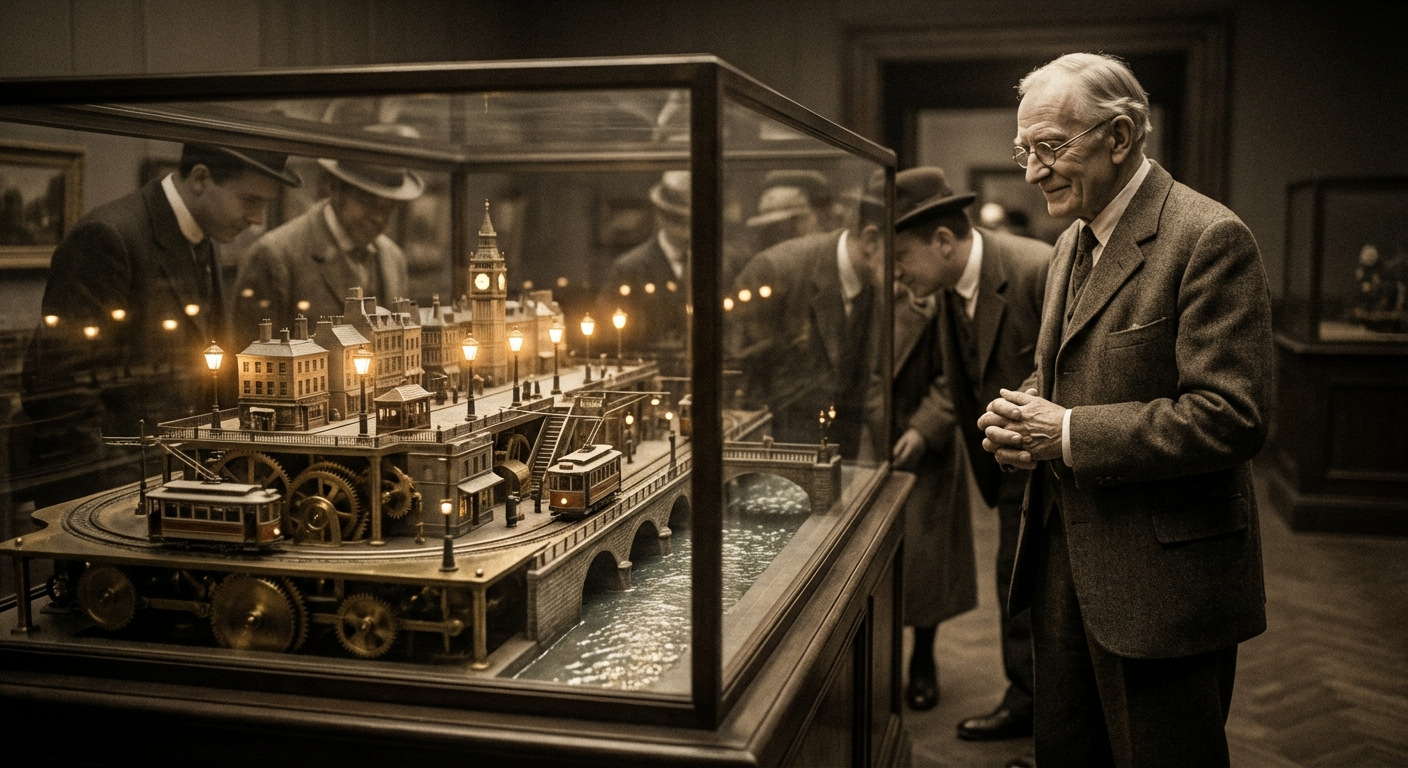
The exhibition of Oswin Faraday’s extraordinary mechanical model of Bobington opened this morning at the Historical Preservation Society on Grayling Street, and the first thing one notices is the light.
Forty-eight miniature streetlamps, wired by hand over the course of two winters, illuminate a city of 2,340 buildings, 14 bridges, and six functioning clockwork tramlines. Water flows in the Ashwater, pumped through channels no wider than a pencil. The number 7 tram runs from Caldecott Square to Millgate, exactly as it did when Faraday drove it for twenty-six years. The Bellvue Theatre is there, and the Bramblegate Fish Market, and Bridgewater Stadium, and the spire of St Cuthbert’s, and ten thousand other particulars that one only notices after standing over the model for several minutes with one’s mouth slightly open.
It is, without qualification, the most remarkable thing I have seen in a gallery this year, and I include the Hargrove retrospective in that assessment.
Mayor Blackthorne opened the exhibition at ten o’clock, cutting a ribbon that Louisa Marchbank of the Historical Preservation Society had strung between two miniature lampposts. The Mayor spoke briefly and well, noting that Faraday had built “a monument to attention” and that the city should be proud to have a citizen who looked at his home this carefully.
Faraday, 62, stood beside his wife Constance and said very little. When the first visitors gathered around the model and the clockwork was engaged, he removed his spectacles and cleaned them for rather a long time.
The model’s journey to Grayling Street has been well documented in these pages — the division at the river by Arthur and James Bayliss, the transport of both halves by flatbed, the painstaking reassembly that restored all twelve connectors and relit all forty-eight lamps. That the model works at all after being cut in two is a testament to the Baylisses’ skill. That it works beautifully is a testament to Faraday’s.
Two hundred and forty-three visitors came through the doors by four o’clock. The Society expects to extend the exhibition beyond the originally planned three weeks. Admission is free, though a donations box has been placed at the entrance. At the time of writing it contained forty-seven florins and a note that read: “Worth more than the entry fee.”
One visitor in particular should be mentioned. Oliver Chalk, 11, brought by his grandfather from Thornhill, spent forty minutes lying flat on the floor to observe the underside of the Fernwick Bridge mechanism. When he stood up he announced, with complete conviction, “I want to make one.”
Faraday, who overheard this, said: “Start with something smaller.”
Constance Faraday, who was standing nearby, said: “He started with the garage. I got the rest of the house.”
The exhibition is open Tuesday through Sunday, 10 AM to 5 PM. I recommend arriving early. And lying on the floor if you are so inclined.