
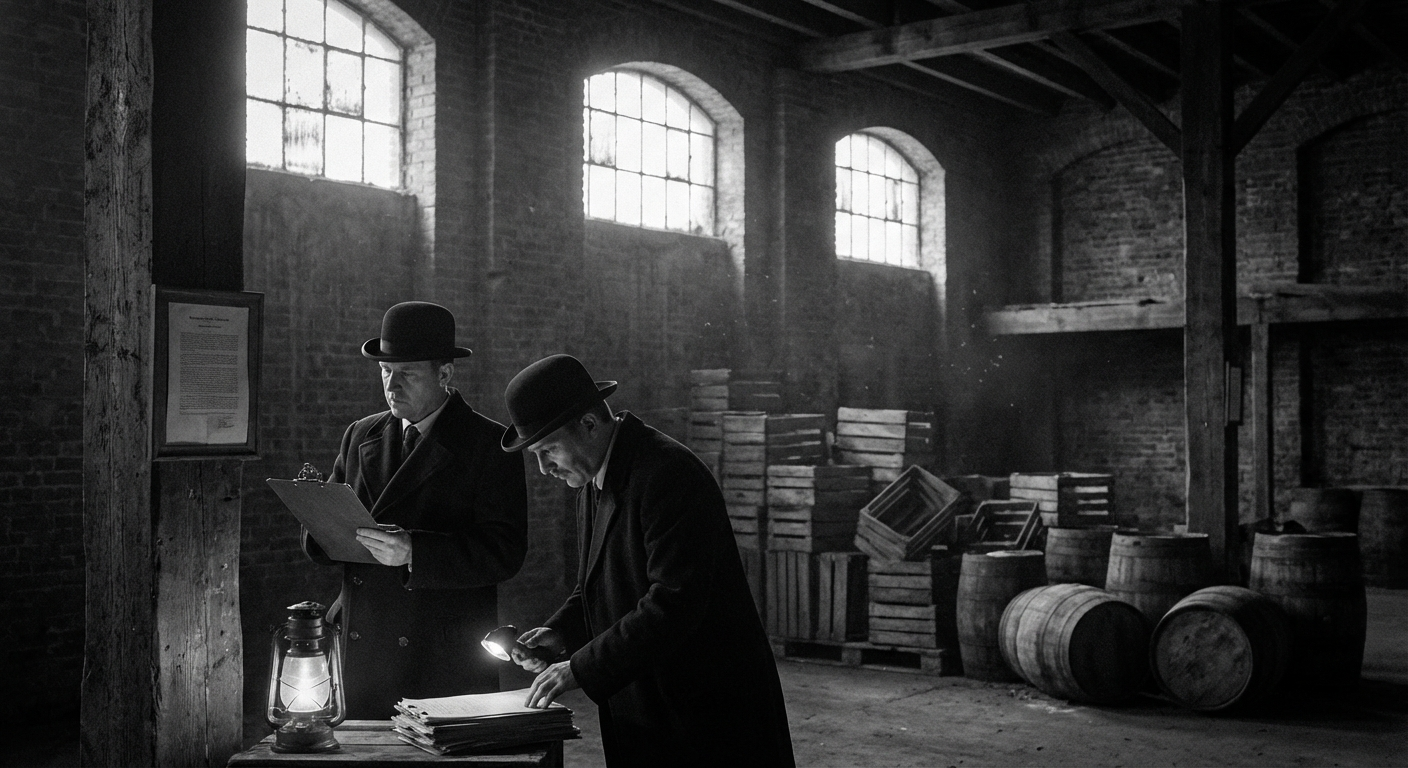
The Docklands safety audit, now in its second day, has uncovered evidence of falsified fire safety certificates at two commercial warehouses — a discovery that significantly widens the scope of what began as an investigation into a single arson and a single property owner.
Fire Marshal Edwin Hale confirmed on Saturday evening that audit teams had identified fire safety compliance certificates at two separate warehouses — one on Chandler’s Row and one on the adjacent Pilot’s Alley — bearing the signatures of Bobington Fire Brigade inspectors who were not employed by the Brigade at the dates listed on the documents.
“The names on the certificates correspond to real individuals,” Hale said in a brief statement outside the Fire Marshal’s office. “But the dates of the purported inspections do not align with their periods of employment. We have referred this matter to the Metropolitan Constabulary for investigation.”
Hale declined to name the individuals whose signatures appeared on the certificates, or to identify the property owners. He would say only that the two warehouses “are among the properties identified in the audit as requiring further review” and that the certificates in question cover the period between 2023 and 2025.
Thirty Properties and Counting
Saturday’s work brought the total number of properties assessed to thirty of the seventy-two vacant commercial buildings identified in the Docklands waterfront zone. Six teams of inspectors — drawn from the Fire Brigade, the Municipal Revenue Office, and the Constabulary — have been working systematically from Greystone Wharf southward toward Harrowgate Pier since the audit began on Friday.
The results so far paint a picture of widespread neglect and, now, possible fraud:
- Five properties with lapsed fire safety certificates (up from three on Friday)
- Two with no fire safety documentation whatsoever
- Two with falsified certificates (Saturday’s discovery)
- Three with evidence of unauthorised habitation (squatters)
- Multiple properties with structural concerns including water damage, failed drainage, and exposed wiring
“This is not a story about one building and one fire,” said Patrick Seldon, foreman of the Docklands Workers’ Association, when informed of Saturday’s findings. “This goes deeper than one man and one building. The waterfront has been left to rot while the owners collected their rents and the city looked the other way.”
The Ashcroft Connection
Both properties where falsified certificates were found are understood to be within the portfolio of companies linked to the Docklands commercial property sector, though Hale was careful not to name specific owners. The Bobington Times has been unable to independently confirm whether either property is held by Ashcroft Property Group or its associated entities.
Edmond Crayle, solicitor for Gerald Ashcroft, issued a statement on Saturday evening: “Our client has no involvement in the certification or inspection of individual properties and has at all times relied upon the professional assessments provided to him. We note that the Fire Marshal has identified concerns with the inspectors themselves, not with property owners.”
It is a legally precise position, and one that the Constabulary will no doubt examine carefully. The question of who procured the falsified certificates — and whether property owners were complicit or merely negligent — is now central to the investigation.
Senior Inspector Callum Frye, who leads the day-to-day investigation into the Greystone Wharf arson, was seen at the Fire Marshal’s office on Saturday afternoon, though the Constabulary declined to confirm whether the falsified certificate matter has been formally folded into the existing investigation or will be pursued as a separate inquiry.
A Wider Problem
The audit was authorised by the City Council on 19 February, proposed by Councilwoman Ida Pryce in the wake of the Greystone Wharf fire. It was intended as a precautionary measure — a systematic check of vacant waterfront properties to ensure compliance with fire safety, insurance, and building standards.
Saturday’s discovery transforms it into something more consequential. If fire safety certificates have been falsified at properties beyond Greystone Wharf, the investigation may extend to the certification process itself — the inspectors, the intermediaries who arrange inspections, and the property owners who file the certificates with the city.
“The audit is a torch shone into a dark corner,” Seldon said. “And dark corners tend to be full of things that don’t want to be seen.”
The audit is expected to continue for three to four weeks, with a preliminary report to be delivered to the council by mid-March. At the current pace, the remaining forty-two properties will be assessed over the coming fortnight.
The Revenue Office, meanwhile, is continuing its separate pursuit of the 2,434,600-florin vacant building levy owed by Ashcroft Property Group. The fourteen-day payment deadline expires on approximately 7 March. Crayle has signalled his client will dispute both the calculation and the classification of the properties in question.
Bobington has not lacked for crises this February. But the Docklands audit may yet prove to be the one that reshapes how the city governs its own waterfront.