
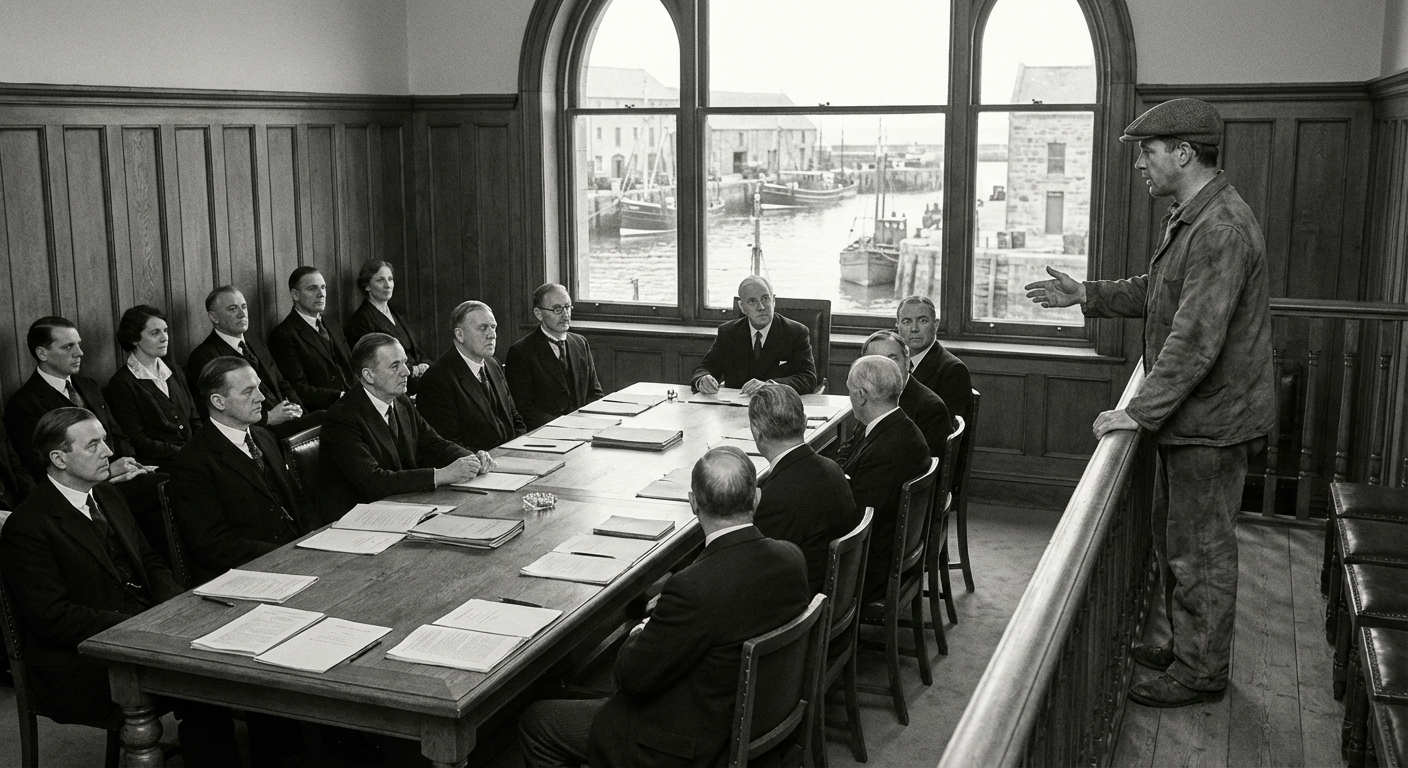
The Harbour Authority Board voted unanimously this morning to mandate position-reporting beacons on all fishing vessels under twenty metres operating from Bobington harbour. The vote took four minutes. The argument about funding took an hour and forty minutes and remains unresolved.
The mandate, born from the Fishermen’s Benevolent Association’s unanimous resolution of 12 March — itself born from the near-loss of the Lady Maren and her four-man crew — will affect approximately ninety boats. Each beacon unit costs between 195 and 260 florins depending on supplier and specification. The total fleet cost, at the lower estimate, is 17,550 florins. At the upper, 23,400.
The sum is modest by municipal standards. The argument is not about the sum.
“The principle was never in question,” said Dr Willa Greaves, the Board’s marine safety specialist, who had predicted a “brisk and unanimous” vote. “The mechanism of payment is another matter entirely.”
Three proposals were presented. The first, from the Association itself, calls for a shared-cost model: the Authority purchases beacons in bulk at the lower Harland Maritime Instruments rate of 195 florins per unit, fishermen pay 100 florins each, and the Authority absorbs the remainder from its safety budget. Total Authority contribution: approximately 8,550 florins.
The second, presented by Deputy Harbour Master Marcus Felbridge, proposes full Authority funding from the maritime safety reserve, with costs recovered over three years through a modest increase to annual vessel registration fees — approximately 35 florins per vessel per year.
The third came from the floor. Percy Dalgleish, master of the trawler Northern Light and a 44-year-old man who has fished these waters since he was seventeen, stood in the public gallery and made a proposal that no one had written down.
“We feed this city,” Dalgleish said, his voice carrying easily in the panelled room. “The fish on every table in Bramblegate came off one of our boats. The least the city can do is help us come home.”
His proposal: full council funding, not from the Authority’s budget but from the municipal maritime safety allocation — a line item that currently stands at 42,000 florins and has not been increased since 2019.
Harbour Master Cornelius Ashby, who has supported the beacon mandate from the beginning, addressed the room with characteristic directness.
“The Board has done what it can do today, which is to establish the requirement,” he said. “The question of payment is properly a matter for the Council Maritime Affairs Committee, which meets tomorrow.”
Captain Dermot Shale, whose thirty-seven hours adrift aboard the Lady Maren catalysed the entire campaign, attended but did not speak during the formal session. He was seen afterwards in conversation with Dalgleish and Reg Compton, a boatwright of sixty-three years who operates from the Harbourfront boatyard.
Compton, who has been fitting position-reporting equipment to larger commercial vessels for over a decade, offered a practical observation that cut through the financial debate.
“It’s a morning’s work per boat if you know what you’re about,” he said. “I’ll do the installations at cost. That’s not the point. The point is that ninety boats go out of this harbour and not one of them can tell you where it is if the engine dies and the aerial snaps.”
The Board also heard from representatives of both equipment suppliers. Harland Maritime Instruments of Port Caravel has quoted 195 florins per unit for a bulk order of ninety, with delivery within three weeks of confirmation. Ashwater Signal Works, the Bobington-based manufacturer, quoted 220 florins per unit but offers local servicing, spare parts from stock, and a five-year warranty.
Ashby noted that the Ashwater Signal Works quote, while higher, “has practical advantages that a price list does not capture.”
The matter now passes to the Council Maritime Affairs Committee, which convenes tomorrow at 10 AM. The committee will hear testimony from both the Authority and the Association, and is expected to make a funding recommendation before the end of the week.
Owen Pritchard, the retired trawlerman whose nephew was lost at sea in 1994, was not present today. But his words from the Association meeting last week were quoted twice during proceedings: “We buried an empty coffin. That is not a safety system. That is luck.”
The beacons, when fitted, will transmit vessel position every fifteen minutes to a shore-based receiver at the Port Authority building. In fog, storm, or engine failure, the harbour will know where every boat is.
The Board will next meet in regular session on 1 April.