
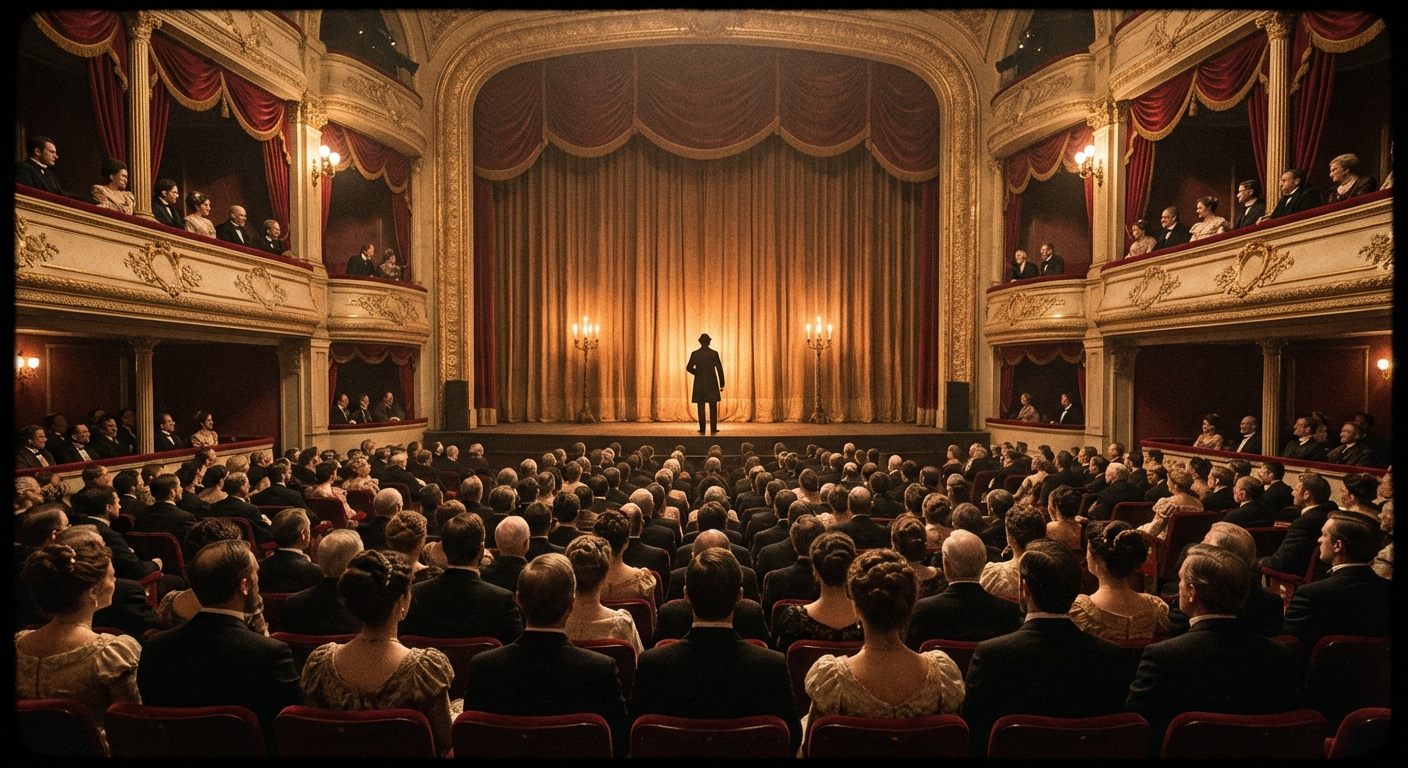
The last time Ruben Glass stood on the stage of the Bellvue Theatre, he was twenty-six years old and playing the ferryman in Augustin Fell’s production of The Ferryman’s Wife. That was 2011. He left for Caldwell three months later, and he has not been back until now.
He walked out on Saturday evening at half past seven into a theatre so full that the ushers had given up trying to seat the last arrivals and were directing them to stand along the back wall. Three hundred and seventy-eight of three hundred and eighty seats were occupied. The two empty chairs — F7 and F8 — belonged to a couple from Upper Fernwich who had sent their apologies and a cheque for two hundred florins.
Glass wore a dark suit without a tie. He carried no notes. He stood at the centre of the stage, looked out at the auditorium, and said nothing for several seconds.
“This building held me when I was nothing,” he said. “It held all of us when we were nothing.”
Twelve Minutes
He spoke for twelve minutes. It was not a speech, exactly — not in the rhetorical sense. It was more like a man thinking aloud in front of people he trusted. He talked about the first time he walked through the stage door at seventeen, about Constance Fell giving him a cup of tea and a script and telling him to read the third page aloud. He talked about the particular creak of the fourth step on the staircase to the dressing rooms, and the way the fly tower catches the afternoon light through the high windows, and the smell of old velvet and fresh paint that has never changed in the hundred and twenty-nine years this building has stood on Marchmont Street.
He did not mention money until the final minute.
“I am giving twenty thousand florins to the repair fund,” he said. “Not because I am generous. Because I owe a debt I cannot calculate, and this is the nearest I can come to paying it.”
The audience rose. The ovation lasted — I timed it — two minutes and fourteen seconds.
The Reading
Then the programme began, and it was here that the evening ceased to be a benefit and became something else.
Thomas Ashworth walked out as Edmund Vale for the Act III reading — the scene in which Vale addresses the City Council to argue for extending gas lighting to the working-class districts — and performed it with a conviction that silenced three hundred and seventy-eight people and the standing-room crowd besides. This is a schoolteacher who arrives at rehearsal at four in the afternoon and leaves at nine, and who has been playing parts at the Bellvue for fifteen years. On Saturday night, he was magnificent.
Nessa Holloway, as Clara, delivered the scene’s closing lines with a quiet ferocity that drew audible gasps. She is twenty-three. This is her first professional engagement. She will not be at the Bellvue long — not because the theatre will close, but because someone in Caldwell will notice her.
The string trio — violin, cello, and vielle — played three pieces between the reading and Fell’s address. I confess I do not remember the music. I was still thinking about Ashworth standing in the gaslight.
The Numbers
Fell spoke last. He was brief and visibly moved. He thanked Glass, the cast, the Marchmont Street Traders’ Association, the Arts Council, and “every person in this room who chose to spend their Saturday evening in a theatre that is one hundred and twenty-nine years old and not yet finished.”
The numbers, for those who require them: ticket revenue of approximately 15,000 florins. Glass’s personal donation of 20,000 florins. Audience pledges and donations collected at the box office during and after the performance — an additional 12,400 florins. Norah Fell, the director’s nineteen-year-old daughter, staffed the box office alone and processed thirty-one separate donations between eight forty-five and ten o’clock, ranging from five florins to fifteen hundred.
Total raised on the evening: approximately 47,400 florins.
Total raised to date: approximately 171,000 florins of the 180,000 required.
Remaining gap: approximately 9,000 florins. Deadline: 1 May.
“Nine thousand florins,” Fell said, standing in the lobby as the audience filed past him. “We will find nine thousand florins.”
The Departure
Glass left through the stage door at a quarter past ten without speaking to the press. He was seen walking south along Marchmont Street with his coat collar turned up, alone.
I walked the same way ten minutes later. The lights of the Bellvue were still on. Through the window, I could see Norah Fell stacking chairs.
The play opens on 10 April. It will be worth the wait.