
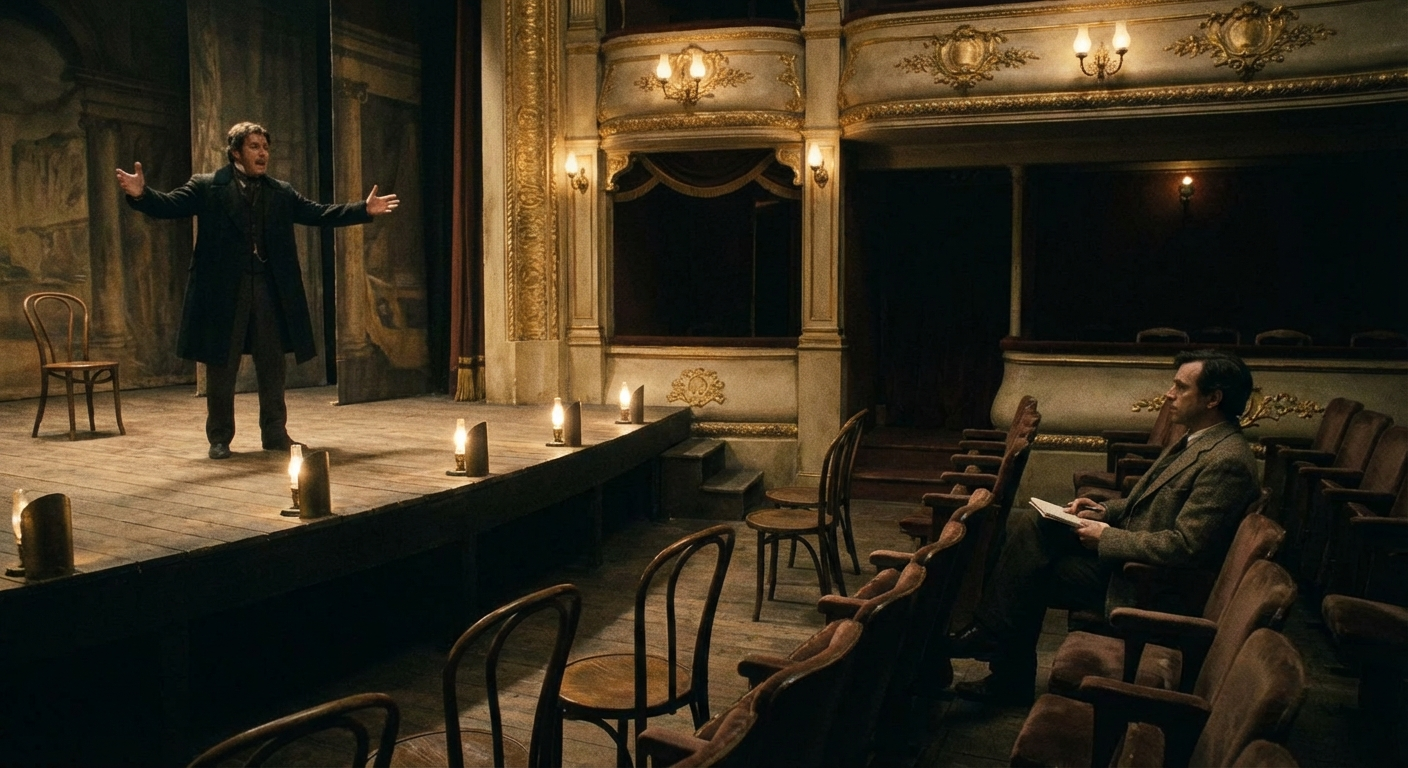
There is a moment in the third act of The Lamplighter’s Oath — the act they have been rehearsing this week, the act that will determine whether Augustin Fell’s gamble succeeds or fails — when Edmund Vale stands before the fictional City Council of 1847 and says: “You will light these streets, or you will explain to every family south of the river why their children walk home in the dark.”
Thomas Ashworth delivered the line on Thursday evening at approximately 7:40 PM. He was still wearing his school trousers — he teaches history at Thornhill Secondary and arrives at the Bellvue each afternoon at four o’clock, changing into rehearsal clothes in the wings. The line landed. The room — three actors, Fell in the fourth row, the stage manager with her prompt book — went quiet in the particular way that an empty theatre goes quiet when something works.
“Again,” Fell said.
They did it again. It worked again.
The Third Act
The play has three acts. The first establishes Vale and his world — the lamplighter who becomes superintendent, the widower raising his daughter Clara in a city half-lit. The second chronicles his campaign, the resistance of the gas companies, the indifference of a council that cannot see what happens south of the river at night. The third is the confrontation — Vale before the council, the argument for light, the cost of darkness.
This reporter has not seen the third act performed. Fell has closed rehearsals to press until the benefit night. But what can be reported is this: the company has been rehearsing the council scene every evening this week, and Ashworth’s Vale has found the register that the role demands — not anger, which would be easy, but the controlled authority of a man who has walked the dark streets himself and knows exactly what he is asking for.
Nessa Holloway, who plays Clara, has scenes in the third act that require her to stand in the gallery and watch her father make his case. Fell describes her work this week as “truthful.” Those who have seen rehearsals describe something more specific: a young actress discovering that stillness, done well, is harder and more powerful than movement.
The Benefit Night
One week from tonight — Saturday, 15 March — the Bellvue will hold its benefit performance. The evening will include scenes from the play (Acts I and II), a reception, and a fundraising appeal. Ruben Glass, who launched his career at the Bellvue in 2011, will attend in person. His framed telegram of support has been hanging in the theatre lobby since February.
Over half the 380 seats are sold. Tickets are 25 florins — more than five times the regular admission price that Fell intends to charge when the play opens on 10 April. The premium reflects the evening’s purpose: every florin goes to the fly tower repair fund.
Fell has invited Councilwoman Pryce, the Marchmont Street Traders’ Association committee, and representatives of the Historical Preservation Society. Whether anyone from the Mayor’s office will attend has not been confirmed.
The Numbers
Fundraising stands at approximately 110,000 of the 180,000-florin target — roughly sixty-one per cent. The Arts Council’s emergency heritage grant of 35,000 florins, received last week, was the largest single contribution and brought the total from a fragile 73,000 to a more credible six figures. Private donations have continued at a steady pace — several anonymous, most modest, a few substantial.
The Marchmont Street traders’ door-to-door collection of 4,200 florins remains, in its way, the most remarkable contribution. It represents the accumulated generosity of a butcher, a stationer, a tobacconist, two tea rooms, and an ironmonger — businesses for whom 4,200 florins is not a negligible sum.
The gap is 70,000 florins. The deadline is 1 May. If the benefit night sells out and the reception raises what Fell hopes, the target is within reach. If it does not, the Bellvue’s fly tower — and with it, the oldest continuously operating independent theatre in Bobington — faces an uncertain future.
Ashworth will be back at the Bellvue on Monday at four o’clock, school trousers and all. The third act needs more work. The light, as Vale might say, is not yet where it needs to be.