
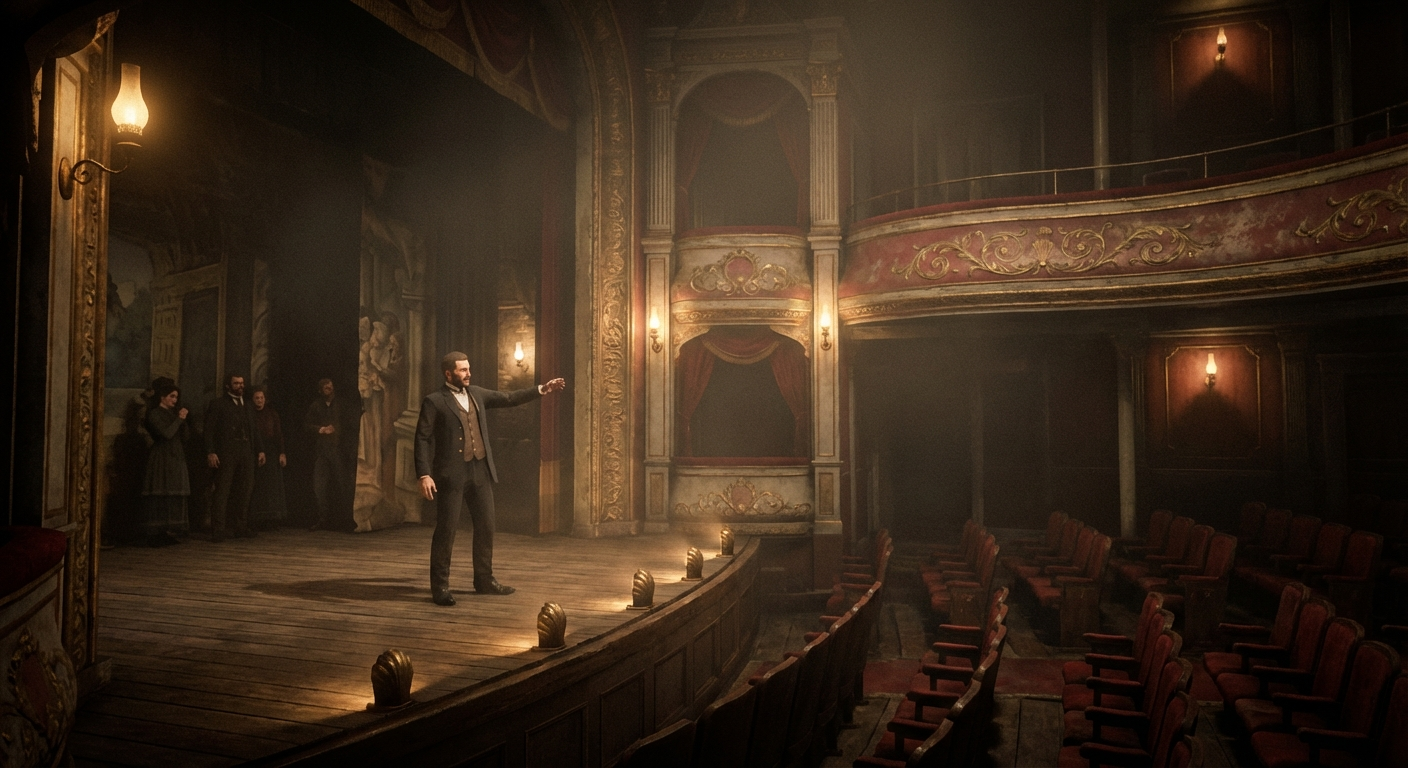
Seven days from tonight, the lights of the Bellvue Theatre will go up on a performance that is, in ways both literal and metaphorical, a matter of survival.
The benefit night staging of The Lamplighter’s Oath — Augustin Fell’s first original play, his first benefit, and quite possibly his last production if the money does not arrive — is scheduled for Sunday, 15 March. Over half of the theatre’s 380 seats are sold. Ruben Glass, who got his start on the Bellvue’s stage in 2011 and is now a fixture of the Caldwell theatre scene, is confirmed to attend in person.
Fundraising stands at approximately 110,000 of the 180,000 florins needed for fly tower repairs by the 1 May deadline. The gap is 70,000 florins. It is, depending on one’s temperament, either a manageable distance or a chasm.
In the Rehearsal Room
This newspaper was permitted to observe a portion of Thursday evening’s rehearsal — the first full run of the third act, in which Edmund Vale, Bobington’s first superintendent of lamps, confronts the aldermen who would confine gas lighting to the prosperous streets of Midtown.
Thomas Ashworth, who arrives at the theatre each day at four o’clock after a full day’s teaching at Thornhill Secondary, has grown into the role with a quiet authority that owes nothing to theatrical convention. His Vale is not a crusader. He is a civil servant who has seen something that cannot be unseen: that the darkness of a city’s streets is not an accident but a choice.
“The light is not expensive,” Vale says, in the act’s pivotal speech. “What is expensive is the decision to keep others in the dark.”
Ashworth delivered the line on Thursday with a stillness that silenced the rehearsal room. Fell, watching from the third row, did not interrupt.
Nessa Holloway, twenty-three and in her first professional engagement, has found Clara — Vale’s daughter and the play’s moral compass — through a stubbornness that works beautifully against Ashworth’s restraint. In the third act, Clara must persuade her father to continue his campaign after the aldermen’s first refusal. Holloway played the scene with a kind of compressed fury that surprised the cast.
“She wasn’t like that last week,” one actor said, with evident admiration.
Fell, asked about the production’s readiness, offered one of his characteristically oblique assessments: “The play is almost ready. The theatre is almost funded. ‘Almost’ is the most dangerous word in the language.”
Glass Returns
Ruben Glass’s attendance at the benefit night is not merely a celebrity endorsement. Glass performed in fourteen productions at the Bellvue between 2011 and 2017, including the role of Sergeant Callister in The Ferryman’s Wife that launched his career. His telegram, framed in the theatre’s lobby since February, reads: “The Bellvue made me. It is not too much to say that it made Bobington.”
Glass is expected to make brief remarks before the performance and to remain for the reception afterwards. Whether his presence translates into donations or simply into atmosphere is a question Fell has declined to address directly.
“Ruben is coming because the Bellvue matters to him,” Fell said. “What the audience does with that is their business.”
The Numbers
The 35,000-florin Arts Council heritage grant, confirmed in February, provided the foundation. The Marchmont Street Traders’ Association contributed 4,200 florins through a door-to-door appeal. Private donations make up the balance.
The benefit night itself will generate ticket revenue — seats are priced at 15 florins, roughly double the usual Bellvue admission — but the evening’s true purpose is to place 380 people in a Victorian theatre watching a play about public service and hope that the combination proves persuasive.
If the full 180,000 is not raised by 1 May, the fly tower repairs cannot proceed on schedule, and the Historical Preservation Society’s listing — one of 52 “structures of cultural significance” identified in a 2024 survey — offers no legal protection against closure.
Fell is aware of this. He is also, by all appearances, undaunted.
“I’d rather go out with a play than a whimper,” he said when the campaign began. He has not revised the statement.