
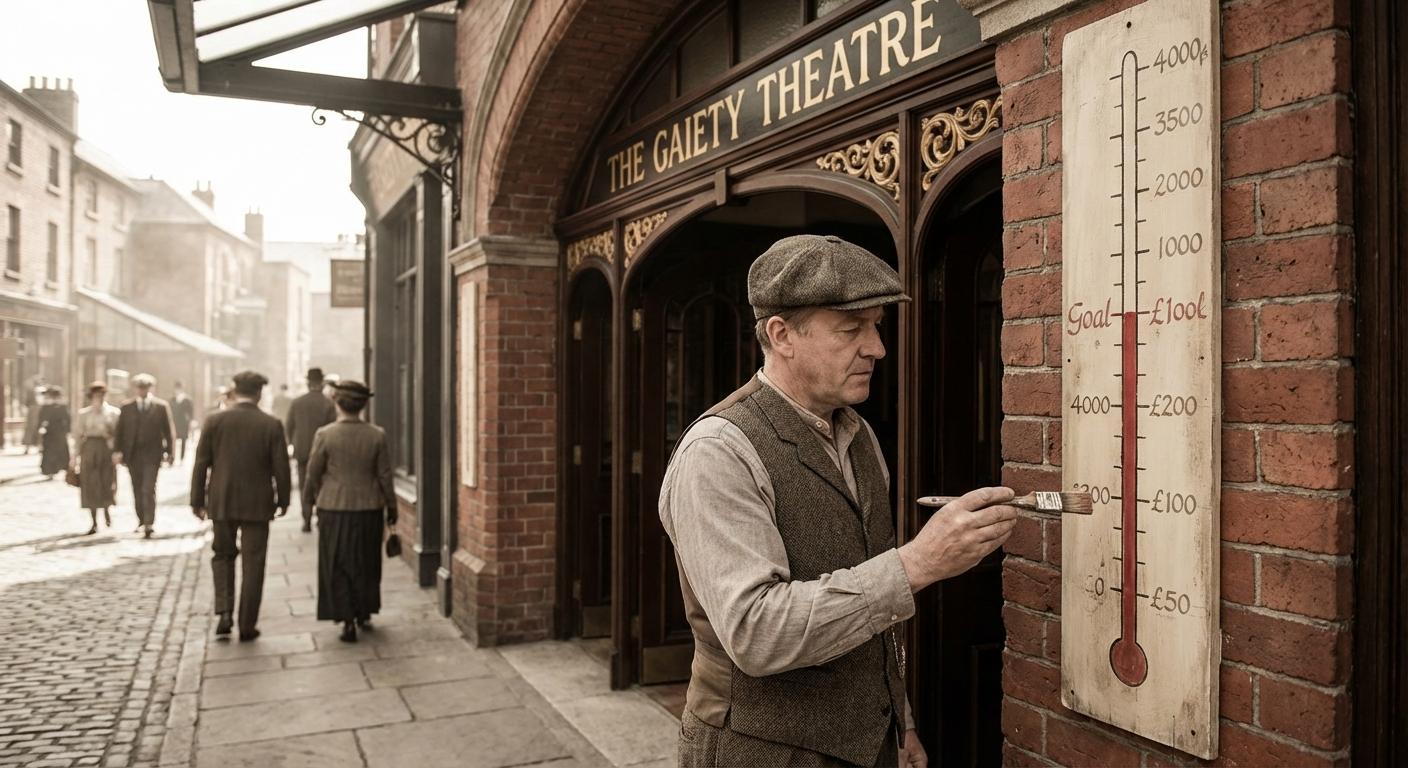
There is a thermometer painted on the wall beside the Bellvue Theatre’s box office — a literal one, red-filled and graduated, marking the progress toward 180,000 florins. On Friday it stood at 90,000. On Sunday morning, Augustin Fell repainted the mercury line to 95,000, and for the first time since he announced the campaign, he did not look like a man measuring the distance to catastrophe.
“Halfway,” he said, stepping back to examine his handiwork with the critical eye of a man who has spent nineteen years directing other people’s blocking. “Past halfway, actually. The second half is always easier.”
This is not true, and Fell knows it. But optimism, in the theatre, is a professional obligation.
The Money
The jump from 74,000 to 95,000 florins in the past five days reflects a combination of quiet generosity and organised effort. The Marchmont Street Traders’ Association — the butcher, the stationer, the tobacconist, the two tea rooms, and the ironmonger who share the Bellvue’s block — collected 4,200 florins over the past week through a door-to-door appeal among local businesses. A further 8,000 arrived in individual donations, several of them anonymous, prompted by the publicity around the first read-through of The Lamplighter’s Oath and Ruben Glass’s telegram from Caldwell.
The remaining 85,000 florins must be raised by 1 May — the deadline imposed by the structural engineers who assessed the fly tower. The benefit night on 15 March is expected to be the campaign’s centrepiece: a programme of scenes, songs, and speeches at the Bellvue, with tickets at 25 florins (the most the theatre has ever charged for a single performance) and all proceeds to the repair fund.
Glass, the actor who got his start at the Bellvue in The Ferryman’s Wife in 2011 and is now a fixture of the Caldwell stage, has confirmed he will attend the benefit in person. His telegram — “Break a leg. The Bellvue made me. Now make it last” — has been framed and hung in the theatre lobby.
The Play
Rehearsals for The Lamplighter’s Oath, Fell’s first play, entered their second week on Sunday with what the director described as “the difficult part — the part where everyone has to stop reading and start feeling.”
Thomas Ashworth, the forty-seven-year-old schoolteacher who plays Edmund Vale, has reportedly been arriving at the theatre straight from his classroom at four o’clock each afternoon and rehearsing until nine. His Vale — the first superintendent of lamps who fought to bring gas lighting to working-class Bobington in the 1840s — has been described by those who have seen early rehearsals as “commanding but quiet, the way authority used to sound.”
Nessa Holloway, the twenty-three-year-old Academy graduate making her professional debut as Vale’s daughter Clara, has grown visibly more confident since the first read-through. “She found something in the second scene,” said one cast member. “A kind of stubbornness that works beautifully against Ashworth’s stillness.”
The play opens on 10 April — five weeks from now. Whether it opens with a functioning fly tower depends on the next sixty days of fundraising.
The Pending Decision
The Arts Council emergency heritage grant — a separate funding stream that could contribute significantly to the repair costs — remains pending. The Council’s current attention is divided: an observer recently completed an assessment of the Hargrove retrospective at the Royal Bobington Gallery, and the formal report on that exhibition is expected midweek. Whether the Bellvue application will be considered alongside or after that assessment is unclear.
Fell, characteristically, is not waiting for institutional salvation. “If the grant comes, wonderful,” he said. “If it doesn’t, we paint the thermometer anyway.”
The theatre — gilt and crimson, Victorian bones under a century of paint — stood quiet on Sunday afternoon, waiting for the Monday rehearsal. On the stage, marks in tape showed where Ashworth would stand to light his first lamp.