
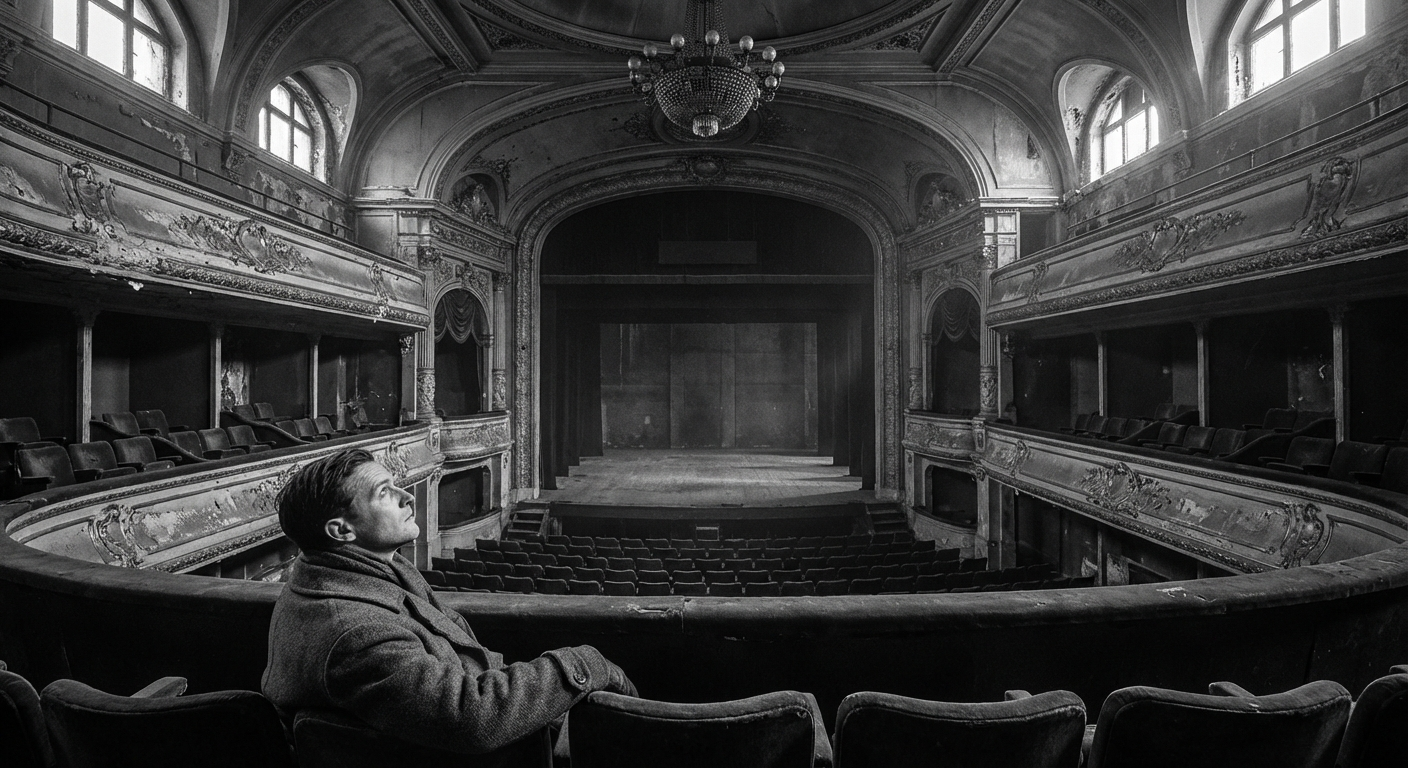
The Bellvue Theatre has been dying for so long that it would be impolite to mention it still hasn’t managed.
Built in 1897 on Marchmont Street — in the days when that stretch of the city between Midtown and Upper Fernwich was the centre of Bobington’s theatrical life — the Bellvue was once among the city’s finest houses. A gilt-and-crimson jewel box of a theatre, seating 440, with a raked stage, a fly tower that was the envy of the capital’s touring companies, and an orchestra pit deep enough to accommodate a full Verlainese harmonic choir. For half a century, it was where serious drama happened in Bobington.
That was a long time ago.
Today the Bellvue seats 380, owing to a row of stalls removed in 1988 to accommodate fire regulations. The crimson has faded to something nearer rust. The gilt survives in patches, like memories of a richer age. And the fly tower — the tall structure above the stage that houses the ropes, pulleys, and counterweights essential to any production more complex than a man in a chair — requires, according to a structural assessment completed last month, 180,000 florins in urgent repair to its steel framing.
The city’s building inspector has given the theatre until 1 May to begin remedial work or cease using the fly tower entirely.
Without the fly tower, the Bellvue cannot stage productions that require scenery changes, overhead rigging, or lighting rigs above the stage. Which is to say: it cannot stage most productions.
And Augustin Fell, who has owned and operated the Bellvue for the past nineteen years, does not have 180,000 florins.
A Man in a Chair
“I have approximately forty-seven florins,” Fell told this newspaper, seated in the front row of his empty theatre on a Tuesday morning, a wool scarf wrapped twice around his neck because the heating is, as he put it, “aspirational.” He is 53, tall, with the kind of theatrical presence that certain people carry as naturally as a coat — a voice that fills a room without raising itself, and the slightly ravaged elegance of someone who has spent two decades choosing art over comfort.
“Forty-seven florins and an idea.”
The idea is a new production: The Lamplighter’s Oath, a historical drama about the founding of Bobington’s public lighting system in the 1840s. Written by Fell himself — his first play — it follows the true story of Edmund Vale, the city’s first superintendent of lamps, who fought a decade-long battle with the city council to extend gas lighting from Midtown into the working-class districts of the Docklands and Lower Ashwater.
“It’s a play about a man who believed that light was a civic right, not a commercial privilege,” Fell said. “That every street deserved a lamp, not just the streets where the money lived. The council told him it was too expensive. He told the council it was too important.”
He paused.
“I find the parallels somewhat resonant.”
Nineteen Years of Beautiful Stubbornness
Fell came to theatre management by an indirect route. He was a history teacher at Thornhill Secondary School before inheriting the Bellvue from his aunt, Constance Fell, who had run it since 1971 — through the lean years of the seventies, the brief renaissance of the eighties, and the long decline that followed. She died in 2006 and left the theatre to the only member of the family who had ever shown any interest in it.
Augustin took it on in 2007 with, as he has said on multiple occasions, “no experience, no money, and no sense.” The first of these deficiencies he has remedied over the past nineteen years. The other two persist.
Over that time, he has staged more than a hundred productions, weathered four financial crises (each resolved by a combination of personal debt and what he calls “the mercy of strangers”), launched several notable careers — the actor Ruben Glass, now a fixture of the Caldwell stage, got his start in a Bellvue production of The Ferryman’s Wife in 2011 — and maintained the theatre’s reputation as a home for new writing, risky programming, and the kind of work that the larger theatres in Caldwell consider too uncommercial for their stages.
What he has not managed to do is make it profitable. The Bellvue has operated at a loss in fifteen of the past nineteen years.
“Theatre is not a business,” Fell said, with the weary conviction of a man who has had this argument many times. “It is a civic function. Like libraries. Like parks. Like lamplighters. It exists because a city needs places where people sit in the dark together and feel something.”
The Arithmetic
The building inspector’s report, which Fell shared reluctantly, is blunt. The fly tower’s steel framing shows significant corrosion in two of four main load-bearing supports, graded “unsatisfactory.” A third is graded “poor.” The report recommends “complete replacement of the affected members and comprehensive corrosion treatment of the remaining structure.”
Estimated cost: 160,000 to 200,000 florins. The city’s building inspector has set 1 May as the deadline for commencement of works.
Fell’s plan, such as it is, consists of three parts. First, a benefit night at the Bellvue on 15 March, with performances donated by several former Bellvue company members and — Fell hopes — at least one name from the Caldwell theatre world. Second, a public appeal, which he intends to launch this week. Third, and most critically, the success of The Lamplighter’s Oath, which opens 10 April.
“If the play is good — really good — maybe that buys us time,” he said. “Maybe that gets people through the door who can help. Maybe it gets the city’s attention. Maybe it doesn’t.”
Rehearsals begin next week with a cast of eleven, several of whom are being paid, in Fell’s words, “in gratitude and sandwiches.” The production budget is being assembled from personal loans, the anticipated proceeds of the benefit night, and what Fell described, without irony, as “the generosity of people who don’t know any better.”
What Would Be Lost
The Bellvue is not, to be clear, one of Bobington’s great architectural treasures. It is not the Royal Bobington Gallery. It is a small theatre on a street that is no longer fashionable, and its loss would not make headlines for more than a day.
But it is the city’s oldest continuously operating independent theatre — a distinction it has held since the closure of the Adelphi on Parade Street in 2003. Its stage has seen work by virtually every significant Bobington playwright of the past half-century. Its audience, on a good night, is the most engaged in the city: intimate, attentive, and close enough to the stage to see the actors breathe.
The Bobington Historical Preservation Society has listed the building as one of fifty-two “structures of cultural significance” in its 2024 heritage survey. This designation carries no legal protection and no funding.
“The Bellvue matters,” said Louisa Marchbank, the Society’s chairwoman, when contacted. “Whether it matters enough to save — that is a question for the city, not for us.”
A Parting
Fell walked this reporter to the theatre door after the interview, through a lobby where the wallpaper is peeling and a framed photograph of Constance Fell — small, fierce, magnificent — watches from above the box office window.
“People ask me why I don’t just sell it,” he said. “The building’s worth something, even in this state. A developer would flatten it and put up flats.”
He looked back at the auditorium — the faded seats, the dusty chandelier, the stage where, next month, eleven actors will attempt to save the place by telling a story about a man who lit the city’s lamps.
“I’d rather go out with a play than a whimper.”
The Lamplighter’s Oath opens at the Bellvue Theatre, Marchmont Street, on 10 April. Tickets from 3 florins. The benefit night is 15 March; details to be announced.