
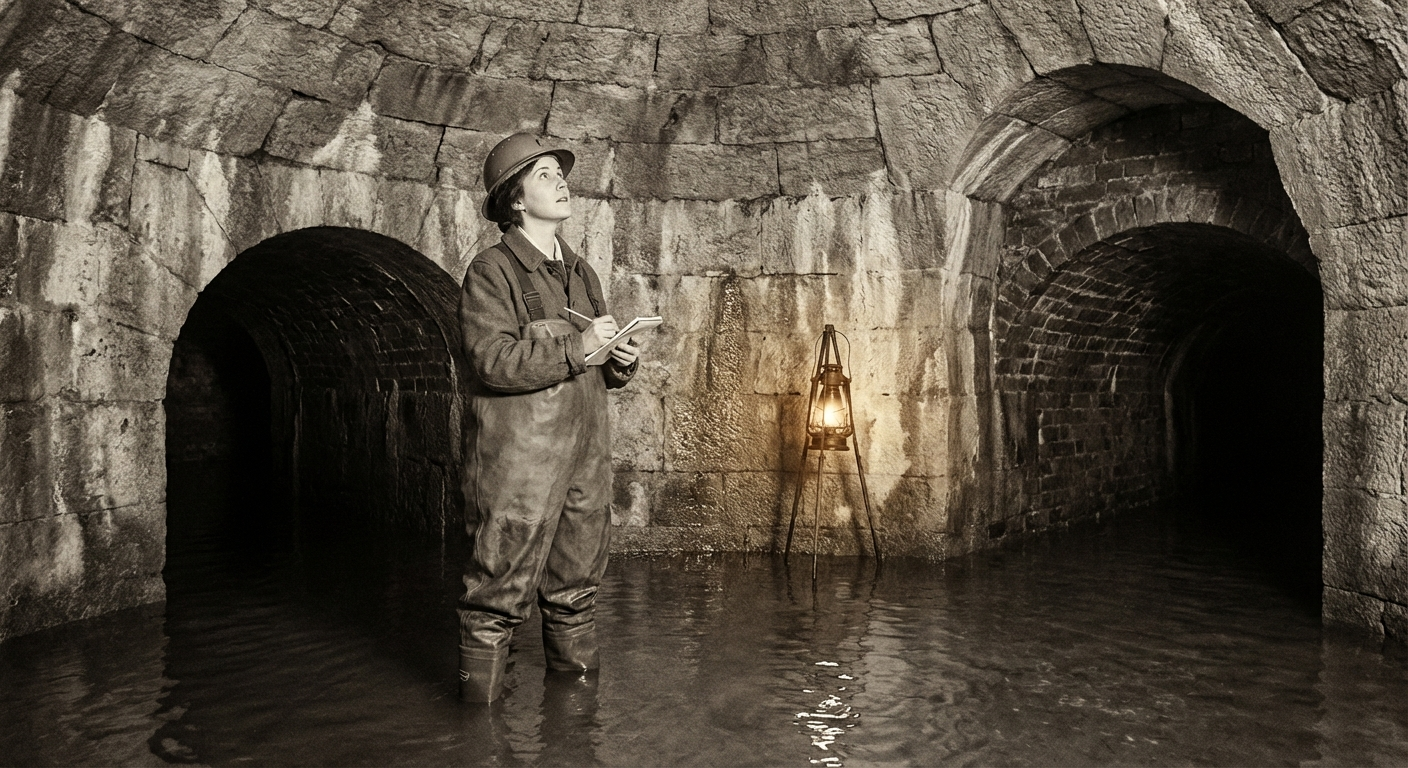
Municipal surveyor Pella Strand entered the western branch of the Lower Conduit through the flooded cellar of the Old Cooperage on Cooperage Lane yesterday evening, extending her survey of the buried waterway by a further 110 metres and discovering what appears to be a purpose-built cistern chamber beneath the site of the former Ashwater Brewery.
The chamber — roughly circular, approximately four metres in diameter and two and a half metres high at its vaulted centre — is constructed from the same hand-cut limestone blocks used throughout the conduit system, dated by mason’s marks to 1782. Its floor is submerged beneath approximately fifteen centimetres of clear, cold, flowing water. Three brick channels enter from different directions, converging at a central stone basin that Strand believes served as a distribution point.
“This is not drainage,” Strand said, standing in the cellar of the Old Cooperage at 7 PM, her waders still dripping. She had been underground for approximately three hours. “This is a water supply system. Someone in the 1780s built an engineered network to bring fresh water from a spring source to at least three different brewery operations. The conduit is the trunk. The cistern is the junction box.”
The discovery significantly extends the known scope of the Lower Conduit system. The total traced length now stands at approximately 890 metres, with the western branch accounting for roughly 200 metres from the junction discovered on 13 March. Strand believes the system may extend further west, toward a spring source that has not yet been identified.
Arthur Penrose, publican of the Old Cooperage and the man whose flooded cellar provided the access point, watched Strand disappear through the breach in his cellar wall with the expression of a man whose morning has taken an unexpected turn.
“She said she needed access to my cellar,” Penrose said. “I thought she meant to look at the damp. She came back three hours later talking about cisterns and the Ashwater Brewery.”
Penrose, whose family has owned the building since 1922, confirmed that the cellar had been dry for approximately twenty years before water began rising on Saturday 15 March. He had attributed it to a burst main. Strand’s investigation revealed instead that a partial blockage downstream — likely accumulated silt — had raised the water level in the western branch sufficiently to breach the cellar’s original drain connection to the conduit.
The drain, Strand noted, was built deliberately. The cellar wall at the connection point uses the same lime mortar as the conduit, and the opening is framed with cut stone. “The people who built this pub — or rather, the brewery it was part of — knew exactly where the conduit was,” she said. “They built their cellar to connect to it.”
Three breweries operated on Cooperage Lane and the surrounding streets from the 1770s to the 1890s: the Ashwater Brewery (the largest, operating from approximately 1772 to 1891), Chandler’s Brewery (1785-1847), and the Bramblegate Ale Works (1810-1893). All three would have required a reliable source of fresh water.
The cistern chamber sits approximately seven metres below street level, directly beneath what historical maps identify as the Ashwater Brewery’s main brewhouse. Strand found no evidence of the brewery’s own infrastructure within the chamber — no copper vessels, no brick furnaces — suggesting it was stripped when the brewery closed.
But the water was still flowing.
“The spring, wherever it is, is still active,” Strand said. “It has been feeding this system for at least 244 years. The conduit was built to manage it. The breweries were built to use it.”
Strand’s survey has now filled fifteen notebooks. Her comprehensive report is due at the end of March. Chief Municipal Engineer Dorothea Kinnear has reviewed the cistern findings and described them as “significant for both heritage and infrastructure planning.”
The Bobington Historical Preservation Society’s heritage listing application for the conduit system remains before the Municipal Heritage Committee. Louisa Marchbank, the Society’s chairwoman, said the cistern discovery “substantially strengthens the case.”
Penrose asked whether the water in his cellar would go down. Strand said she would clear the blockage on her next visit.
“I appreciate that,” he said. “I have sixty barrels of winter ale down there.”