
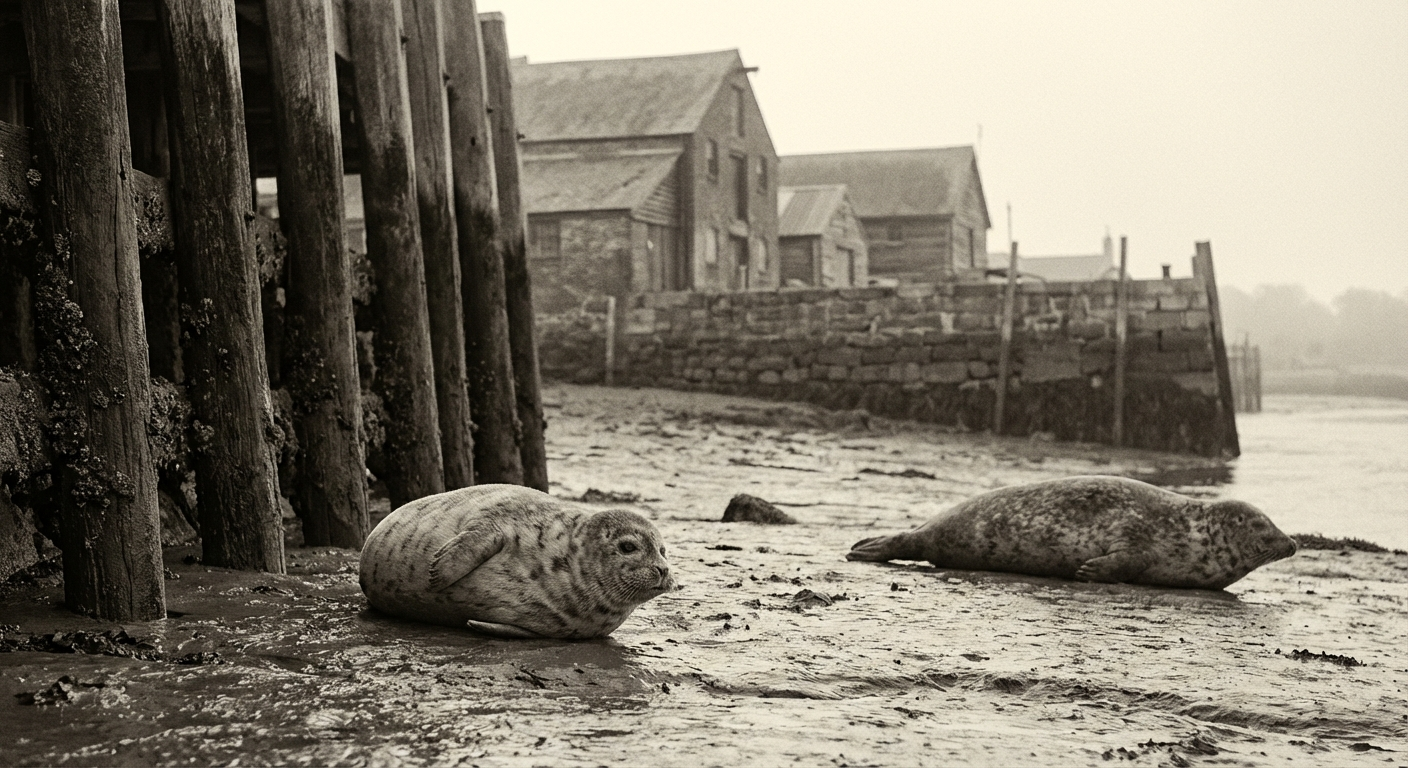
The pup weighs approximately twelve kilograms. It is roughly sixty centimetres from nose to tail. It was first observed on Tuesday, a small grey shape among larger grey shapes on the mudflats below Bramblegate Steps, and it has been observed nursing from an adult female every morning since.
Dr Annalise Fenn-Coulthard, marine biologist at the Bobington Institute of Natural Sciences, confirmed on Thursday what she had suspected since Tuesday but declined to announce until she was certain: the smallest juvenile in the Lower Ashwater harbour seal colony was born on the mudflats. It is the first seal birth recorded in Bobington waters since 1891, when the naturalist Clement Birch documented a colony of “eight or ten” harbour seals on the same stretch of river before industrial discharge drove them away.
One hundred and thirty-five years.
“The evidence is now conclusive,” Fenn-Coulthard said, speaking from the embankment above the colony on Thursday afternoon. “The pup’s size and developmental stage are consistent with a birth within the past seven to ten days. It has been observed nursing. It has not been observed arriving from elsewhere. It was born here.”
The colony now numbers ten harbour seals — seven adults and three juveniles, including the pup. Five females and two males have been individually identified by natural markings. The survey, which entered its third week on Friday, has documented consistent use of the mudflats at low tide, with animals hauling out between the Lower Ashwater footbridge pilings and the wharf at Bramblegate Steps.
The micro-habitat that appears to have attracted the colony — a cooler, fresher zone created by the outfall of the Lower Conduit beneath the wharf — continues to function as the colony’s preferred resting area. The spring-fed waterway, mapped this month by municipal surveyor Pella Strand, delivers clear flowing water to the river at precisely the point where the seals congregate.
“It is not a coincidence,” Fenn-Coulthard said. “The conduit outfall creates conditions that resemble a natural estuary. The seals are responding to water quality and temperature. They have found what they were looking for.”
The Harbour Authority has been deliberating on Fenn-Coulthard’s request for a temporary wildlife protection zone around the mudflats for two weeks. A decision is now expected within the week, according to Deputy Harbour Master Marcus Felbridge.
“The birth strengthens the case considerably,” Felbridge said. “The Authority takes its responsibilities seriously.”
Fenn-Coulthard has also renewed her request for reduced ferry speed past Bramblegate Steps at low tide — a matter of forty-five seconds per crossing, she has repeatedly noted. The Transit Authority has not yet responded.
Retired harbour pilot Reg Garside, seventy-four, who first spotted the colony from his bench on Harbourfront Parade on 11 March, received the news with satisfaction.
“Ten seals and a pup,” he said. “That’s not a visit. That’s a neighbourhood.”