
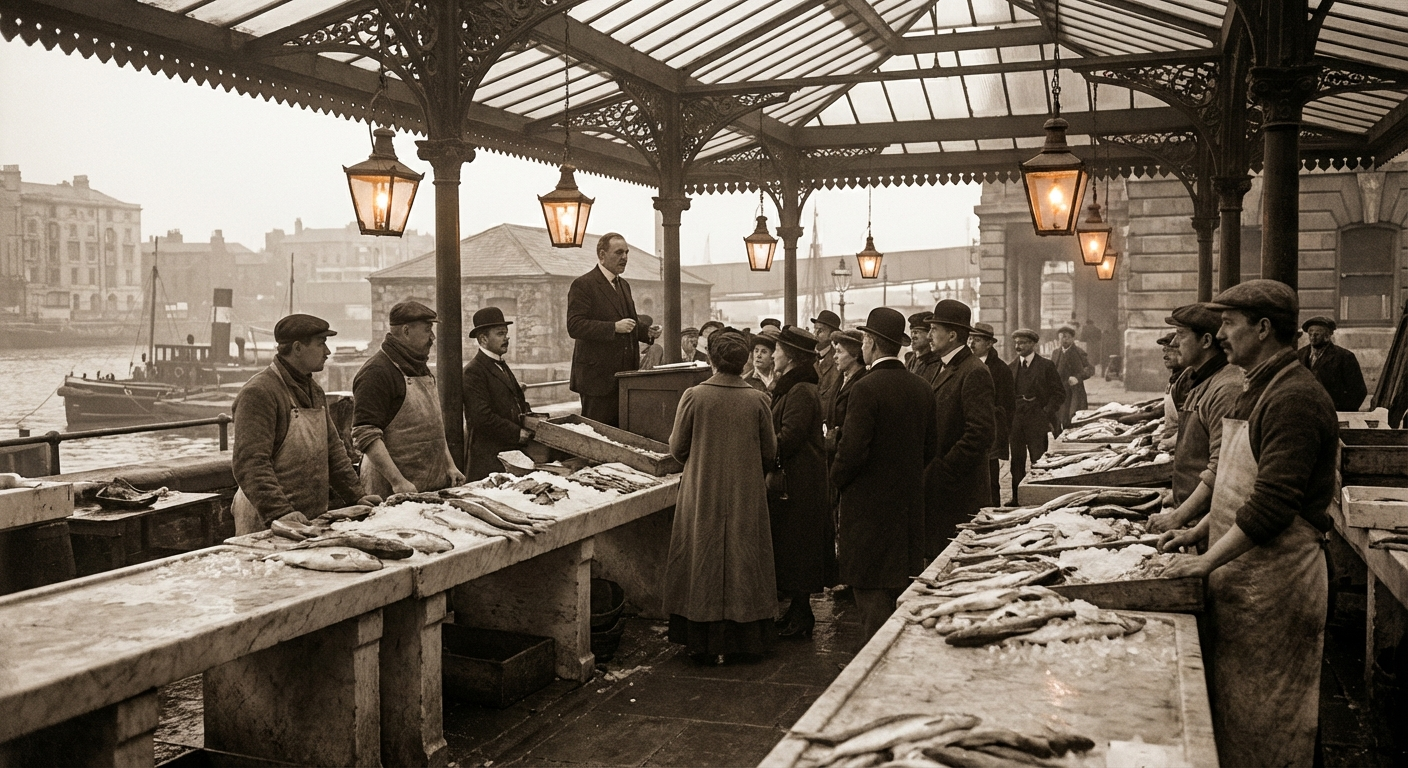
The bell rang at twenty past five on Saturday morning, just as it did one hundred years ago.
It was the same bell — a salt-weathered brass casting the size of a man’s head, bolted to an oak post at the market’s eastern gate since the day Bramblegate Fish Market first opened for trade. On that morning in February 1926, Lord Mayor Oswald Fenn rang it himself, in a top hat and galoshes, while thirty-two fishmongers stood behind stalls loaded with pike, Ashwater bream, saltwater cod from the Thessarine boats, and a single enormous sturgeon that nobody had ordered and nobody could explain.
On Saturday morning, Fenn’s great-granddaughter, Dr. Annalise Fenn-Coulthard — a marine biologist at the Bobington Institute of Natural Sciences — rang it again. She wore wellington boots and a wool coat. There was no sturgeon, but there was applause.
“My great-grandfather would have been appalled at the early hour,” said Dr. Fenn-Coulthard, to laughter from the crowd of several hundred gathered beneath the market’s wrought-iron canopy. “He was a man who believed firmly that civic duties should begin no earlier than ten o’clock and preferably after lunch.”
A Century on the Ashwater
The Bramblegate Fish Market occupies a long, narrow strip of riverfront between the Bramblegate Exchange and the Lower Ashwater footbridge. It operates six days a week — closed Sundays — and currently hosts forty-seven permanent stall holders, down from a peak of eighty-three in 1961 but stable for the past decade.
The market’s fortunes have tracked those of the river itself. In its early decades, the Ashwater was a working waterway: barges carried goods from Port Sovereign upriver to the market, and fishermen launched dinghies from the jetties at dawn. The construction of the Millgate weir in 1958 ended barge traffic above Bramblegate, and the slow cleanup of the river’s lower reaches — once an open sewer of industrial runoff — gradually restored the fish populations that had sustained the market’s freshwater trade.
Today, the market is an odd hybrid: part working fish exchange, where restaurateurs and hotel kitchens send buyers before dawn, and part tourist attraction, where visitors come for the atmosphere, the fried whitebait, and the vinegar.
“The fish is the excuse,” said Orna Vesely, who has run her smoked-fish stall — Vesely & Sons, though her sons work in insurance — for twenty-eight years. “People come for the noise.”
She is not wrong. The market at full cry is one of Bobington’s great public performances: the rhythmic calling of prices, the slap of fish on marble, the arguments about weight and freshness conducted at a volume that carries across the water to the Coldharbour side.
Civic Remarks
Mayor Blackthorne, in a written statement (the Mayor’s office confirmed she did not attend at 5:20 AM), praised the market as “one of Bobington’s most enduring institutions — a place where commerce, community, and the River Ashwater have met every morning for a hundred years.”
Market Warden Phillip Catton, who oversees the site for the Municipal Markets Board, used the occasion to announce a 600,000-florin restoration of the market’s canopy and drainage system, which he described as “overdue by approximately thirty years.” Work will begin in April and proceed in sections to avoid closing the market.
“We’ve survived two floods, one fire, and a proposal in 1987 to turn us into a car park,” Catton said. “I think we can survive some scaffolding.”
The centenary celebrations continue through the week, with a fishmongers’ competition on Wednesday — judged on speed, precision, and presentation of filleting — and a public supper on Saturday evening featuring dishes from each of the market’s five decades of immigrant traders: Thessarine salt cod, Verlainese bouillabaisse, Ashford-style ceviche, Delvarian pickled herring, and a dish from the Sarenne coast that involves setting a small fish on fire.