
The message arrived at the Cartwright Observatory at half past nine on Tuesday morning, transmitted by telegraph from the Southern Observatory in Ashford Bay. It was twenty-three words long: “Object independently confirmed. Orbital elements consistent with new periodic comet. Congratulations to the discoverer. Formal report to follow by post.”
Dr. Sable Nightingale, director of the Cartwright Observatory, telephoned Mrs Edith Calloway at her home on Harbinger Lane shortly after ten o’clock. The conversation, by Nightingale’s account, lasted approximately four minutes.
“I told her it was confirmed,” Nightingale said. “She was quiet for a moment, and then she said, ‘Well, I suppose I had better press my good dress for Thursday.’”
A Brass Telescope and Forty Years of Patience
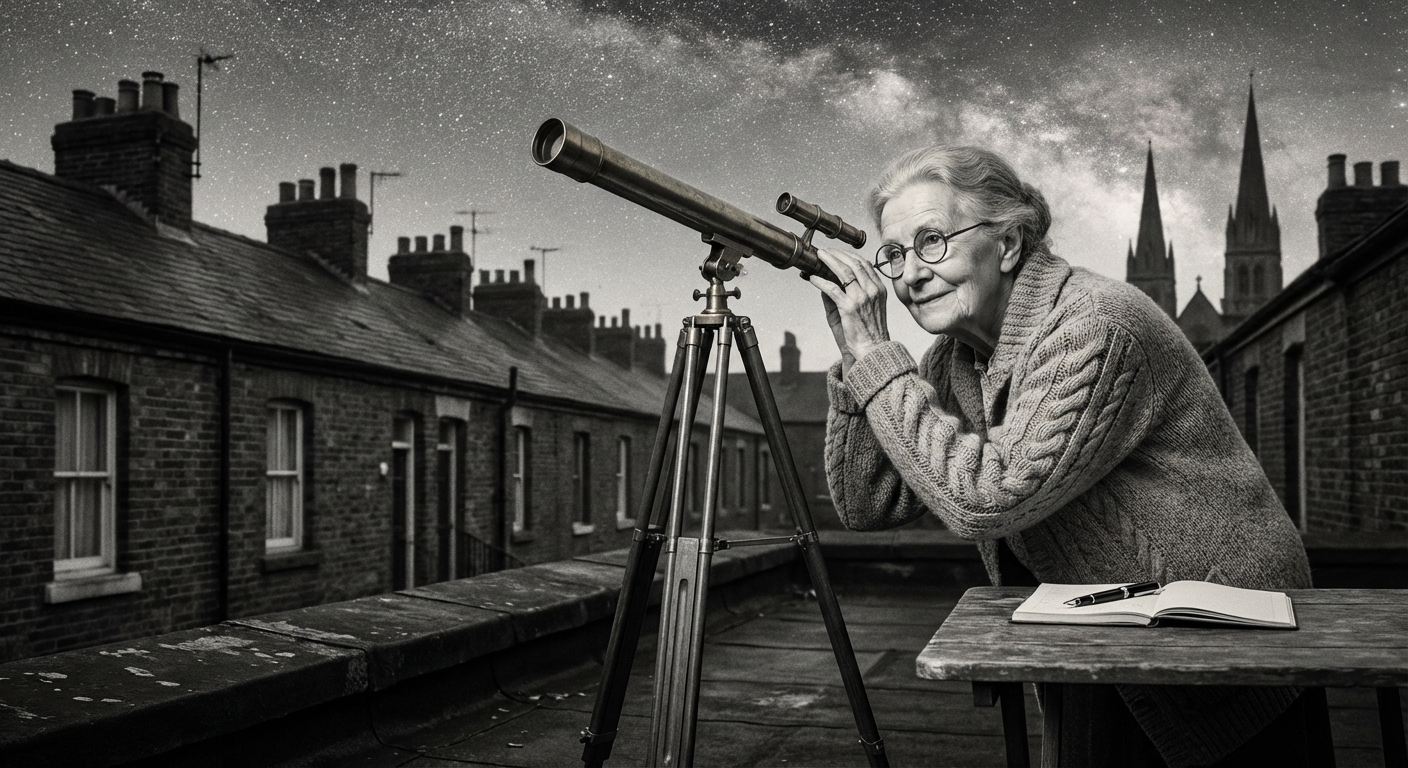
Edith Calloway, seventy-three, retired seamstress, sole remaining member of the Bramblegate Astronomy Circle, has watched the sky from the roof of 14 Harbinger Lane since 1986. Her telescope is a four-inch brass refractor she assembled herself from surplus optical components. Her records — forty-seven notebooks of nightly observations spanning nearly four decades — constitute what Nightingale has called “a genuinely valuable long-term observational dataset.”
On the evening of 17 February, Mrs Calloway observed an unfamiliar object in a star grouping she refers to in her notebooks as “the Fisherman’s Basket.” She reported it to the Cartwright Observatory the following morning. Nightingale located the object using the Observatory’s thirty-six-inch refractor and confirmed it as “an object of interest” — but independent verification by at least two observatories is required before the International Astronomical Registry in Fenmouth will assign a formal designation.
The Southern Observatory’s confirmation constitutes the first independent verification. The Thessarine Astronomical Society, which was also contacted, has not yet responded — a delay that Nightingale attributed diplomatically to “the current political climate.” A third request has been sent to the Verlaine National Observatory.
First in Forty-One Years
If the Fenmouth registry proceeds with designation — as is now considered certain, pending the formal report — it will be the first comet discovered from Bobington since 1985, when Professor Aldous Merrifield of the Royal Institute identified the short-period comet that bears his name using the Cartwright thirty-six-inch.
It will also be the first comet discovered by a non-credentialed observer to receive designation from Fenmouth in over two decades. The registry’s verification requirements make no distinction between professional and amateur astronomers, but in practice the overwhelming majority of recent discoveries have come from institutional observatories with larger instruments and photographic capabilities.
“Mrs Calloway found this with a four-inch refractor and her own eyes,” Nightingale said. “There is no photographic plate, no spectrograph. She saw it because she has looked at the same patch of sky, on every clear night, for nearly forty years. She noticed something new because she knew what was old.”
Thursday at the Royal Institute
Mrs Calloway will present her findings at the Royal Institute’s Thursday evening lecture series — the same session at which Professor Whitstone and Dr. Fenn will deliver the sold-out copper geology lecture. The Institute has arranged for Mrs Calloway to speak in the smaller Meridian Lecture Room at half past six, before the main programme begins at half past seven.
It will be the first time a non-credentialed speaker has addressed the Royal Institute in fourteen years. The last was a Millhaven beekeeper named Harold Pratt, who presented original research on colony communication patterns in 2012.
When the Times visited Harbinger Lane on Tuesday afternoon, Mrs Calloway was watering a window box of winter pansies. She invited the reporter inside for tea, served in china cups that did not match, and spoke about the comet with the same careful precision that fills her notebooks.
“I did not go looking for a comet,” she said. “I was looking at the sky, which is what I do. The comet was there because the comet was there. I simply happened to be looking at the right patch at the right time, after thirty-nine years of looking at the wrong patch at the wrong time.”
She paused to pour more tea.
“I suppose that is how most things are found.”
The International Astronomical Registry typically assigns designations within four to six weeks of confirmed discovery. If the formal designation proceeds, the comet will in all probability carry Mrs Calloway’s name — a seventy-three-year-old seamstress from Bramblegate, immortalised in the orbital mechanics of the solar system.
Mrs Calloway, when this was mentioned, adjusted her spectacles and said: “The comet was doing perfectly well without a name.”