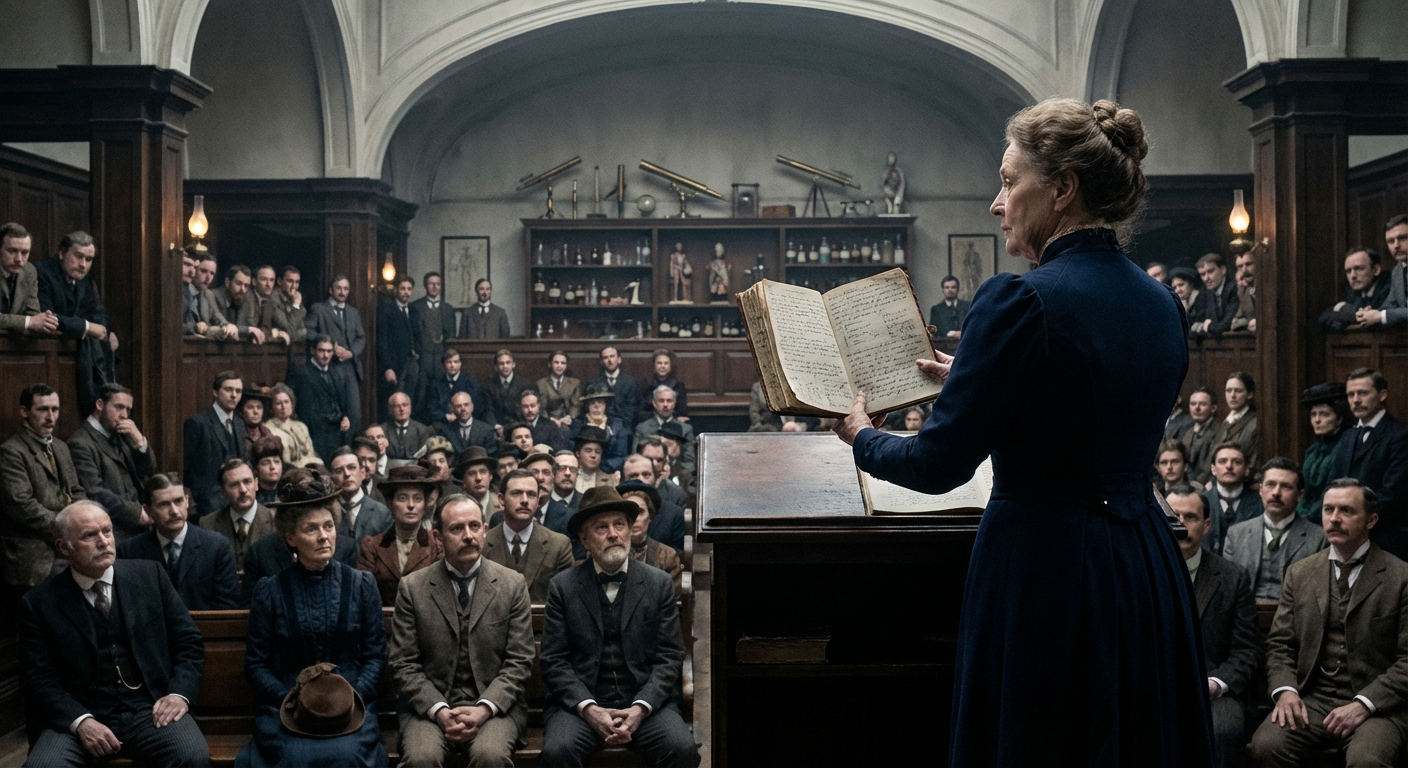
She wore her navy dress — the one she keeps for weddings and funerals, she said afterwards — and she carried a canvas bag containing three of her forty-seven observation notebooks. The bag was heavier than it looked. The notebooks are dense with notation.
Edith Calloway, 73, retired seamstress, sole remaining member of the Bramblegate Astronomy Circle, and discoverer of what will soon bear her name in the International Astronomical Registry, stood before the Royal Institute of Natural Philosophy on Thursday evening and told the story of a light she found in the dark.
The Meridian Lecture Room on Arundel Crescent seats one hundred and forty. Every seat was taken. A further thirty or so stood at the back and along the side aisles — an attendance that the Institute’s records office believes is the largest for a Thursday lecture since Professor Whitstone’s Greymoor seismology series in 2019.
Mrs Calloway was the first non-credentialed speaker to address the Thursday lecture series in fourteen years, a fact that seemed to concern her not at all.
“I’m not a professor,” she said, adjusting the lectern to her height with a firmness that suggested she had considered the matter and found it irrelevant. “I’m a woman with a telescope and a great deal of patience.”
Forty Years on a Rooftop
She began, as she has told this newspaper before, with the telescope — a four-inch brass refractor she built herself from salvaged optics and a length of drainpipe in 1986. The audience, composed largely of professional astronomers and Institute fellows, listened with the particular attentiveness that experts reserve for someone who has done something they find genuinely remarkable.
Mrs Calloway described her nightly routine: the climb to the rooftop of 14 Harbinger Lane, the alignment of the instrument, the systematic scanning of the sky in strips she has mapped and labelled in her own notation. She explained the notation. Several audience members took notes.
She then opened the first of her three notebooks — Volume 43, covering October through December 2025 — and walked the audience through a typical month of observations. The pages, projected onto the lecture room’s screen by an Institute assistant with a document camera, revealed a recording system of extraordinary discipline: date, time, sky conditions, instrument settings, and precise positional data for every object she had logged, rendered in a small, immaculate hand.
“Some nights there is nothing new,” she said. “Most nights. That is the work. You look, and you write down what you see, and you do it again the next night. The sky does not care whether you are tired.”
The Discovery
She reached the entry for Tuesday the 17th of February. The room grew very quiet.
At 9:47 in the evening, scanning a region of sky she calls “the Fisherman’s Basket” — a grouping of stars between the constellations more formally designated as the Net and the Southern Arch — she observed a faint, slightly diffuse object that was not in her previous night’s record of that field.
“It was not where anything ought to have been,” she said. “And it had a quality to it — a softness at the edges — that stars do not have.”
She logged it. She checked her references. She observed it again the following night and noted a positional shift consistent with an object in solar orbit. On the 19th of February, she contacted the Cartwright Observatory.
Dr Sable Nightingale, director of the Observatory, was in the audience. She did not speak during the lecture, but she was seen nodding throughout, and she applauded vigorously at its conclusion.
“What Mrs Calloway has done,” Nightingale said in a brief comment afterwards, “is exactly what professional astronomers aspire to and frequently fail at. She observed systematically, she recorded meticulously, and when she found something anomalous, she verified before she reported. Her notebooks are a treasure of amateur science.”
Confirmation and Designation
Mrs Calloway addressed the confirmation timeline with the directness of someone accustomed to waiting. The Cartwright Observatory verified the object on the 20th of February. The Ashford Republic’s Southern Observatory independently confirmed it on the 25th. The Thessarine Astronomical Society has not responded — the political climate has, regrettably, intruded on celestial matters — but a third request has been sent to the Verlaine National Observatory.
The International Astronomical Registry in Fenmouth requires independent verification by two or more observatories before assigning a formal designation. With two confirmations now in hand, the process is, in the words of one Institute fellow, “a formality of paperwork, not of doubt.”
The comet is the first to be discovered from Bobington in forty-one years, since Professor Aldous Merrifield’s observation in 1985 using the Cartwright 36-inch refractor. It is the first discovered by a non-credentialed observer in living memory.
Standing Ovation
When Mrs Calloway concluded her presentation — forty-two minutes in total, without a single unnecessary sentence — the audience rose. The ovation lasted, by this correspondent’s count, a full minute and a half, which is a very long time to stand and applaud in a room full of people who are not given to sentiment.
Mrs Calloway stood at the lectern through the whole of it, her canvas bag at her feet, looking faintly bewildered and entirely dignified.
She was asked, during the brief reception that followed, what she planned to do next.
“Go home,” she said. “The sky will be clear tonight.”