The telegram arrived at the Cartwright Observatory at 9:17 AM on Tuesday, sent from the International Astronomical Registry at Fenmouth. It read, in the concise style that scientific bureaucracies favour:
OBJECT C/2026-B1 FORMALLY DESIGNATED. COMMON NAME: COMET CALLOWAY. DISCOVERER: E. CALLOWAY, BOBINGTON. INDEPENDENT CONFIRMATIONS: CARTWRIGHT OBSERVATORY (BOBINGTON), SOUTHERN OBSERVATORY (ASHFORD REPUBLIC). ORBIT CLASSIFICATION: LONG-PERIOD, RETROGRADE. REGISTRY CERTIFICATE FOLLOWS BY POST.
Dr Sable Nightingale, director of the Cartwright Observatory, read the telegram, set it on her desk, and telephoned 14 Harbinger Lane.
“Mrs Calloway was quiet for some time,” Nightingale said. “Then she asked whether this meant she needed to attend another ceremony. I told her it did not. She said: ‘Good. It’s clear tonight and I have observations to make.’”
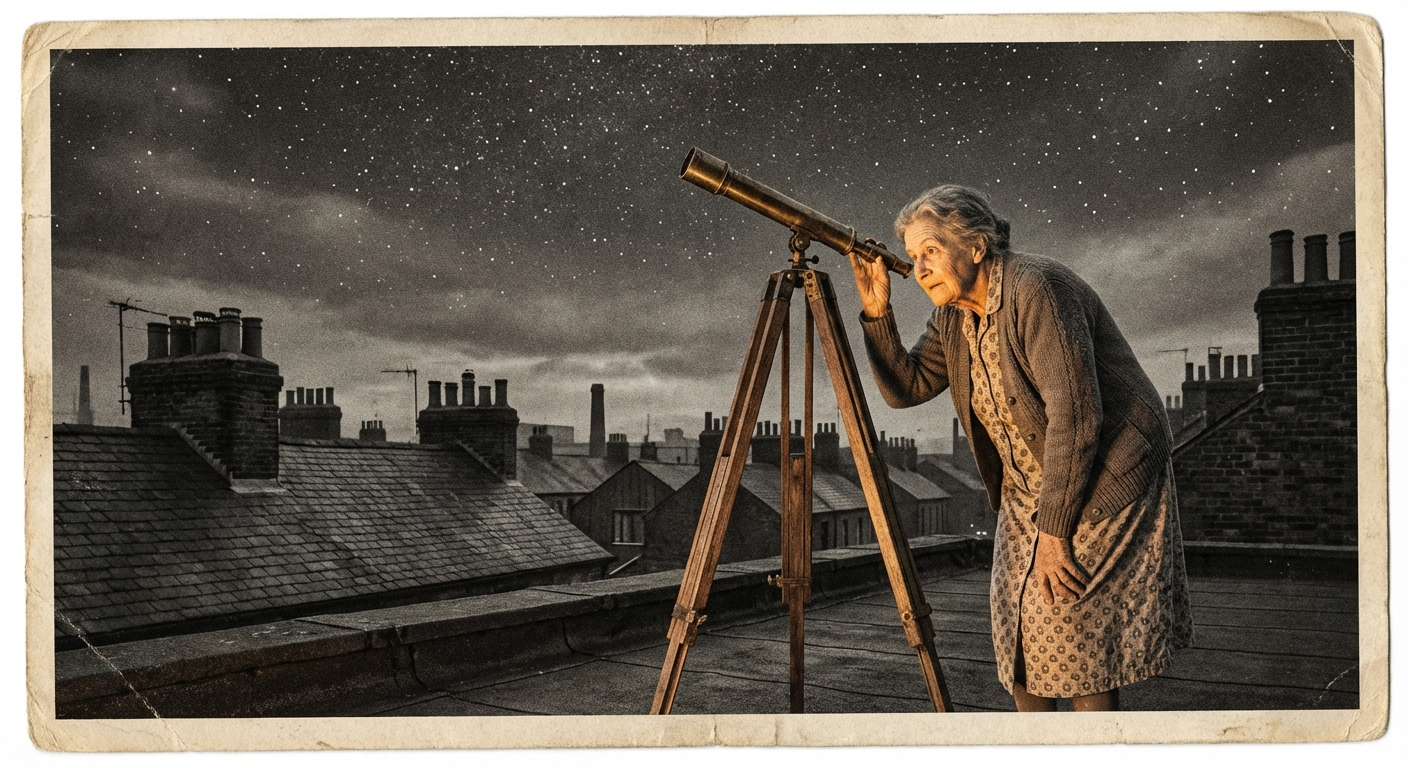
Edith Calloway is seventy-three years old. She is a retired seamstress who worked for thirty-one years at Pringle & Hatch on Moorgate. She has observed the night sky from her rooftop since 1986 using a homemade four-inch brass refractor telescope, maintained forty-seven notebooks of systematic observations, and remained the sole member of the Bramblegate Astronomy Circle after its other eight members drifted away over the decades.
On Tuesday 17 February, at 9:47 PM, she identified an unfamiliar object in a star grouping she calls “the Fisherman’s Basket” — a constellation that does not appear on any formal star chart because Mrs Calloway invented it. The Cartwright Observatory confirmed the object within days. The Ashford Republic’s Southern Observatory provided independent verification on 25 February. The Thessarine Astronomical Society has not responded to three requests for confirmation, though the political situation has improved since February.
The designation follows standard Registry protocol: initial letter C (comet), year and half-month of discovery (2026-B, denoting the second half of January through early February), and a sequential number (1, the first comet designated in that period). The common name honours the discoverer, as is tradition for amateur discoveries.
It is the first comet discovered from Bobington in forty-one years, since Professor Aldous Merrifield identified a short-period comet using the Cartwright thirty-six-inch refractor in 1985. It is the first comet in the Observatory’s records discovered by a non-credentialed observer, and the first to bear the name of a Bobington citizen.
“What Mrs Calloway has done,” Nightingale said, “is what astronomy has always been about before it became a profession. She looked at the sky every night for forty years and she noticed when something was different. That is not amateur science. That is science.”
The comet is currently visible in the pre-dawn sky through a small telescope or strong binoculars, tracking slowly westward through the constellation that professional astronomers have now labelled NGC-region 4412 and that Mrs Calloway continues to call “the Fisherman’s Basket.” It will remain observable through late spring before moving beyond naked-eye instrument range.
Mrs Calloway was invited by the Royal Institute to present at its Thursday evening lecture series in February — the first non-credentialed speaker in fourteen years. She spoke for forty-two minutes to a standing-room audience and received a ninety-second standing ovation. She has since declined two further speaking invitations and one newspaper interview request (not from this newspaper, which she tolerates).
The registry certificate, which Nightingale says will include an orbital diagram and the comet’s calculated period, is expected to arrive by post within the fortnight. Nightingale has offered to frame it. Mrs Calloway has not yet said where she would like it hung.
The rooftop telescope on Harbinger Lane, which Mrs Calloway built from salvaged brass fittings, a surplus optical lens, and a length of copper drainage pipe, has been in continuous service for forty years. It does not have a name. “It’s a telescope,” Mrs Calloway said, when asked. “What would I call it?”