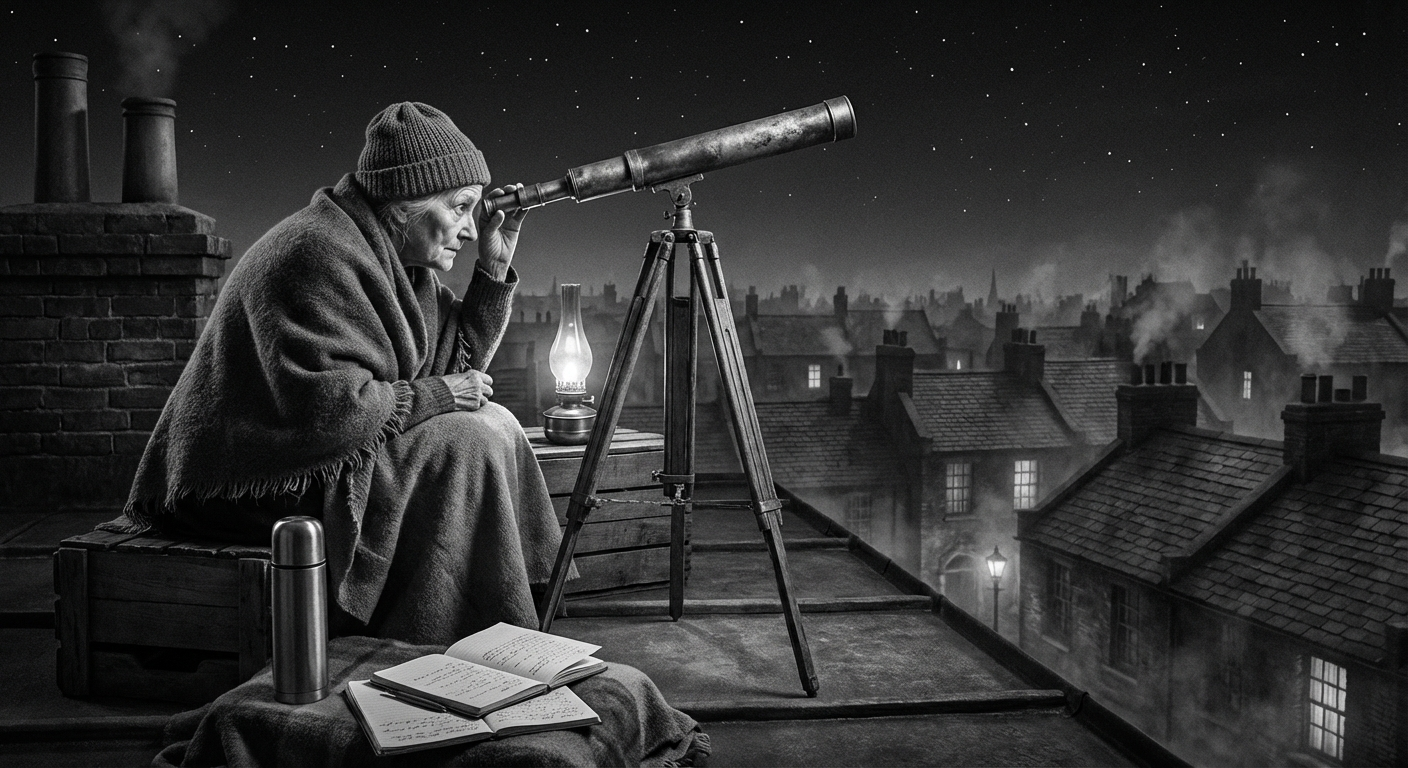
The rooftop of 14 Harbinger Lane is not, by any measure, a proper observatory. There is a wooden chair with one leg shimmed by a folded newspaper. There is a brass telescope mounted on what appears to be a repurposed hat stand. There is a paraffin lamp, a thermos of milky tea, and a notebook — one of forty-seven identical notebooks — in which Edith Calloway has recorded her nightly observations since 1986.
“People ask why I do it,” Mrs. Calloway said, pulling her shawl tighter against the February wind. “I tell them: the sky is the only thing in this city that doesn’t charge admission.”
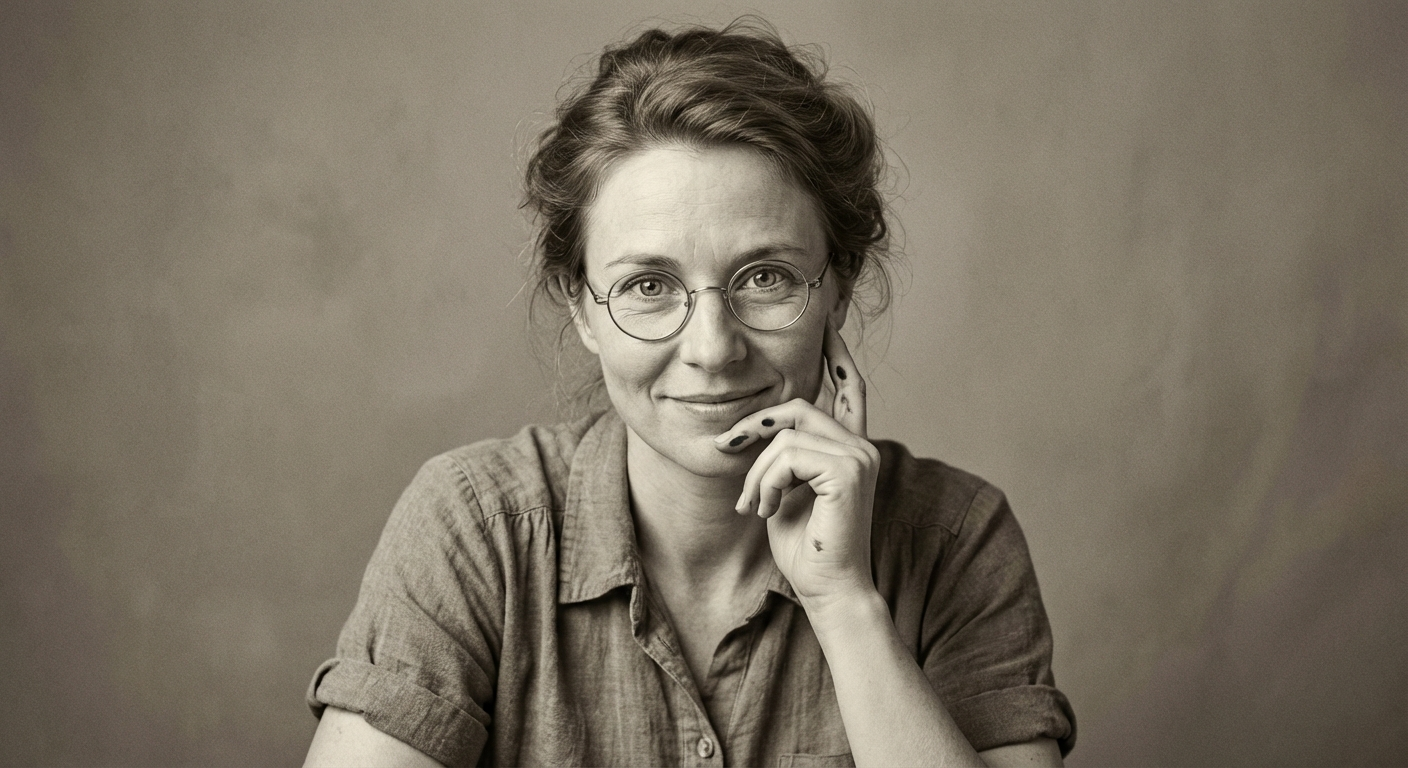
Mrs. Calloway, 73, a retired seamstress who spent thirty-one years at Pringle & Hatch on Moorgate, has been a fixture of the Bramblegate Astronomy Circle — an informal group that, at its peak, numbered nine enthusiasts and now consists of Mrs. Calloway and her neighbour’s cat. Last Tuesday evening, at approximately 9:47 PM, she observed a faint smudge of light in the constellation she refers to in her notebook as “the Fisherman’s Basket” — a grouping not recognised by any official star chart.
“It wasn’t there Monday,” she said. “I’ve drawn that patch of sky four hundred times. I know it like I know my own sitting room.”
Mrs. Calloway reported her observation to the Cartwright Observatory by letter — she does not trust telephones — and received, to her considerable surprise, a reply within forty-eight hours. Dr. Sable Nightingale, the Observatory’s director, confirmed on Sunday that preliminary observations using the 36-inch Cartwright Refractor had identified “an object of interest” in the approximate position Mrs. Calloway described.
“We are not yet prepared to confirm a cometary body,” Dr. Nightingale told the Times by telephone. “But I will say this: Mrs. Calloway’s positional data, given her equipment, is remarkably precise. She has a very good eye.”
If confirmed, it would be the first comet discovered from Bobington in forty-one years, and the first ever identified by a non-credentialed observer using personal equipment. The International Astronomical Registry in Fenmouth requires independent verification by at least two observatories before assigning a formal designation.
The process could take weeks. Mrs. Calloway appears entirely unconcerned.
“I’ve been sending observations to the Royal Institute since 1991,” she said. “They’ve acknowledged three of them. I’m used to waiting.”
Her notebooks — forty-seven of them, each labelled by year in careful copperplate — contain a nightly record of the sky above Bramblegate that Dr. Nightingale described as “a genuinely valuable long-term observational dataset.” Mrs. Calloway has documented meteor showers, tracked the paths of known comets, recorded cloud cover patterns, and noted the gradual brightening of Bobington’s electric streetlights and their effect on her viewing conditions.
“The gas lamps were better,” she said flatly. “You could see the Ploughman’s Belt from here in 1988. Now you can’t see it at all.”
Mrs. Calloway’s telescope — a 4-inch refractor she assembled herself from a kit advertised in the back pages of the Bramblegate Advertiser in 1985 — is not a precision instrument. The eyepiece is slightly loose. The focusing mechanism requires a specific lateral pressure that Mrs. Calloway applies with the heel of her left hand in a gesture so practised it appears involuntary. Dr. Nightingale, who visited Mrs. Calloway’s rooftop on Saturday to examine her records, described the instrument as “charmingly inadequate” — a remark Mrs. Calloway received with characteristic composure.
“It sees what it sees,” she said. “Same as me.”
The Royal Institute of Natural Philosophy has, somewhat unusually, invited Mrs. Calloway to present her observations at its Thursday evening lecture series — the first non-credentialed speaker in fourteen years. Professor Elara Whitstone, the Institute’s president, confirmed the invitation.
“Amateur observers have made contributions to astronomy for centuries,” Professor Whitstone said. “If Mrs. Calloway’s observations hold up, she will have earned every moment of that lecture hall.”
Asked whether she would want the comet named after her — a tradition for discoverers — Mrs. Calloway paused for the first time in the conversation.
“I hadn’t thought about that,” she said. “I suppose ‘Calloway’ would look nice in an almanac.”
The Cartwright Observatory has contacted the Ashford Republic’s Southern Observatory and the Thessarine Astronomical Society to request independent verification. Results are expected within the fortnight.
In the meantime, Mrs. Calloway will be on her rooftop tonight, notebook in hand, as she has been every clear night for the last forty years.
“The sky doesn’t care who’s watching,” she said. “But someone should be.”