
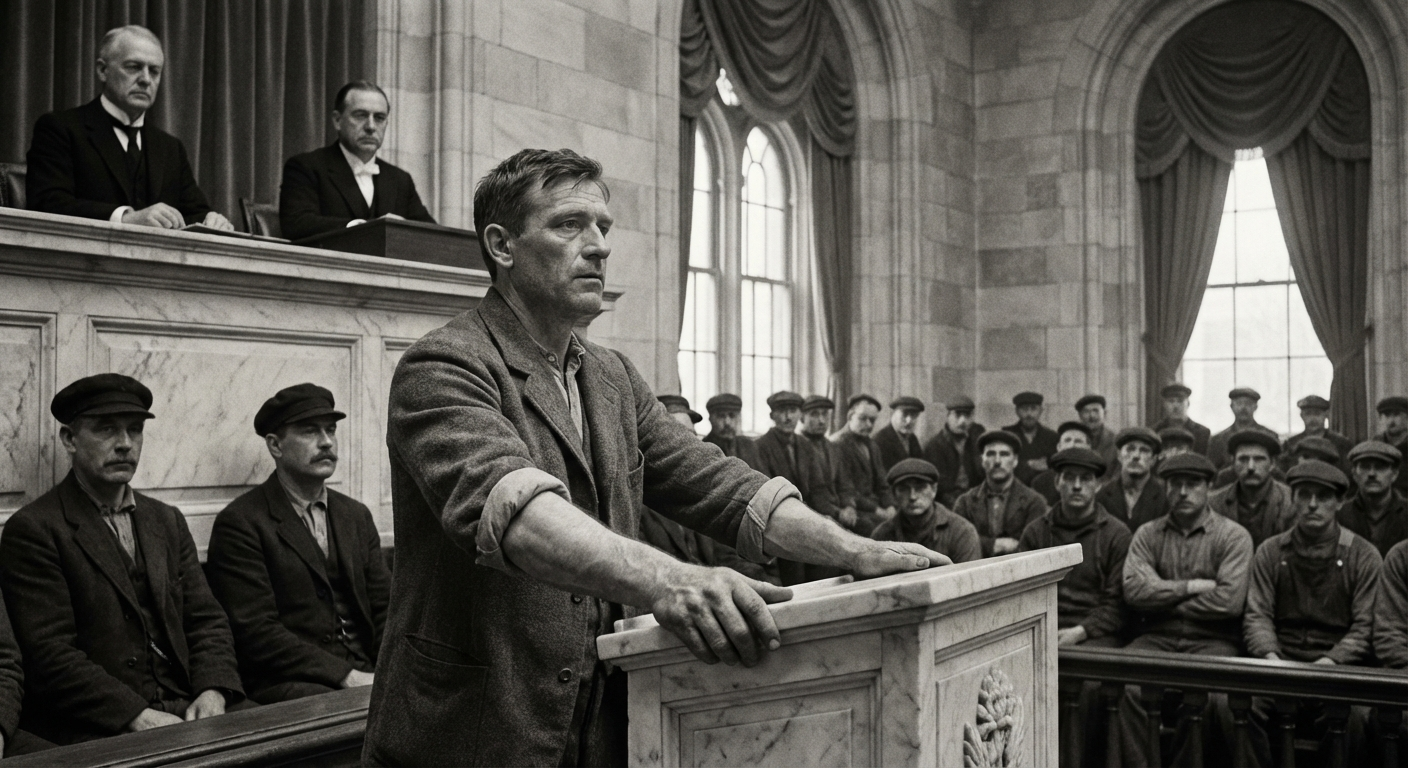
The Municipal Chamber has heard a great deal of arithmetic this week. On Monday it was the arithmetic of copper prices and bond capacity and geological surveys. On Tuesday it heard something different. It heard a man describe what it is to carry a city on your back.
Patrick Seldon, foreman and spokesman of the Docklands Workers’ Association, rose at twenty minutes past eleven to deliver the DWA’s oral testimony. He spoke for thirty-seven minutes. For the final twelve, the only sound in the chamber besides his voice was the scratch of the stenographer’s pen.
”We Are Not a Line Item”
Seldon, fifty-one, broad-shouldered and deliberate, had submitted the DWA’s five-page written brief last week. What he delivered on Tuesday bore little resemblance to that document’s careful formulations. He began with numbers — 4,200 association members, 6,000 projected tramway workers, an average dockworker’s wage of 38 florins per week — then set the numbers aside.
“I have listened with respect to the testimony of engineers and treasurers and geologists,” Seldon said, gripping the edges of the witness lectern. “I do not question their expertise. But I will ask this commission to remember that behind every florin of expenditure there is a hand that will earn it.”
He described the Docklands workforce in granular, human detail: men who had waited two years for the tramway contracts, who had turned down shipping work in Caldwell to remain available, who had taken out loans against future wages. He named three workers by name — a riveter named Ged Halloran, a cable-layer named Petra Voss, and an apprentice welder named Samuel Obi — and described their circumstances.
“Ged Halloran has a wife and two boys in Chandler’s Row,” Seldon said. “He could have signed with Ironhall Steelworks in November. He stayed because his council told him the tramway would break ground in autumn. Petra Voss — no relation to the Councilman — has completed a nine-month cable-laying certification. She borrowed 280 florins for the course. Samuel Obi is nineteen. He has never held a full-time position. The tramway was to be his first.”
The Commission’s Response
Councilwoman Pryce, visibly moved, asked Seldon to clarify the association’s position on the three options presented by Chief Engineer Okonkwo on Monday. Seldon was direct.
“We are not in a position to choose between proceed, redesign, and phase,” he said. “That is your burden. What we ask is this: whatever you decide, do not pretend the workers do not exist. If you proceed, guarantee the wages. If you delay, provide a transition fund. If you cancel — ” He paused. “If you cancel, look these people in the eye and tell them why.”
Councilman Voss, who had spent Monday focused on cost exposure, took a different tack. He asked Seldon what the DWA’s estimate of fair compensation would be in the event of a two-year delay. Seldon quoted a figure of 14 million florins — the approximate cost of maintaining 2,000 workers at half-wage for 18 months, based on precedent from the 2011 dockers’ strike settlement.
Voss did not react visibly, but wrote the figure down. Fourteen million florins is roughly one week of copper price exposure at current rates.
Merchants’ Guild: “The Ships Will Not Wait”
Before Seldon’s testimony, the morning session heard from Guildmaster Hadrian Voss — who, as the Times has noted before, bears no relation to the Councilman — presenting the Merchants’ Guild’s twelve-page submission in person.
The Guildmaster’s testimony focused on the cascading costs of the Kaelmar disruption. Twelve Bobington-registered cargo vessels are currently rerouting via the Cape of Sarenne, adding 12 to 15 days per voyage. Total fleet costs now exceed 1.6 million florins. Shipping insurance premiums have doubled on Kaelmar routes, and three underwriters — including Fairweather & Chalk — have ceased writing new policies for eastern passages entirely.
“The Guild supports proceeding with the tramway at modified scope,” Hadrian Voss said. “But we must be clear: the current copper market is not a temporary disruption. If the strait remains closed or restricted for six months, some of our member firms will not survive.”
He urged the commission to consider a phased procurement strategy, purchasing copper in tranches rather than committing to a single bulk contract, to reduce exposure to price swings. Chief Engineer Okonkwo, recalled briefly, acknowledged this was feasible but would add approximately 3 per cent to total copper costs through the loss of volume discounts.
Insurance Testimony
The afternoon session heard from two witnesses representing the shipping insurance market. Caspar Helmsley, senior underwriter at Tidewater Mutual, testified that his firm had not written a new Kaelmar-route policy since 12 February and had no plans to resume until the diplomatic situation clarified. Premiums on existing policies had risen by 110 per cent on average.
Nora Felling, of the Bobington Insurance Exchange, provided data showing that total claims related to Kaelmar diversions had reached 420,000 florins in the past ten days alone — primarily for spoiled cargo on extended Sarenne routings.
Looking Ahead
The commission adjourned at four o’clock. Speaker Falk announced that Wednesday’s session will hear from Chief Municipal Engineer Dorothea Kinnear on infrastructure costs, and from Professor Elara Whitstone of the Royal Institute on domestic copper geology — a preview of tomorrow evening’s sold-out public lecture.
The commission has eight days remaining before its 5 March reporting deadline. Five options have now emerged from two days of testimony: proceed at current scope, proceed at modified scope, redesign with aluminium substitution, phase the project, or suspend pending diplomatic resolution. The commission’s interim report, expected Friday, will narrow these to a formal shortlist.
As the gallery emptied on Tuesday afternoon, the 200-odd DWA members who had attended both days filed out in the same disciplined silence with which they had arrived. Seldon was the last to leave the witness area. He shook hands with both co-chairs, collected his papers, and walked out through the public entrance.
Councilwoman Pryce was overheard telling an aide: “That is the testimony I will remember.”