They had heard the engineers and the geologists, the guild masters and the underwriters, the foreman who named three workers and the treasurer who counted every florin. On Thursday morning, in the final session of the Copper Review Commission, it was the turn of the people who will live with whatever the commission decides.
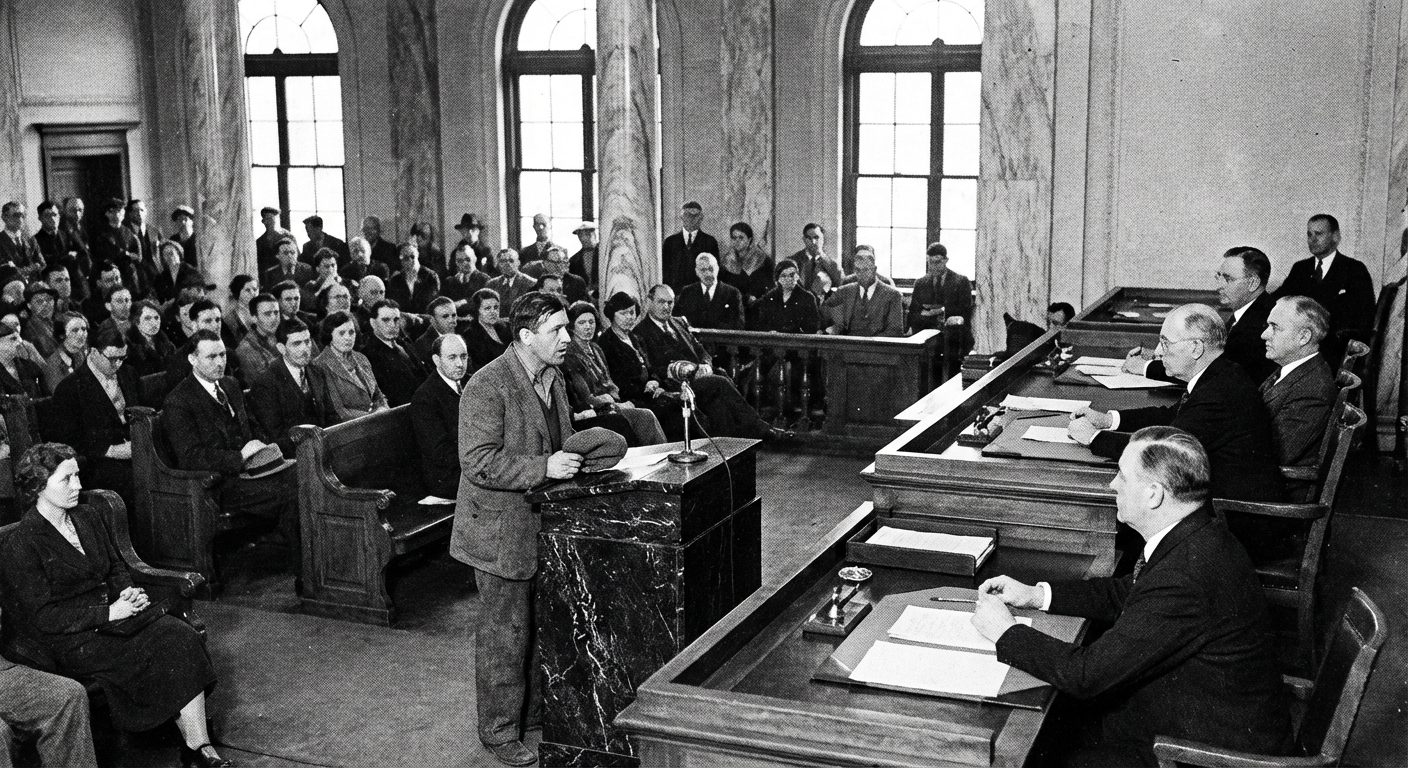
Twelve members of the public addressed the co-chairs in a hearing that ran from nine o’clock until well past one. Some had prepared remarks. Most had not. All were heard in a Municipal Chamber that, for the first time this week, was not at capacity — the gallery perhaps two-thirds full, the urgency of Monday’s crowds replaced by something quieter and more settled.
Ged Halloran spoke first. The riveter from Chandler’s Row, named by Patrick Seldon in Tuesday’s testimony, had not planned to speak. He stood at the public lectern in his work jacket, turning his cap in his hands, and said what he had come to say in fewer than three minutes.
“I’ve been a riveter for twenty-two years,” Halloran said. “I stayed in Bobington because the tramway was coming. My boys are in school here. If the work comes, we’ll be all right. If it doesn’t — well, I’ve got no second plan. I’m not an engineer or a councillor. I just need to know.”
There was no applause. The gallery was very still.
A grocer from Harbourfront Parade named Celia Dunbar — no relation to the Duncastle footballer — spoke about what the construction delays were costing her business. “The Docklands is holding its breath,” she said. “When a neighbourhood holds its breath for too long, shops close.”
Not all testimony favoured proceeding. Walter Griggs, a retired schoolteacher from Thornhill, delivered a terse assessment of the city’s fiscal exposure. “Phased or not, you are committing future generations to debt they did not choose,” he said. “I would like to hear someone in this chamber say the word ‘no’ without qualifying it.” Voss wrote something down.
The most affecting testimony came from a woman who identified herself only as Mrs Holm, a dockworker’s wife from Pilot’s Alley. She spoke about the uncertainty of the past two weeks — the rumours at the school gates, the conversations over kitchen tables. “My husband doesn’t follow the commission,” she said. “He follows whether there’s work next month. That’s all he follows.”
Speaker Falk, who observed from the public gallery rather than the chair, was seen to remove his spectacles and polish them for some time after Mrs Holm sat down.
Closing Statements
Councilwoman Ida Pryce delivered her closing statement at half past twelve. She spoke for eleven minutes without notes, her voice steady but lower than it had been all week.
“This commission was asked to assess the city’s options,” Pryce said. “We have heard them. Some are ruinous. Some are inadequate. One — a phased approach — is imperfect but honest. It acknowledges what we can do, what we cannot yet know, and what we owe to the people who are waiting.”
She referenced Seldon’s testimony from Tuesday, Kinnear’s engineering analysis, and Whitstone’s geological evidence in a sequence that amounted to a clear argument for Phase 1 construction at current copper specifications, with Phase 2 deferred pending geological survey results and diplomatic resolution of the Kaelmar crisis.
“We must not build cheaply what must last a lifetime,” Pryce said, echoing Kinnear’s phrase from Wednesday. “But neither must we build nothing at all.”
Councilman Aldric Voss followed with a statement that was, characteristically, more cautious and more precisely worded. He spoke for eight minutes, consulting a single handwritten page.
“I remain concerned about the fiscal commitment this city is being asked to make,” Voss said. “But I am persuaded — by the engineering testimony, by the geological evidence, and by the people who spoke this morning — that delay is not neutral. Delay has a cost, and that cost falls disproportionately on those least able to bear it.”
It was, by any measure, a remarkable concession from the man who had opposed the tramway expansion from its first council reading.
Voss added a qualification that will matter in the weeks ahead: “Any recommendation from this commission must be contingent on a full geological and seismic survey of the Greymoor deposits. Four months and 1.2 million florins is a modest price for certainty.”
Interim Report Saturday
Speaker Falk rose briefly to confirm that the commission’s interim report — expected to narrow the five original options to no more than two or three — will be released Saturday morning.
“The commission has done its work with diligence and, I believe, with honour,” Falk said. “The interim report will reflect that.”
The final report remains due by the 5th of March.
As the chamber emptied, Halloran was seen shaking hands with Seldon near the public gallery steps. Mrs Holm left by the side door without speaking to anyone. Pryce and Voss exchanged a few words at the co-chairs’ table before departing separately.
The tramway question is not yet answered. But after four days of testimony that ranged from the molecular structure of copper to the contents of a grocer’s till, the shape of the answer is becoming visible.
The commission will report. The council will vote. And the Docklands will, at last, exhale.