
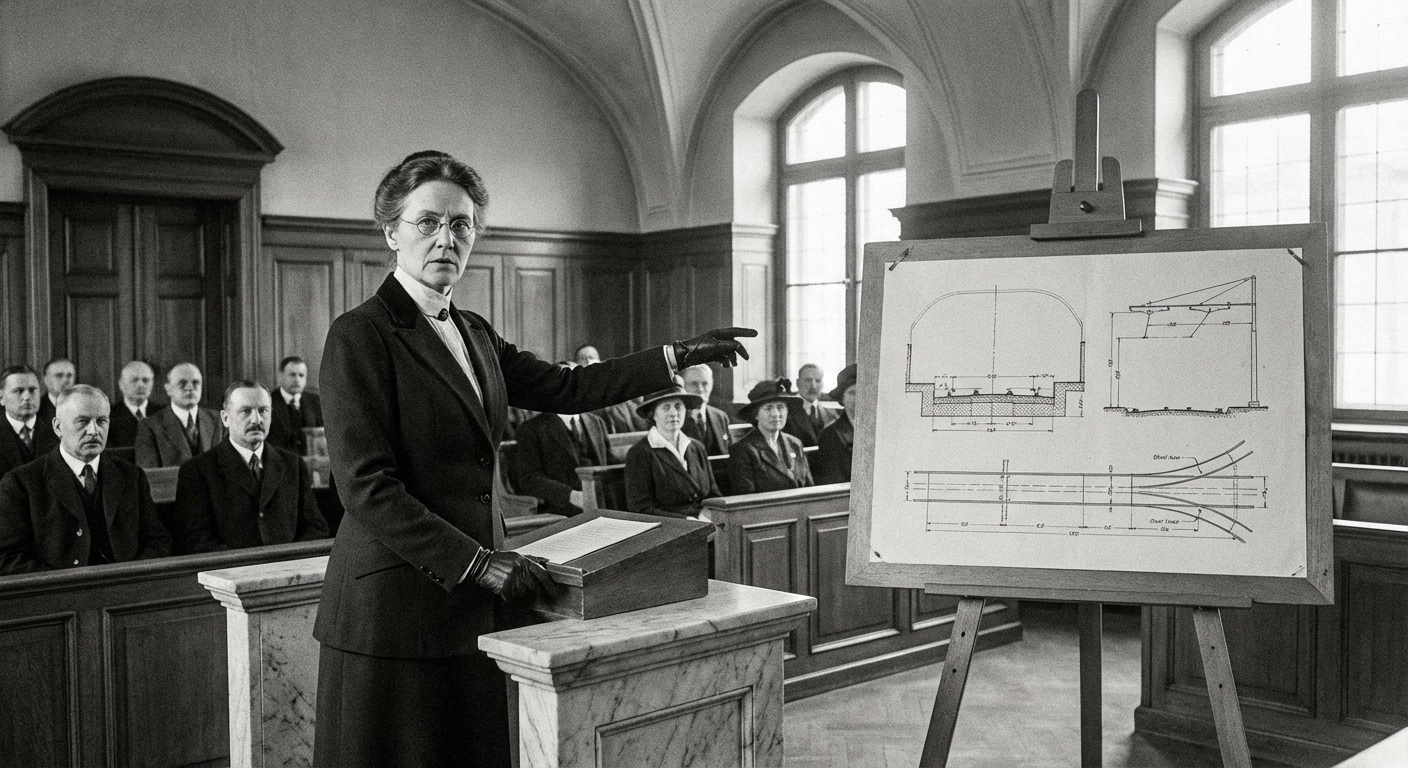
The third session of the Copper Review Commission brought the city’s tramway debate from the realm of finance and labour into the unyielding world of physics and geology, and the picture that emerged on Wednesday was both clarifying and discomfiting.
Chief Municipal Engineer Dorothea Kinnear, who had been notably absent from the commission’s first two sessions, appeared with a bound volume of engineering analysis that ran to sixty-three pages and a series of diagrams rendered with the precision of a woman who does not tolerate approximation.
“I have been asked to assess alternatives,” Kinnear said, adjusting her spectacles as she opened the volume. “I have assessed them honestly.”
Three Designs, Three Lifespans
Kinnear presented three design variants for the Veridan Corridor tramway, each with distinct copper requirements and projected lifespans.
The original specification — copper overhead catenary, copper power distribution, copper-wound traction motors — requires approximately 12,000 tonnes and yields a system designed for a 60-year operational life. At current prices of 885 florins per tonne, the copper component alone exceeds the budgeted 380 million florins by more than 530 million.
An aluminium-substituted design — replacing copper in the catenary and distribution networks while retaining copper-wound motors — reduces the requirement to approximately 4,100 tonnes but produces a system Kinnear rated for 30 years. “Aluminium fatigues differently,” she explained. “It work-hardens under the vibration of constant tram traffic. At 30 years, you are rebuilding the entire overhead network.”
The cost saving on materials is approximately 310 million florins. The cost of the rebuild at year 30, at current prices, would be approximately 280 million. “You have saved one generation the trouble,” Kinnear said, “and left the next one the bill.”
A phased design — building Phase 1 (Docklands to Midtown, 7.4 miles, 6 stations) in full copper specification while deferring Phase 2 — requires 5,200 tonnes of copper, at a cost of roughly 4.6 billion florins. The overrun for Phase 1 alone is approximately 280 million.
”You Cannot Build a Cheaper Tramway That Lasts”
Councilman Voss pressed Kinnear on the aluminium design. “Is it not a functional system? Does it not carry passengers?”
“It carries passengers,” Kinnear acknowledged. “It carries them for 30 years and then it stops carrying them while you spend two years replacing everything above their heads.”
“And if copper prices return to normal?”
“Then the next generation can build Phase 2 in copper. But the aluminium Phase 1 will still need replacing in 30 years regardless of what copper costs. The metallurgy is the metallurgy.”
Councilwoman Pryce asked whether any design existed that preserved the 60-year lifespan at a lower copper requirement. Kinnear said her team had investigated copper-clad aluminium conductors — a core of aluminium with a copper sheath — but found the manufacturing capability did not exist domestically. “Three firms in the Ashford Republic produce it. None in Bobington. Importing it would add 18 months to the timeline and introduces a supply chain dependency of its own.”
The gallery of approximately 150 — smaller than Monday’s and Tuesday’s packed houses, but including a substantial contingent of engineers from the Municipal Works Office — took notes throughout.
The Geologist’s Sober Assessment
Professor Elara Whitstone, president of the Royal Institute and the nation’s foremost volcanologist, took the lectern in the afternoon session. Where Kinnear had been precise and slightly impatient, Whitstone was measured and careful, speaking with the deliberation of a scientist presenting data she knew would disappoint.
The commission had hoped to hear that Greymoor copper could meaningfully offset the city’s dependence on imported ore. Whitstone offered a more complicated truth.
Current production from the Miners’ Cooperative of Greymoor stands at approximately 2,000 tonnes per year from three active shafts. Expansion to 3,500 tonnes — as chairman Nils Haversten had described as theoretically possible in Monday’s hearing — would require a minimum investment of 28 million florins and 18-24 months of development.
But Whitstone added a finding that had not been publicly disclosed. Core samples extracted from existing shafts over the past six months show a consistent decline in ore grade at current working depths. “The copper at 40 to 60 metres is good quality — roughly 2.8 per cent by weight,” she said. “At 80 metres, our most recent samples show 1.6 per cent. The ore is thinning.”
Deeper deposits almost certainly exist — geological surveys from the 1970s suggest significant mineralisation at 150 metres and below — but accessing them would require entirely new shafts, modern ventilation, and safety infrastructure the cooperative is not equipped to finance.
The Tremor Question
Whitstone addressed the seismic tremor of 23 February directly. Her team has begun mapping fault structures in the Greymoor Highlands using a network of portable seismometers placed after the event. Early data suggests the tremor originated at approximately 4 kilometres’ depth along a previously unmapped fault that runs roughly north-south through the eastern highlands.
“The tremor does not preclude mining,” Whitstone said carefully. “But it mandates that any expansion be preceded by a comprehensive geological and seismic survey. I estimate four months for the fieldwork and analysis, at a cost of approximately 1.2 million florins.”
Haversten, seated in the gallery, was seen nodding.
Voss asked whether domestic copper could ever meet the tramway’s full requirement. Whitstone paused before answering. “Not from Greymoor alone. Not within the timeline of this project. If you are asking whether Bobington can produce 12,000 tonnes of copper, the answer is: not soon, and not cheaply.”
The Narrowing Path
As the session concluded at 4:20 PM, the outlines of the commission’s likely recommendation were becoming visible. The full-specification option is financially devastating. The aluminium redesign is an engineering compromise that Kinnear clearly views as irresponsible. The phased approach — expensive, but manageable — is the middle road, and both co-chairs appeared to be converging on it.
Speaker Falk, observing from the rear of the chamber, told this correspondent that the interim report due Friday will “narrow the field considerably.”
The commission’s fourth and final hearing is scheduled for Thursday, with public comment and closing statements from the co-chairs. The report deadline remains 5 March.