
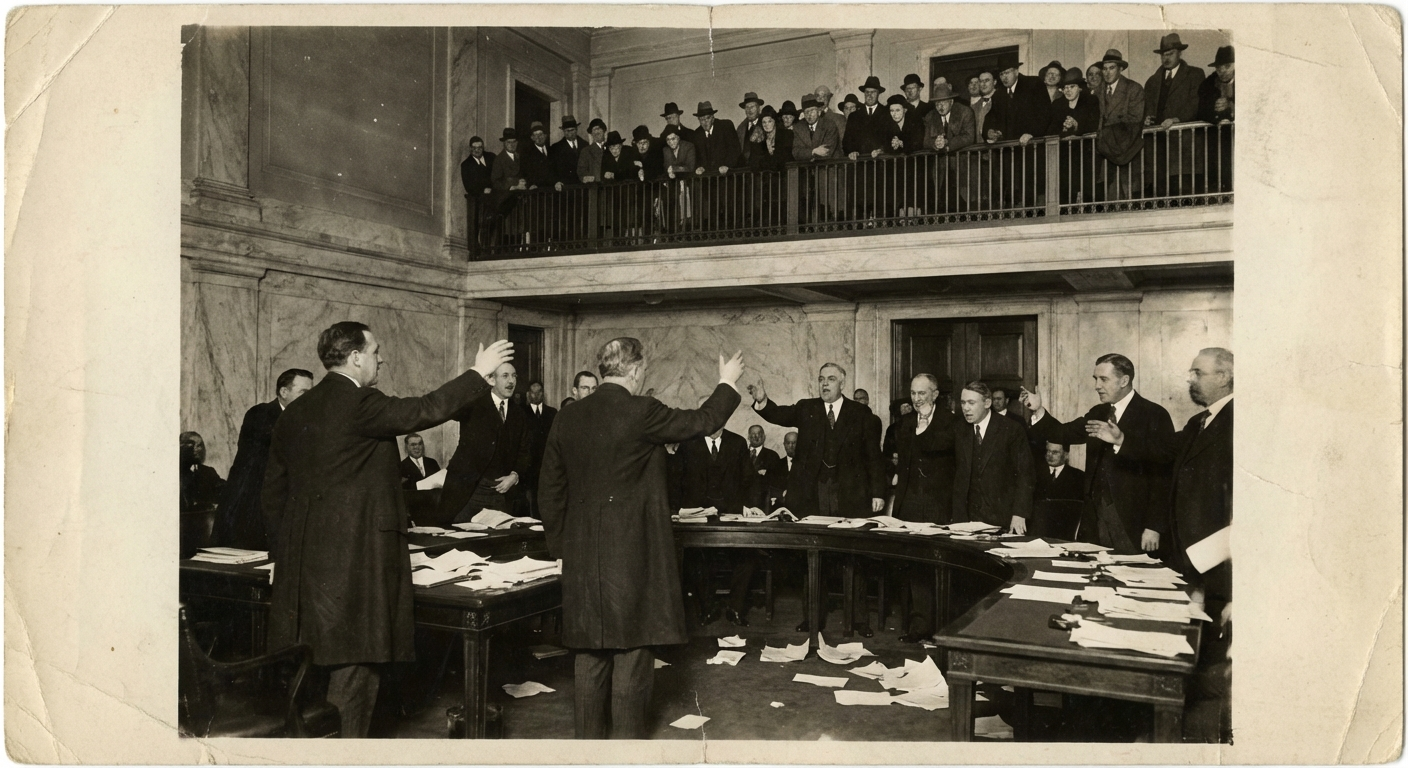
The marble halls of the Municipal Chamber have witnessed their share of rancour over the centuries, but few sessions in recent memory have matched the gravity — or the volume — of Wednesday’s extraordinary meeting on the copper crisis and the future of the Veridan Corridor Tramway.
By the time Council Speaker Desmond Falk gavelled the session to a close shortly before three o’clock, the city’s most ambitious infrastructure project in a generation had been laid bare as a venture balanced on the knife-edge of international events far beyond Bobington’s control. And the council, for all its shouting, had been forced to confront a truth that several members admitted privately they had hoped to avoid: the numbers no longer work.
”The Arithmetic Is Unforgiving”
Chief Transit Engineer Yara Okonkwo, the woman who designed the tramway and shepherded it through eight years of planning, was the first to testify. She spoke for forty-five minutes without notes, projecting cost tables onto the chamber’s great screen — a modern indignity in a room built for gaslight oratory — and her opening words set the tone for the day.
“Councillors, I will not insult your intelligence with optimism,” Okonkwo said. “The arithmetic is unforgiving. At the current copper price of 862 florins per tonne, the project’s copper component — wiring, connectors, transformer housings, catenary systems — faces an overrun of approximately 430 million florins above the baseline budget. If copper reaches 900, as several analysts project, the overrun approaches 490 million. At 950, it exceeds half a billion.”
The budget for the tramway’s copper needs had been set at 740 florins per tonne — a figure that was considered conservative when the council voted 7-4 to approve the project just four days ago. The Kaelmar Strait crisis has rendered it a relic.
Okonkwo presented three scenarios, each projected onto the screen in columns of black and red ink that drew audible groans from the public gallery.
Option One: Proceed as planned. Absorb the overrun through a combination of municipal bonds and reallocation from other capital budgets. Estimated additional borrowing: 350-400 million florins. Annual debt service increase: approximately 28 million florins for twenty years. “This is viable,” Okonkwo said, “but it means other projects — school repairs, the Bridgewater sewer works, the East Palisade fire station — will be delayed or cancelled.”
Option Two: Redesign and substitute. Replace copper components with aluminium alloys where technically feasible, reducing copper requirements by an estimated thirty per cent. Cost savings: 130-150 million florins at current prices. Trade-offs: eighteen-month redesign period, reduced system efficiency, shorter component lifespan, and the need to renegotiate contracts with three major suppliers. “It is the cautious path,” Okonkwo said, with a note of reluctance that did not go unnoticed. “But it is not the tramway I designed, and I will not pretend otherwise.”
Option Three: Phase and delay. Build Phase 1 (Docklands to Midtown, 6 stations) on the current timeline. Defer Phase 2 (Midtown to Upper Fernwich, 6 stations) until copper prices stabilise — potentially two to three years. Cost savings in the near term: approximately 200 million florins. Risk: Phase 2 costs will likely be higher when construction eventually begins, and the Docklands-to-Fernwich service that residents have been promised will not materialise until 2032 or later.
“There is no Option Four,” Okonkwo said quietly. “Abandoning the project would cost the city an estimated 180 million florins in contract termination penalties alone, plus the political cost of telling 380,000 daily commuters that the future they were promised last Friday is cancelled."
"We Told You So”
Councilman Aldric Voss, who led the opposition to the tramway and voted against it last Friday, did not trouble himself with restraint.
“Four days,” Voss said, rising from his seat before Speaker Falk had formally recognised him. “Four days ago I stood in this chamber and warned that this project was built on assumptions that could not withstand a single international shock. I was told I was a pessimist. I was told I lacked vision. Well, here is your vision, councillors — 430 million florins of it.”
Voss called for an immediate project pause — not cancellation, he was careful to say, but a full suspension pending resolution of the Kaelmar crisis and a “sober reassessment” of the city’s fiscal position.
“We cannot in good conscience pour hundreds of millions of florins into copper wire while our school roofs leak and our fire brigades operate with equipment that belongs in a museum,” Voss said. “This council has a duty of care that extends beyond any single project, however popular.”
The remark drew sharp responses from the moderniser faction. Councilwoman Ida Pryce, whose Docklands constituents stand to benefit most from the tramway and who has campaigned for the project for the better part of a decade, was on her feet within seconds.
“A pause is a euphemism for a coffin,” Pryce said. “The contracts are signed. The workers are being hired. The Docklands has waited sixty years for decent transit connections. You do not pause a project of this scale — you strangle it.”
The Treasury’s Cold Comfort
The Municipal Treasury’s testimony, delivered by Deputy Treasurer Annabel Whitford, was no more reassuring. The city’s contingency reserve for capital projects stood at 142 million florins — less than a third of the projected overrun. The reserve had been partially drawn down in January to cover emergency repairs to the Bramblegate Market roof following winter storm damage.
“The contingency was designed for normal cost fluctuations,” Whitford told the chamber. “A thirty-per-cent increase in the price of a primary material within five days of project approval is not a normal fluctuation. It is an external shock, and our reserves are not dimensioned for external shocks of this magnitude.”
When Voss asked whether the city could borrow its way out, Whitford was blunt: “The city can borrow. The question is at what cost. Our current credit rating assumes the tramway will be delivered on budget. If it is not, the rating agencies will notice. Borrowing 350 million florins at a higher interest rate compounds the problem.”
The Merchants Weigh In
Guildmaster Hadrian Voss — no relation to the councilman, a point he has been making with visible weariness for six years — offered the Merchants’ Guild’s perspective. Shipping costs through the Kaelmar Strait had doubled in a week. Insurance premiums for Strait-route cargo had tripled for some firms. Three Bobington-registered vessels were diverted during Tuesday’s Delvarian live-fire exercises, at an estimated cost of 40,000 florins per vessel per day of delay.
“The crisis is not confined to copper,” Hadrian Voss said. “Every commodity that passes through the Strait is affected. Eastern spice prices are up fifteen per cent in a week. Timber from the southern ports is delayed by a fortnight. The businesses I represent are absorbing costs they cannot pass on to customers without losing them. The tramway is the headline, but the Strait is squeezing the entire economy.”
He urged the council to press the Foreign Office for a swifter diplomatic resolution, noting that “every day without a settlement costs this city more than any council debate can recover.”
The Public Gallery
The public gallery, which can hold two hundred and fifty and was full an hour before the session began, included several notable presences beyond the usual political observers. A group of approximately thirty dockworkers, still in their work clothes, occupied the upper benches. Their foreman, a broad-shouldered man who identified himself to reporters as Patrick Seldon, said they had come “to make sure the people who build this city are not forgotten in the arithmetic.”
“They’re talking about phasing, about delays, about substitutions,” Seldon said during the midday recess. “But nobody’s talking about the six thousand workers who were supposed to break ground this autumn. What happens to them if the project stalls? They don’t have contingency reserves.”
Seldon said the Docklands Workers’ Association, which represents approximately four thousand labourers in the waterfront district, would be seeking a formal meeting with the council to discuss workforce protections.
The Vote
After five hours of testimony and debate — and a brief recess during which Mayor Blackthorne was seen in intense conversation with both Pryce and Aldric Voss in the anteroom — the council voted on two motions.
The first, proposed jointly by Pryce and Voss in a rare display of bipartisan cooperation, established a Copper Review Commission with a mandate to assess the tramway’s options and report back to the full council within fourteen days. The commission will be co-chaired by Pryce and Voss — a pairing that Speaker Falk described, with the faintest ghost of a smile, as “either inspired or catastrophic.” The motion passed unanimously, 11-0.
The second motion, proposed by Pryce alone, authorised a comprehensive safety audit of all vacant commercial properties in the Docklands, with particular attention to fire safety, insurance compliance, and security arrangements. The motion, clearly aimed at the Ashcroft Property Group’s portfolio in the wake of the Greystone Wharf fire, passed 8-3, with Voss and two allies voting against on the grounds that it was outside the scope of the emergency session’s agenda.
“Vacant buildings that burn down are everyone’s agenda,” Pryce told reporters afterward. “The council has spoken.”
What Comes Next
The Copper Review Commission will convene for the first time on Monday, with Okonkwo, the Municipal Treasury, and representatives from the three major copper suppliers expected to testify. The commission must deliver its recommendation — proceed, redesign, or phase — by 5 March.
Mayor Blackthorne, who spoke briefly at the close of the session, struck a tone of measured resolve.
“Today was difficult, and the choices ahead of us are not easy,” Blackthorne said. “But this council has shown that it can face hard truths and respond with seriousness. The tramway is not dead. The question is how we build it wisely in a world that has changed since last Friday. I have confidence in the commission, and I have confidence in this city.”
Copper closed Wednesday’s trading at the Bramblegate Exchange at 871 florins per tonne — up nine florins from Tuesday’s close, a new twelve-year high.
Outside the Municipal Chamber, Patrick Seldon and his dockworkers were still waiting in the February cold. “Fourteen days,” Seldon said, turning up his collar. “We can wait fourteen days. But after that, they’d better have answers.”