
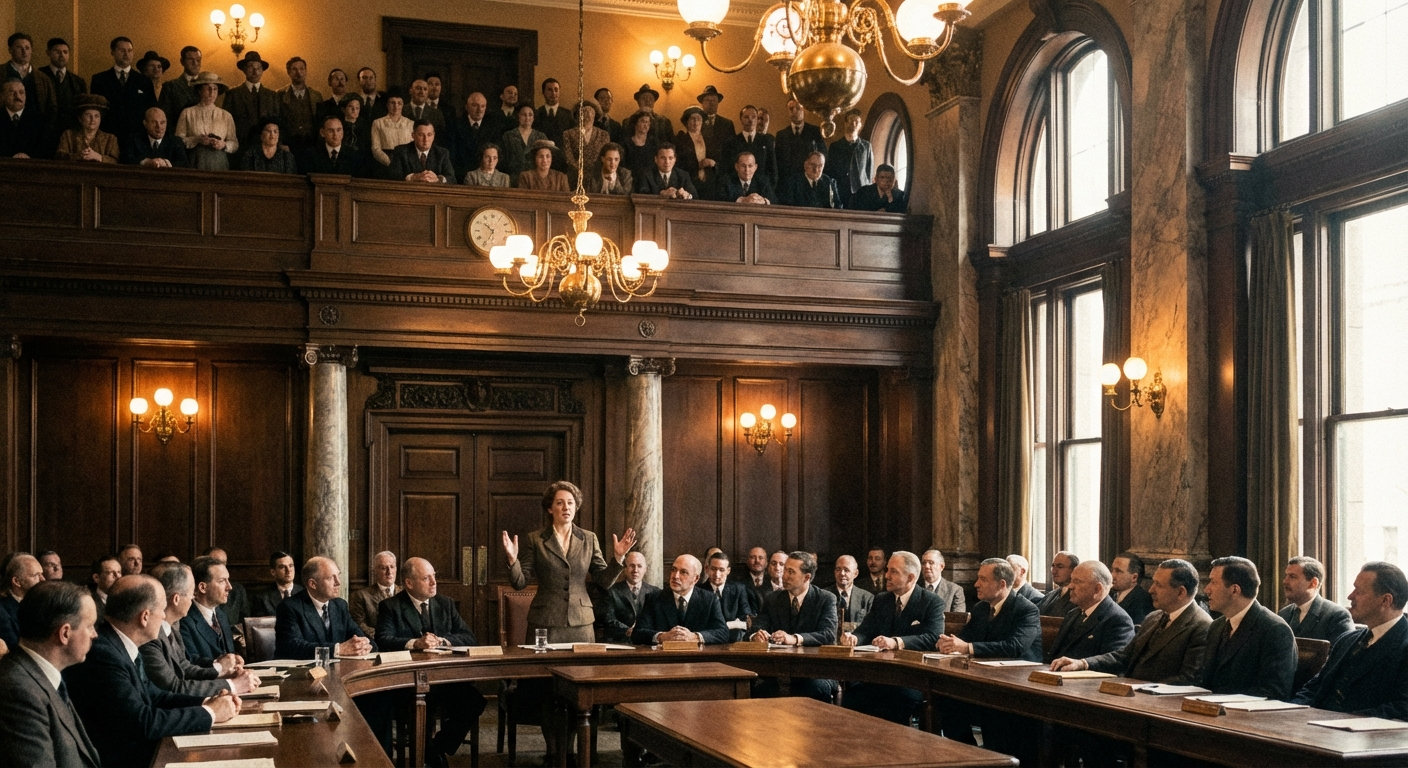
The Municipal Chamber has seen louder days. It has not, in this correspondent’s memory, seen a more consequential one.
At 10:07 on Monday morning — seven minutes behind schedule, owing to the sheer volume of bodies pressing through the gallery entrance — Mayor Harriet Blackthorne rose from her seat at the head of the council table and addressed the eleven members of the Bobington City Council for the first time in twenty-two days.
She spoke for twenty-six minutes. She did not consult notes.
“I have been silent,” Blackthorne began, her voice carrying easily to the upper balcony, where the gallery had been expanded from 120 to 180 seats at Speaker Falk’s instruction. “I have been silent because this commission deserved the space to do its work without the distortion of this office’s influence. That silence ends now.”
What followed was the most commanding public address of Blackthorne’s four-year tenure — a systematic, precise, and at moments unexpectedly personal case for the phased approach recommended by the Copper Review Commission’s final report.
The Speech
Blackthorne moved through four distinct arguments. First, the engineering case: Phase 1’s seven stations and 8.2 miles of track using 5,200 tonnes of copper at current specification, with the roughly 280-million-florin overrun absorbed through a revised bond issuance that Deputy Treasurer Whitford’s office had quietly modelled over the past fortnight. Second, the geological imperative: the Greymoor survey must precede any commitment to Phase 2, and the monitoring station approved last week represented “the beginning of genuine knowledge about what lies beneath our feet.”
Third — and here the gallery grew very still — she spoke about the workers.
“I have read Mr Seldon’s testimony three times,” Blackthorne said. “I have read Mrs Holm’s words twice. I have not slept well since.” She paused. “We do not build tramways for the satisfaction of engineers or the comfort of commuters alone. We build them because six thousand men and women were promised work, and a city that breaks that promise has broken something that cannot be repaired with copper wire.”
The fourth argument was the one the bond market had been waiting for. Blackthorne proposed an accelerated timeline: geological survey to begin mid-May as scheduled, but Phase 1 groundbreaking brought forward to late September — contingent on survey findings — rather than early 2027. “We will not rush,” she said. “But neither will we dawdle while families count the weeks.”
She concluded: “We build, or we betray the promise of this city to its workers and its future. I ask this council to speak with one voice today — not because unanimity is easy, but because the people watching from that gallery, and the thousands beyond these walls, deserve to know that their government can agree on what matters.”
She sat down at 10:33. The gallery applauded for eleven seconds before Speaker Falk restored order.
Seldon’s Amendment
Patrick Seldon, granted a ten-minute speaking slot by prior arrangement with the Speaker’s office, rose at 10:41. The DWA foreman was visibly moved by Blackthorne’s reference to his testimony but maintained composure throughout.
His amendment was precise: expand the 14-million-florin transition fund’s eligibility from workers holding specialist certifications to all workers with twelve or more months of continuous employment on tramway-related contracts. This would encompass apprentice welders, general labourers, and support staff — an estimated 800 to 1,200 additional workers at a cost of 2 to 3 million florins.
“Samuel Obi is nineteen years old,” Seldon said, naming the apprentice welder he had introduced to the commission a fortnight ago. “He has never held a full-time position. Under the current eligibility, if this project is delayed, he receives nothing. He is not a line item. He is a boy waiting for his life to begin.”
The amendment was voted on separately. It passed 8-3, with Voss, Councilman Drayton, and Councilwoman Fenwick voting against on grounds of fiscal scope. Voss was characteristically blunt: “I will not vote against the transition fund. I will vote against expanding it before we know its cost to the penny.”
The Vote
The main motion — adoption of the Copper Review Commission’s phased approach, including the 14-million-florin base transition fund, the geological survey mandate, and the accelerated Phase 1 timeline — was called at 11:14.
Speaker Falk read the motion in full, a process that took four minutes.
The roll was called alphabetically. Councilwoman Barrow: aye. Councilman Crane: aye. Councilman Drayton: aye. The gallery was silent. Councilwoman Fenwick: aye. Councilwoman Hartley: aye. Councilwoman Lennard: aye. Councilwoman Pryce — who had co-chaired the commission with Voss — said “aye” so quietly the clerk asked her to repeat it. She did, more firmly, and pressed a handkerchief to her eye.
Councilman Selwyn: aye. Councilman Talbot: aye. Councilwoman Wells: aye.
Nine votes in favour. One vote remaining.
Councilman Aldric Voss — fiscal conservative, tramway sceptic, co-author of the very report under consideration — adjusted his spectacles, looked at the gallery, and spoke.
“I have opposed this project from its first appropriation,” he said. “I have not changed my mind about its risks. The overrun is real. The copper market is volatile. The geological uncertainties are profound.” He paused. “But this commission — which I had the honour to co-chair with Councilwoman Pryce — has shown me something I was reluctant to admit. Delay is not caution. Delay is cruelty by another name, and it falls heaviest on those who can bear it least.”
He voted aye.
The chamber erupted. Speaker Falk did not attempt to restore order for a full minute.
Eleven to zero. Unanimous.
Reaction
Blackthorne shook Voss’s hand across the table — a gesture the gallery photographed extensively. Pryce embraced Seldon in the corridor outside the chamber. Falk, in a brief statement to reporters, called the vote “the most significant council action of this decade.”
Seldon, asked by this newspaper whether the 8-3 vote on his amendment was a disappointment, shook his head. “The transition fund passed unanimously. The phased approach passed unanimously. Samuel Obi will have work. That is not a disappointment.”
In the directors’ box at the far end of the gallery, two figures were observed in quiet conversation: Guildmaster Hadrian Voss and Deputy Treasurer Annabel Whitford. A bond prospectus, it is understood, was already being drafted.
Municipal bond yields fell sharply within the hour. The market, it seems, got the unanimity it wanted.
The bridge repair tender, which opened at noon in a chamber two doors down from the debate, was attended by representatives of three firms, though it is fair to say that the men and women gathered there were watching the clock on the wall more often than the specifications on the table.