
The survey begins, as Dr Fenn-Coulthard explained, with patience.
“You sit,” she said. “You sit for a very long time with a notebook and binoculars and you watch. You note who arrives, who leaves, who hauls out on the same patch of mud every morning. You learn to recognise them by their markings — scars, colouration patterns, size. After a week, you have individuals. After a month, you have a population.”
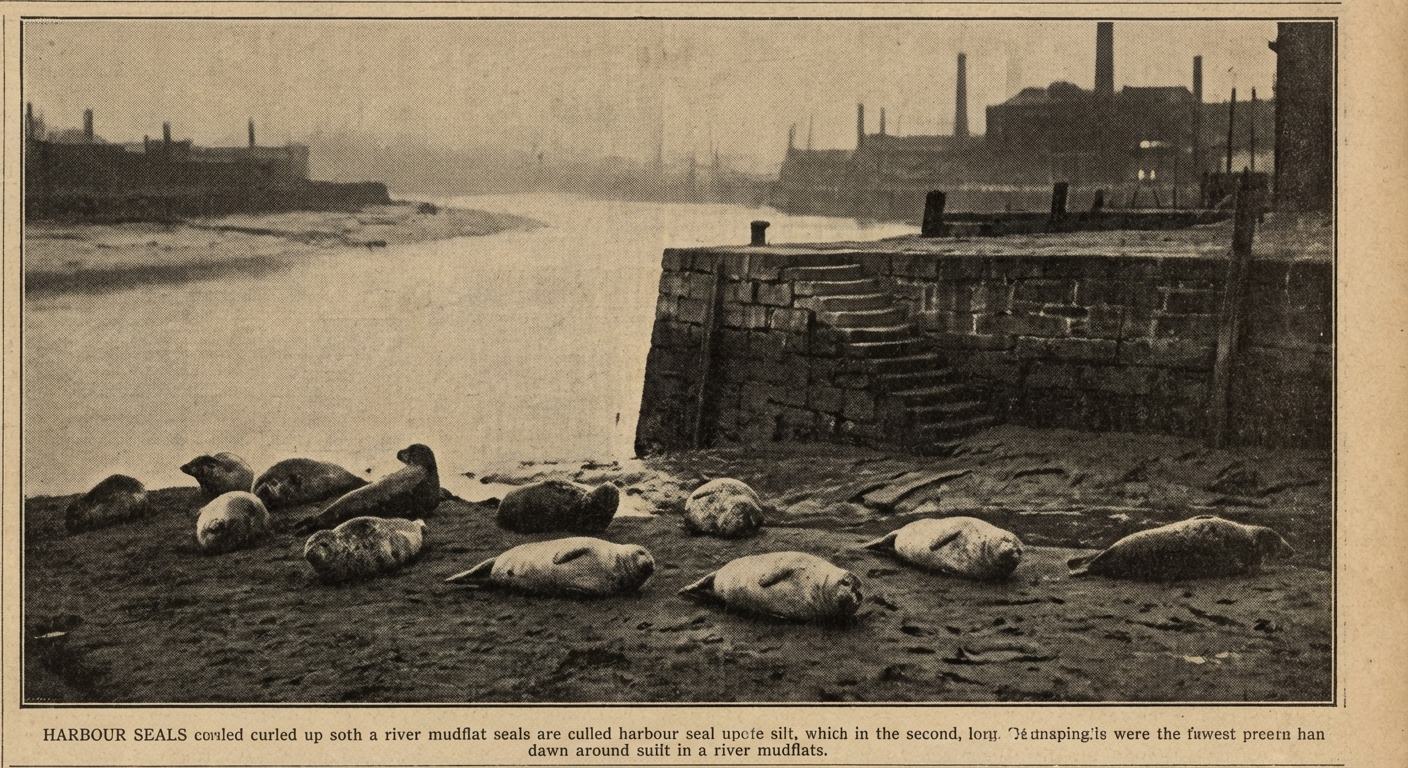
Dr Fenn-Coulthard, a marine biologist at the Bobington Institute of Natural Sciences and great-granddaughter of Lord Mayor Oswald Fenn, arrived at the mudflats below Bramblegate Steps shortly after dawn this morning with a folding stool, two notebooks, a pair of Hoffmann field glasses, and a thermos of tea. By eight o’clock she had counted nine animals: seven adults and two juveniles.
“The same count as Thursday,” she said. “Which is encouraging. It means they are staying.”
The colony was first spotted by retired harbour pilot Reg Garside on the eleventh of March. Mr Garside, who is seventy-four and has sat on the same bench on Harbourfront Parade every morning since his retirement in 2009, noticed “shapes on the mud” at low tide. Dr Fenn-Coulthard confirmed the identification on Thursday — the first recorded harbour seal colony in the lower Ashwater since 1891, when the naturalist Clement Birch documented “a company of harbour seals, eight or ten in number” in roughly the same location.
Industrial discharge — tannery effluent, coal dust, chemical waste from the shipyards — drove the seals from the river in the early twentieth century. Their return, 135 years later, is attributable to two decades of water quality improvement and, Dr Fenn-Coulthard believes, a more specific factor.
“The Lower Conduit outfall is directly below the wharf at Bramblegate Steps,” she said. “The conduit carries fresh, cold water from somewhere upstream — we still don’t know exactly where — and it creates a cooler, fresher micro-habitat on the mudflats at low tide. The seals are hauling out precisely where the outfall meets the river. That is not a coincidence.”
The survey will run for at least four weeks. Dr Fenn-Coulthard will visit the mudflats at dawn and dusk, recording numbers, behaviour, and individual identification. She will also take water temperature and salinity samples at the outfall to confirm the micro-habitat hypothesis.
“If this colony establishes permanently, it will be the first marine mammal population in the lower Ashwater in living memory,” she said. “That is worth documenting properly.”
The Harbour Authority has not yet responded to Dr Fenn-Coulthard’s request for a temporary wildlife protection zone around the mudflats. Harbour Master Cornelius Ashby said on Thursday that the request was “under consideration.” The main concern is the emergency ferry service, whose southern terminal at Bramblegate Steps operates directly above the colony’s preferred haul-out site.
“I am not asking them to move the ferry,” Dr Fenn-Coulthard said. “I am asking them to reduce speed past the steps at low tide. The wash from the Thornhill Star at full speed would be enough to disturb a haul-out. At reduced speed, the seals barely lift their heads.”
Mr Garside, who has appointed himself the colony’s unofficial guardian and arrives at his bench each morning at six, reported that the seals were undisturbed by foot traffic on the steps but reacted to sudden loud noises.
“They don’t mind people,” he said. “They mind surprises. If people would just be a bit quiet on the steps in the morning, we’d all get along fine.”
Dr Fenn-Coulthard expects to publish preliminary findings within three weeks. In the meantime, the seals — nine of them, as of this morning — remain on the mud.