
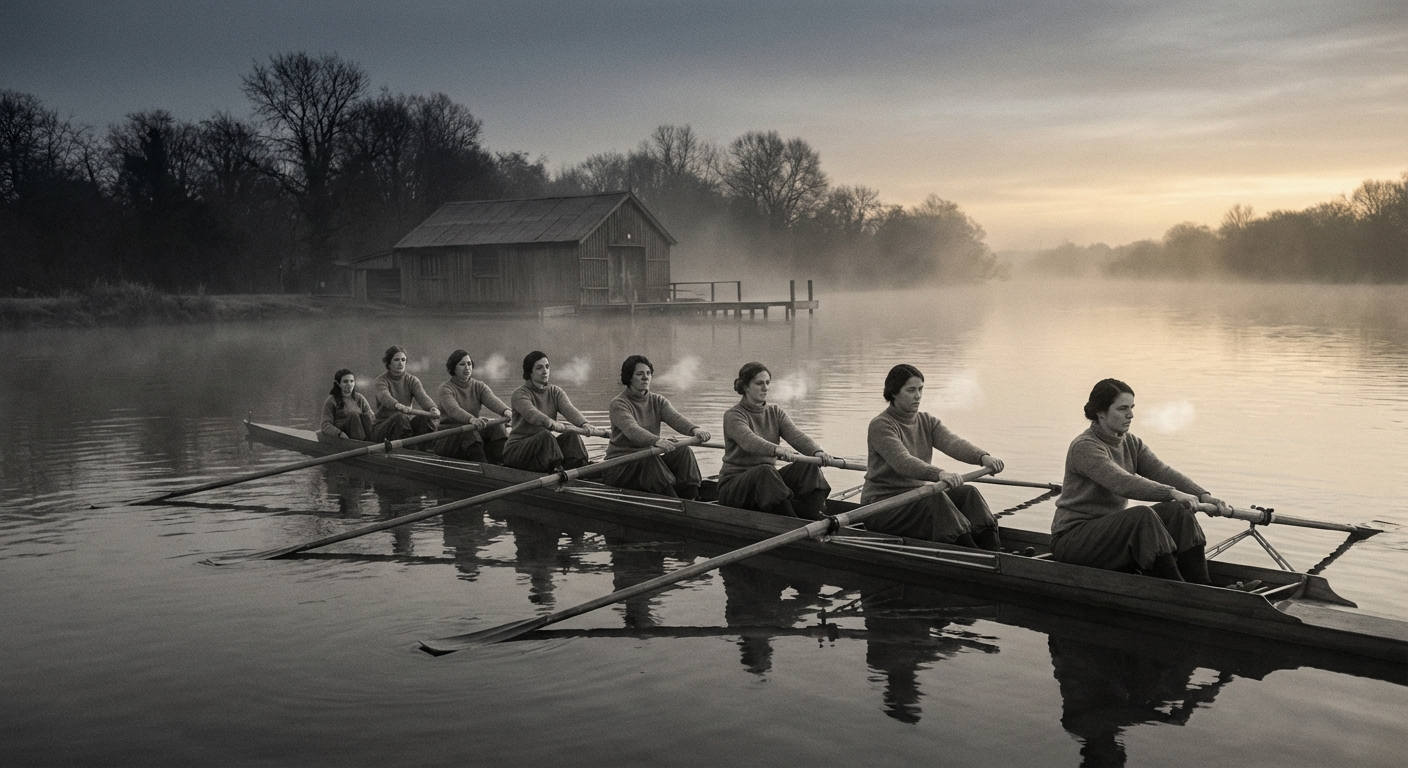
At half past five on a Tuesday morning in February, the Ashwater is black and still. The only light comes from the lamp at the end of Millgate Pier and the faint orange glow of the city behind the trees. The air is cold enough to see your breath. The boathouse door creaks.
Eight women carry a racing shell down the slipway in near-perfect silence. They have done this so many times that words are unnecessary. The boat hits the water. They step in. The oars settle. And then, in the dark, they row.
This is the Bobington Ladies’ Sculling Club. They have been doing this — or something very like it — since 1884, the year the club was founded by a group of mill workers’ wives who wanted, in the words of the original charter, “the liberty of the river and the improvement of the constitution.” They have never, in 142 years, qualified for the National Regatta.
Until now.
On Saturday, at the Ashwater Regional Qualifying Trials held at Coldharbour Reach, the BLSC eight-woman crew posted a time of 6 minutes 42 seconds over the 2,000-metre course — three seconds inside the national qualifying standard and a full eleven seconds faster than their previous best. It was, by any measure, a historic achievement.
It was also witnessed by approximately forty people, most of whom were related to the crew.
“We don’t do this for the audience,” said Vera Duncombe, 58, the club’s head coach, who teaches geography at Bramblegate Secondary School and has coached the sculling club for nineteen years. “We do this because the river is there and so are we.”
Mrs. Duncombe, who rowed competitively in her youth before a shoulder injury ended her racing career at twenty-six, took over the coaching position in 2007 when the previous coach — her mother, Elspeth Duncombe — retired at seventy-three. The elder Mrs. Duncombe, now ninety-two, still attends most Saturday sessions from a folding chair on the pier, offering commentary that her daughter describes as “not always helpful.”
The club has been, to put it gently, a modest operation. Membership has fluctuated between eight and twenty-two over the past two decades. Their boathouse, a timber structure at Millgate Pier, is shared with the Ashwater Rowing Association, which has priority on equipment and water time. The sculling club trains in the early morning because the rowing club trains later.
“We get the dark,” said stroke-seat Agnes Holt, 34, a nurse at St. Dunstan’s Hospital. “But the dark’s quite nice, actually. You hear the river properly when you can’t see it.”
The current eight — Holt, Dora Whitley (31), Patience Greer (29), Suki Adewale (27), Bridget Tolliver (36), Frances Rowe (40), May Cartwright (33), and Nell Parish (30) — have been training together as a settled crew since September. Mrs. Duncombe describes the process of selecting and balancing a crew as “like tuning an instrument.”
“You need eight people whose bodies move the same way at the same time,” she said. “It’s not about individual strength. It’s about rhythm. Synchrony. Trust. You have to be willing to surrender your stroke to the person in front of you.”
The qualifying performance was achieved despite the fact that the crew’s equipment is ageing. Their primary racing shell, The Lark, was built in 1997. Their oars are from 2004. The club’s annual budget, drawn from membership fees and occasional fundraising, is approximately 1,200 florins — a figure that would not, as Mrs. Duncombe observed dryly, cover the cost of a single set of new oars.
“We’ve applied to the Municipal Sports Commission for a grant,” she said. “We need new blades, new rigging, and ideally a boat that doesn’t predate most of the crew.”
The National Regatta, held annually at Lake Thornfield in the Westhaven Hills, takes place over the first weekend of May. Thirty-two crews from across the country will compete. The BLSC will be one of only four women’s crews entered — a statistic that Mrs. Duncombe finds both dispiriting and motivating.
“Four out of thirty-two,” she said. “That’s not enough. But we’ll be one of the four, and that’s a start.”
Dora Whitley, who works as a clerk in the Municipal Records Office and whose husband thinks she is “completely mad” for rising at 4:45 AM six days a week, said the qualification felt “unreal.”
“I’d been telling myself for months that we were good enough,” she said. “But saying it and doing it are different things. When we crossed the line and Vera shouted the time — I just put my head on my oar and cried.”
Mrs. Duncombe, who does not cry — “I was raised Methodist” — permitted herself a small smile.
“They earned it,” she said. “Every cold morning, every session in the rain, every time they wanted to stay in bed and didn’t. That time belongs to them.”
Asked whether she thought the city should pay more attention to women’s sculling, Mrs. Duncombe considered the question for longer than expected.
“The river doesn’t care who’s watching,” she said. “I would like better equipment. I would like the boathouse not to leak. But attention? No. We’ve got along without it for 142 years. We’ll manage.”
The crew will intensify their training through March and April, adding afternoon sessions on weekends. Mrs. Duncombe has arranged for a guest coach — a former national squad rower whose name she declined to share — to visit for a weekend in March to advise on technique.
On Tuesday morning, as the winter sun finally crested the treeline and painted the Ashwater gold, the eight women finished their session, carried the shell back up the slipway, and went to work.
“Same time tomorrow?” asked Nell Parish, towelling her hair.
“Same time always,” said Holt.