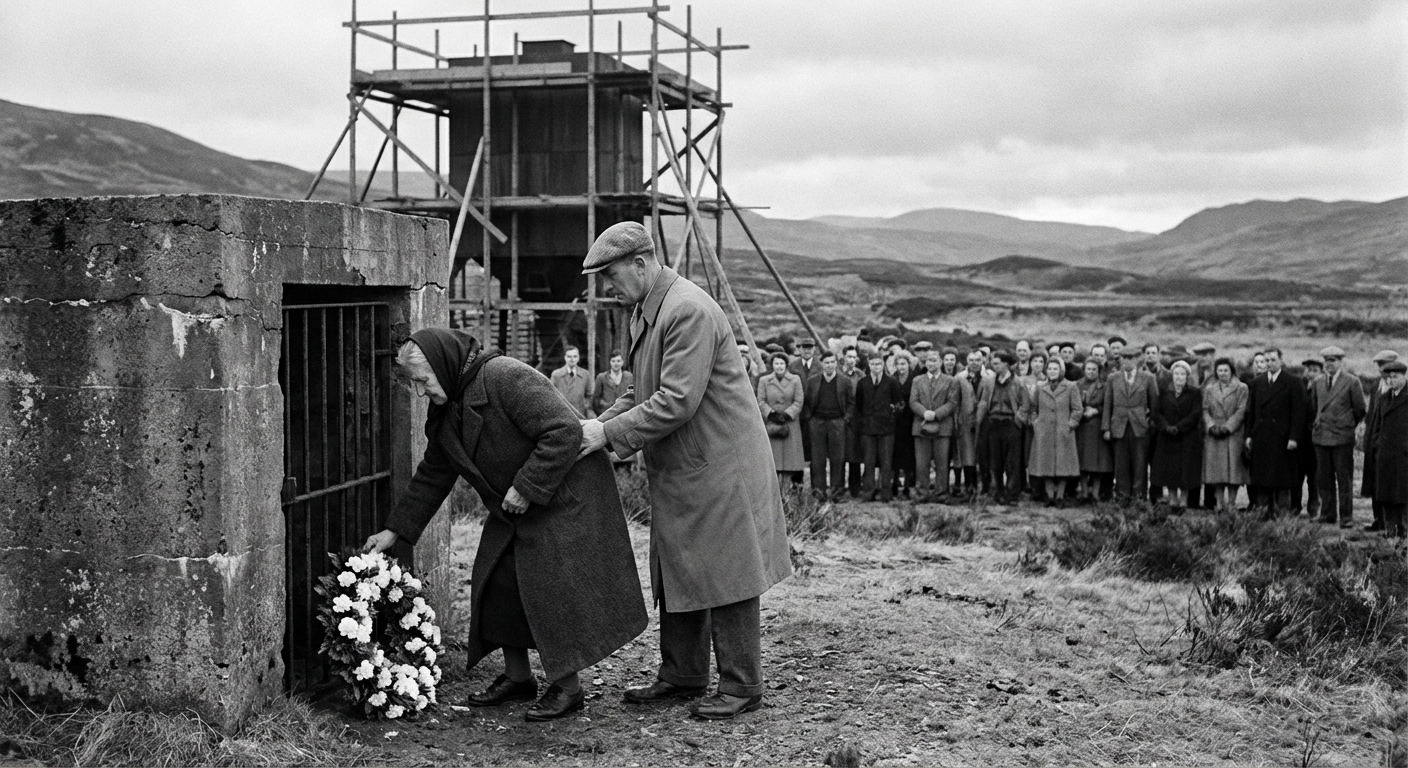
She arrived at half past eight on a cold morning in the Greymoor Highlands, driven from Edgeminster by her son Michael as she has been driven every year for as long as he can remember. The road to Dunvale climbs through open moorland, past the old spoil heaps that have long since greened over, and ends at a turning circle beside the sealed mine entrance where nothing has moved since 1964.
Bess Holloway is eighty-one. She walks with a stick now, and Michael held her arm across the uneven ground to the entrance. She carried the wreath herself — white chrysanthemums, as always, tied with a length of plain cotton.
She placed the flowers against the concrete that sealed the shaft. She stood for a moment. She said nothing, or nothing that anyone standing nearby could hear.
Behind her, steel scaffolding rose thirty feet into the air — the first visible sign of the national memorial that Parliament approved in February and that Ines Cavallo is building from bronze and Greymoor granite. The foundation work is well underway. The forty-one figures that will ascend the memorial staircase are being cast in Port Caravel.
“He can see it going up,” Mrs Holloway said afterwards, gesturing toward the shaft. “I think he’d have found it embarrassing, if I’m honest. Arthur didn’t like a fuss.”
The Anniversary
The Dunvale mining disaster of 14 March 1963 killed forty-one men when No. 3 shaft collapsed at ten minutes past six in the morning, three hours into the day shift. The subsequent inquiry found inadequate shoring in the lower galleries. Seven survivors were pulled from the rubble over eleven days of rescue operations. One company director was convicted of gross negligence and served eighteen months.
The mine closed in 1964. The Mining Safety Reform Act followed in 1965, establishing the Inspectorate of Mines. The settlement itself emptied over the following decade, and Dunvale today is a place of sheep and wind and long memory.
Approximately forty people gathered at the mine entrance on Saturday — families of the dead, a handful of former miners from Edgeminster and the Highland villages, a representative from the Inspectorate. Michael Holloway, sixty-five, a retired miner himself who spent thirty-one years at Edgeminster colliery, read the forty-one names aloud from a card he keeps in his wallet.
“I was two years old,” he said. “I don’t remember him. I remember her remembering him. That’s not the same thing, but it’s what I have.”
The Memorial
Construction on the memorial began in late February. The site, on the slope above the sealed shaft, will feature Cavallo’s ascending figures — each roughly two-thirds life size, each carrying a miner’s lamp — climbing a granite staircase that rises from the valley floor toward the ridgeline. At the top, the staircase ends. There is no figure at the summit. Cavallo has said this is deliberate: “They did not arrive.”
The bronze casting is underway in Port Caravel. Cavallo expects the first figures to be installed by midsummer, with the full memorial complete by autumn. Total cost: approximately 1.2 million florins, funded by parliamentary allocation and private subscription.
Mrs Holloway says she will return for the dedication.
“I’ve been coming here for sixty-three years,” she said. “I can manage one more.”