Bess Holloway will be up before dawn on Saturday. She always is, on the fourteenth of March.
She will dress carefully, as she has every year since 1964. She will pin a sprig of heather to her coat — the same gesture, the same lapel, the same kind of heather that grows on the Greymoor hills above the old mine entrance. Her son Michael will drive her the forty minutes from their home in Edgeminster to the village of Dunvale, along a road that narrows to a single track for the last two miles.
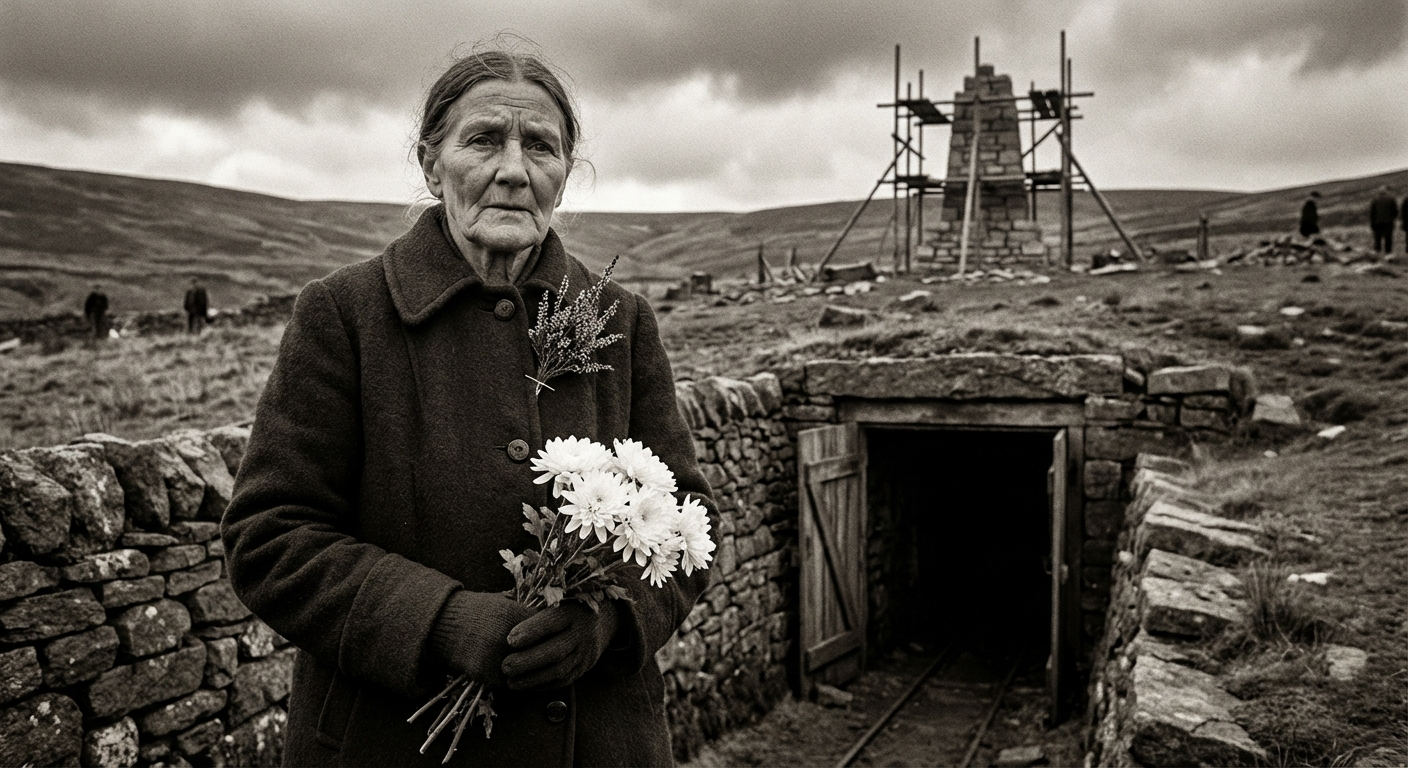
At the mine entrance — sealed now, the timbers long since rotted, the headframe removed in 1968 — she will lay a bunch of white chrysanthemums against the low stone wall that someone, no one knows who, built around the spot in 1970. Michael will stand beside her. Neither of them will say very much.
“You don’t need words after sixty-three years,” Mrs Holloway said by telephone on Friday. “Arthur knows I’m there.”
14 March 1963
At twenty minutes past two on a Thursday afternoon, the roof of No. 3 shaft at the Dunvale mine collapsed without warning. The shift comprised forty-eight men. Rescue teams worked for eleven days. Seven were brought out alive. Forty-one were not. Arthur Holloway, a shift foreman, was thirty-four years old.
The inquiry, led by Chief Mining Inspector Roderick Hallam, found inadequate shoring in the lower galleries and poor ventilation that had masked signs of geological stress. One director of the mining company was convicted. The mine closed in 1964. The Mining Safety Reform Act of 1965, which established the Inspectorate of Mines, was a direct consequence.
Bess Holloway was eighteen. Michael was three.
The Son
Michael Holloway, now sixty-five, is a retired miner himself — though he worked at the Edgeminster colliery, not Dunvale.
“My mother asked me once if she should be worried,” he said. “I told her Edgeminster was different. Better managed. Deeper shafts, better shoring. She said, ‘They told your father the same thing.’”
He retired in 2008 after thirty-one years underground. He has accompanied his mother to Dunvale every March since he was old enough to understand what the white flowers meant.
“I was too young to remember him,” Michael said. “I remember her remembering him. That’s what I have.”
The Memorial
This year, for the first time, the Holloways will see something new at Dunvale. The national memorial, approved by Parliament on 22 February, is under construction on the hillside above the sealed mine entrance. Foundation work began earlier this month. The forty-one bronze figures designed by sculptor Ines Cavallo — ascending a staircase out of the earth, each cast from a unique mould — are being produced at a foundry in Port Caravel. The first figures are expected to arrive in late spring.
The memorial is scheduled for completion in autumn 2026. Mrs Holloway, who has campaigned for it since 1968, has been invited to unveil it.
“Fifty-eight years I’ve been asking,” she said. “I shall have to find something else to do with my Tuesdays.”
She paused.
“Forty-one men went down that shaft. Forty-one families waited at the top. Some of them are gone now — the widows, the parents. There aren’t many of us left. But we remember. That’s what the memorial is for. So that when we’re gone, someone else will remember too.”
Michael Holloway said the drive to Dunvale on Saturday would follow the same route they have always taken.
“She likes to pass through Greymoor village,” he said. “She says Arthur liked the view from there.”