
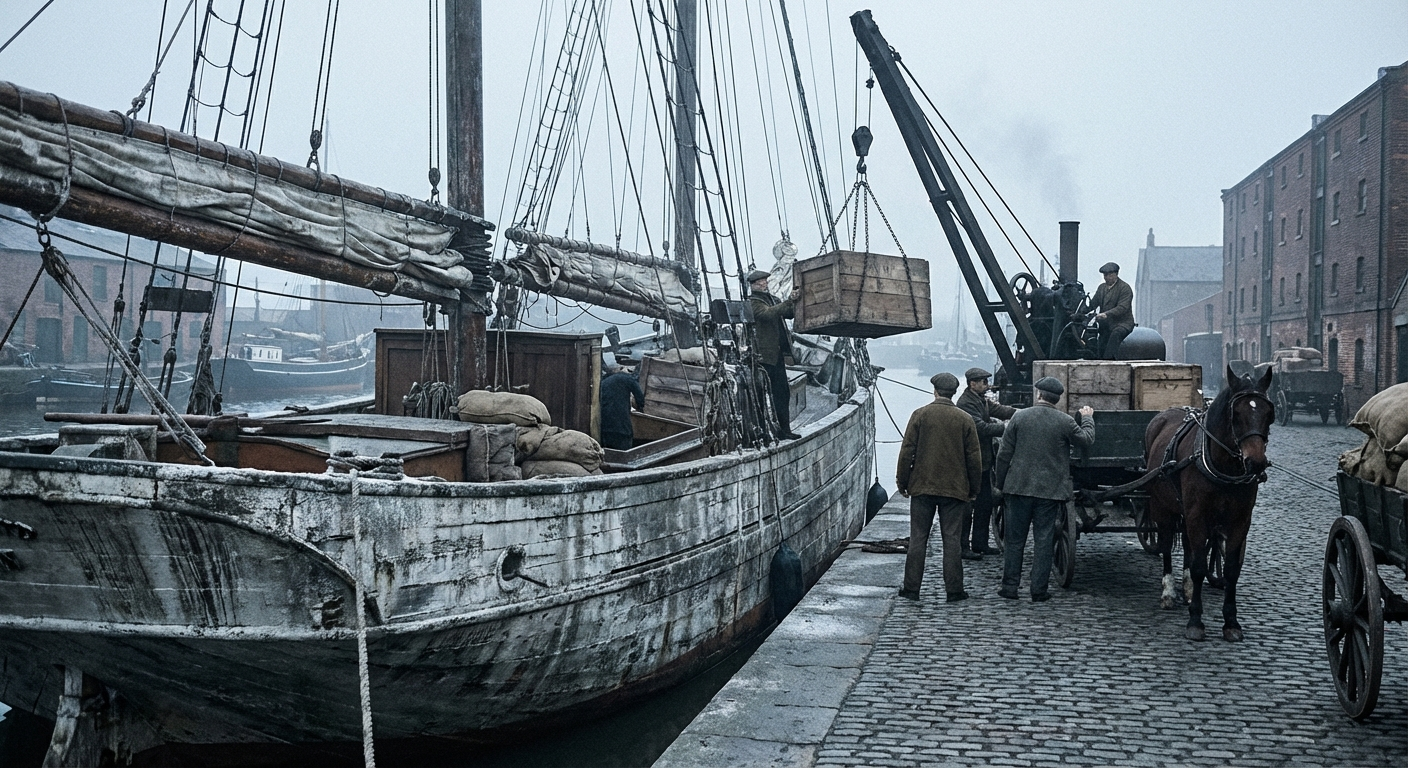
The Fernleigh Cross came alongside Quay Nine at twenty past six on Friday morning — larger than the Aldara, heavier in the water, and carrying in her holds the consignment that the Spice Crisis Committee has been tracking across fourteen thousand miles of ocean since she left Thessara on 18 February.
Captain Edith Varne, a compact woman who has commanded the Fernleigh Cross for three years and navigated the Cape of Sarenne passage in weather that delayed her arrival by two days, said little on the quayside beyond confirming that her cargo was intact.
“Twenty-two days via Sarenne,” Varne said. “We had heavy weather south of the Cape and sheltered in harbour here for the gales. The cargo is complete. May I go to bed?”
She may. The cargo is rather more talkative.
The Numbers
Four hundred and eighty pounds of eastern spice across twenty-two varieties — roughly four times the Aldara’s delivery on Thursday and the largest single eastern spice cargo to reach Bobington since the Kaelmar Strait was effectively closed to commercial traffic three weeks ago.
The headline figure: 42 pounds of velveroot. The city’s total velveroot supply stood at 29 pounds as of Wednesday’s audit — a quantity that the Spice Crisis Committee estimated at two to three weeks’ supply under rationing. The Fernleigh Cross more than doubles it to approximately 71 pounds.
“Seventy-one pounds of velveroot is not abundance,” said Haroun Nazari, the committee chairman, who was at Quay Nine by 7:00 AM to observe the unloading. “But it is breathing room. Two weeks ago, we were measuring the city’s supply in days. Now we are measuring it in weeks. That is a different kind of problem.”
The cargo also includes substantial quantities of black cardamom (65 pounds), dried saffron bark (48 pounds), golden peppervine (38 pounds), and smoked coriander seed (72 pounds) — the five most traded varieties on the Bramblegate Exchange, all of which have been under acute pressure since late February.
The Market
The Eastern Spice Index opened Friday at 328 — down from 336 on Thursday’s close, its sharpest single-session decline since the crisis began and its lowest level since 22 February, the day after the Fernwick Bridge closure temporarily distracted the city from its other problems.
The decline reflects the convergence of three forces: the Fernleigh Cross delivery, the Aldara’s arrival on Thursday, and the diplomatic optimism generated by the quiet channel’s second session and the Kharstad Gazette’s editorial endorsement.
“What you are seeing is the difference between scarcity and shortage,” said Marta Engel, the committee’s wholesale broker. “Scarcity is: we do not have enough and we cannot get more. Shortage is: we do not have enough but more is coming. We have moved from the first to the second.”
Two additional Sarenne-rerouted vessels are expected within the fortnight. If the Kaelmar Strait reopens to commercial traffic — a possibility that the quiet channel’s joint statement has made more plausible, though by no means certain — the first direct shipments could reach Bobington within ten days of reopening.
The Cap and the Holdouts
The Spice Crisis Committee’s allocation framework — existing restaurant clients first, retail second, at prices within the 250 per cent cap — will apply to the Fernleigh Cross cargo as it applied to the Aldara’s. Nazari confirmed that distribution would begin Monday after the committee completes its assessment of member inventories.
The six non-Guild merchants selling above the cap remain the committee’s frustration. The emergency pricing ordinance petition — referred to the Commerce and Consumer Affairs Committee by Council Speaker Falk on Thursday — has not yet been scheduled for consideration.
“We have asked politely,” Nazari said. “We have asked formally. The Council has the petition. In the meantime, a family in the Docklands pays three times what a family in Midtown pays for the same jar of saffron bark, because one shops at a Guild merchant and the other does not. This is not a market inefficiency. It is an injustice.”
Simeon Kade of The Willow Table, who pulled his braised lamb shoulder from the menu three weeks ago, said he expected to restore it “within a week, perhaps less” once the committee allocated his restaurant’s velveroot share.
“It won’t be the same dish,” Kade said. “The velveroot will be rationed. But my customers will see it on the menu and understand that things are moving in the right direction.”
The Route
The Cape of Sarenne route that brought both the Aldara and the Fernleigh Cross to Bobington adds twelve to fifteen days to the standard eastern passage through the Kaelmar Strait. The additional voyage costs — fuel, crew, insurance, wear — add approximately 30 to 40 per cent to the landed price of goods, a surcharge that the Merchants’ Guild estimates at 1.8 million florins across the fourteen vessels currently rerouting.
These costs will persist as long as the strait remains closed. The quiet channel may produce a diplomatic resolution; it has not yet produced an open waterway. But on the quayside at Quay Nine on Friday morning, the calculations were simpler than the diplomacy. There were 480 pounds of spice on a ship, and by Monday there would be spice on the shelves of merchants who had been counting their reserves in tablespoons.
Captain Varne, it was confirmed, did make it to bed.