
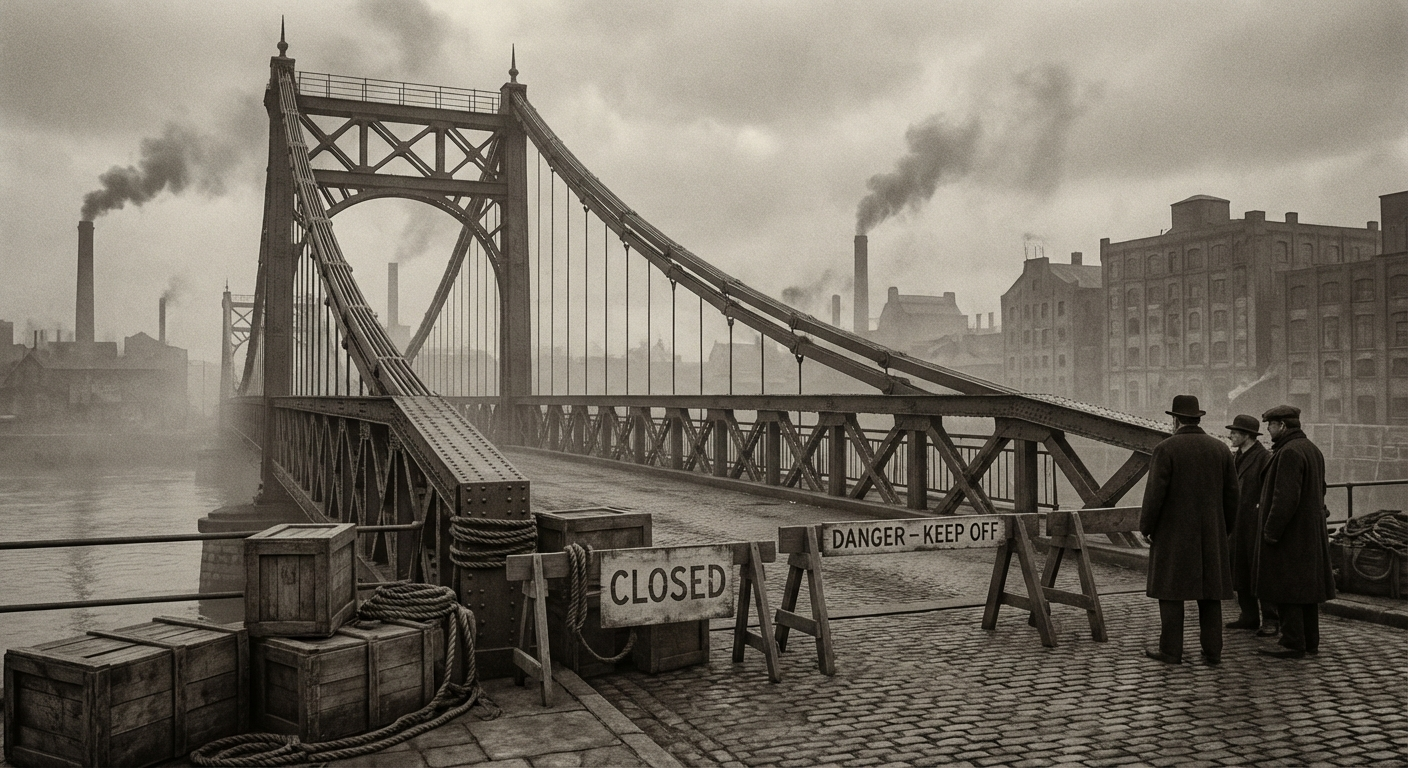
The Fernwick Bridge is closed, and nobody knows for how long.
Municipal engineers shuttered the 112-year-old iron crossing over the River Ashwater at half past four on Friday afternoon — squarely in the middle of the evening rush — after a routine inspection revealed stress fractures in three of the bridge’s four main suspension cables. The closure was immediate and, according to Chief Municipal Engineer Dorothea Kinnear, non-negotiable.
“The fractures are consistent with long-term metal fatigue exacerbated by corrosion,” Kinnear said at a hastily arranged press conference outside the Municipal Works depot on Havelock Road. “We cannot in good conscience allow vehicle or pedestrian traffic until a full structural assessment is completed.”
The bridge, which opened in 1914, carries an estimated 14,000 commuters daily between the residential streets of Thornhill and the commercial heart of Bramblegate. It is the most direct route between the two districts for anyone who does not wish to add twenty-five minutes to their journey via the Coldharbour Viaduct to the north or the Lower Ashwater footbridge to the south — the latter of which does not permit motor traffic.
Commuter Chaos
By Saturday morning, the consequences were already visible. The Coldharbour Viaduct, designed for roughly 8,000 crossings per day, was handling nearly double that figure. Tram services on the Number 7 line, which crosses the Ashwater via its own bridge at Millgate, reported carriages packed beyond capacity from six o’clock onward. The Transit Authority announced Saturday afternoon that it would add four supplementary tram services on the Number 7 route beginning Monday, though officials acknowledged this was “a plaster, not a cure.”
“I’ve lived in Thornhill thirty-one years,” said Marjorie Dunwell, a retired schoolteacher waiting for the 7A tram at Bramblegate terminus. “That bridge has always been there. You don’t think about it until you can’t use it.”
The Fernwick Bridge has been inspected annually since the Municipal Infrastructure Act of 2008, which was itself prompted by the partial collapse of a rail overpass in Greymoor. Kinnear confirmed that no previous inspection had flagged the cable fractures, raising questions about either the rate of deterioration or the thoroughness of earlier assessments.
The Assessment
Kinnear’s team has engaged Hallam & Stroud, the engineering consultancy that oversaw the reinforcement of the Coldharbour Viaduct in 2019, to conduct an independent structural assessment. The firm’s senior partner, Malcolm Stroud, visited the site on Saturday morning and estimated the assessment alone would take three to four weeks.
“The question isn’t whether the cables need replacing,” Stroud told reporters. “It’s whether the towers and anchorages can support the loads during replacement, or whether we’re looking at a more fundamental reconstruction.”
If full cable replacement is required — the most optimistic scenario — the bridge could reopen in four to six months. If the tower foundations are compromised, the timeline extends to eighteen months or more, and the cost could exceed 40 million florins.
Councilman Aldric Voss, whose Thornhill constituency relies heavily on the crossing, called the closure “a reminder that Bobington’s infrastructure is ageing faster than we are repairing it.”
“We are about to spend three billion florins on a new tramway,” Voss said. “I support that project. But we cannot build the future while the present is falling into the river.”
The Municipal Works Office said it would provide daily updates on the assessment’s progress. In the meantime, 14,000 commuters are learning new routes — and developing new opinions about the Number 7 tram.