
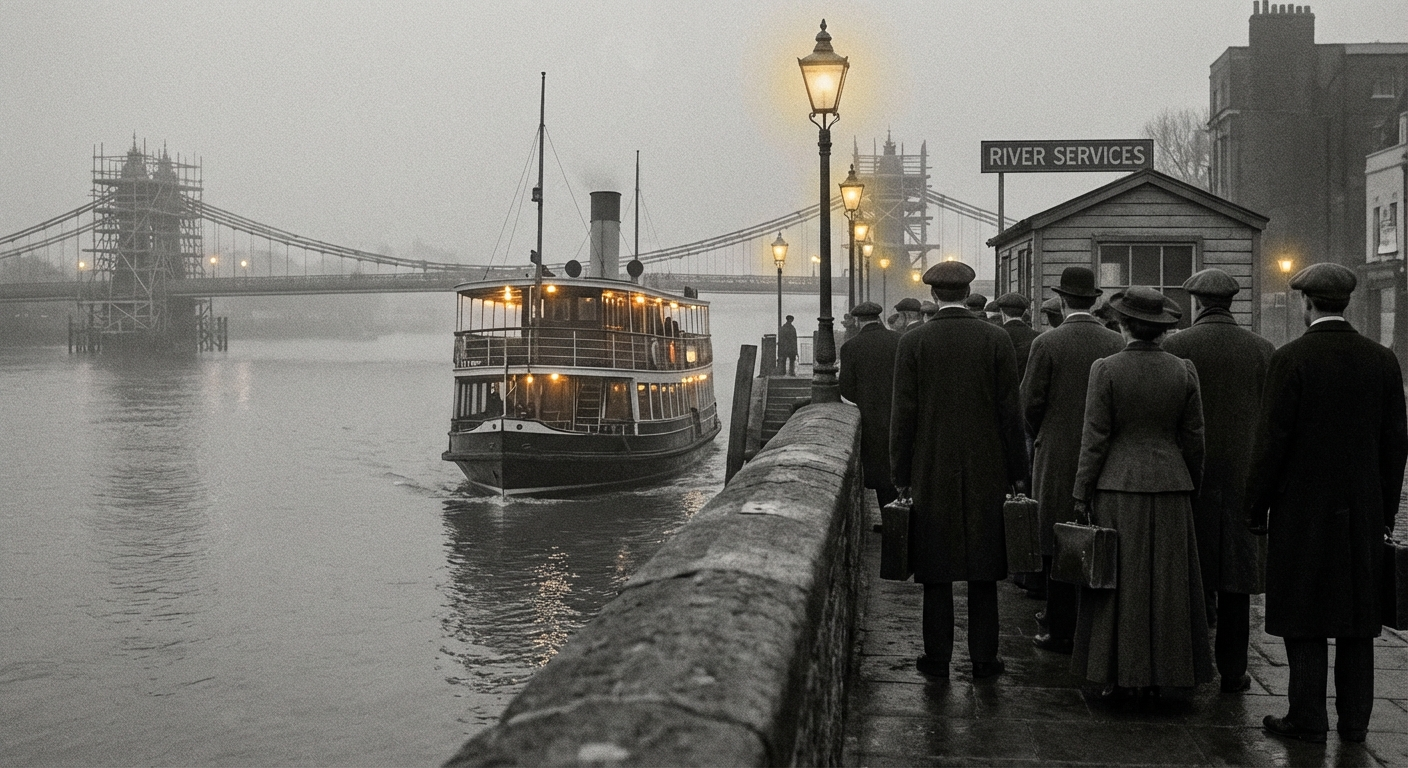
The queue began forming at a quarter to five. It was still dark, and a thin fog sat on the Ashwater, and the Thornhill Star was a shape of running lights at her mooring when the first commuters arrived at Thornhill Reach with their monthly passes and their patience and the particular expression of people who have been taking the long way round for twelve days and do not intend to do so for a thirteenth.
Estelle Danforth was third in line. She had her pass — number 0047, purchased Thursday — in her coat pocket. She works as a bookkeeper in Upper Fernwich. For the past twelve days, her journey has involved the Coldharbour Viaduct, a pavement designed for three abreast and used by thirty, and an additional forty minutes of walking in each direction.
“I set my alarm for four-thirty,” she said. “I wasn’t going to miss this.”
At 5:45, the deck lights of the Thornhill Star came on. At 5:52, the crew opened the boarding gate on the floating pontoon. At 5:58, the gangway was lowered and passengers began filing aboard — orderly, almost reverential, as if the act of boarding a ferry at dawn required a certain seriousness of purpose.
At 6:00, precisely, Captain Morris Aldgate sounded the horn once. The lines were cast off. The Thornhill Star drew away from Thornhill Reach into the grey morning, carrying 193 passengers on a fourteen-minute crossing to Bramblegate Steps.
The Crossing
The Ashwater at dawn is not a wide river — perhaps 200 metres at the Fernwick crossing — but it has been, for twelve days, an impassable one. The iron bridge that carried 14,000 people daily across it sits upstream, silent, its four fractured cables wrapped in weather sheeting. From the deck of the Thornhill Star, its dark shape was visible against the lightening sky: a bridge that was, and is not, and will be again.
The crossing took fourteen minutes. The fog thinned as the ferry passed midstream. Bramblegate Steps materialised from the far bank — the floating pontoon installed last week, the ticket office in a converted harbourmaster’s shed, and a second queue of passengers waiting for the return crossing.
When the Thornhill Star touched at the pontoon, there was a scattering of applause — not orchestrated, not especially loud, but unmistakable. The gangway came down. Passengers filed off, turned left toward Bramblegate Market and the city beyond, and within sixty seconds the first return passengers were boarding.
Gwen Alderly, managing director of Ashwater River Services, had watched the departure from the Thornhill embankment. When the vessel touched at Bramblegate, she allowed herself a small nod.
“Textbook,” she said. “Fourteen minutes, clean mooring. Now we do it sixty-four more times today.”
The Morning Rush
By 7:00 AM, the queue at Thornhill Reach stretched thirty metres. By 8:00, it reached fifty. The ferry was departing at its scheduled fifteen-minute headway, carrying between 180 and 210 passengers per crossing, but peak demand outstripped capacity by a factor the transport planners had anticipated but which commuters experienced as a twenty-to thirty-minute wait in the cold.
Marjorie Dunwell, the retired schoolteacher who has lived in Thornhill for thirty-one years, was not among the morning rush. She arrived at 9:15 for what she described as “a crossing, not a commute.”
“I haven’t been to Bramblegate Market since the bridge closed,” she said. “I could take the viaduct, but my knees and I came to an agreement about that hill some years ago. The ferry suits us both.”
At the Bramblegate terminus, traffic flowed smoothly through the morning. The ticket office reported brisk single-fare sales — thirty centimes, exact change appreciated — alongside a steady stream of monthly pass holders whose cards were checked by a crew member at the gangway. By noon, Ashwater River Services confirmed that the service had completed twenty-four crossings and carried 4,160 passengers, with no mechanical issues and no safety incidents.
The Bridge Tender
Chief Municipal Engineer Dorothea Kinnear confirmed Friday that the tender process for Fernwick Bridge cable replacement will open on Monday — the same day the council debates the tramway commission’s report. Three engineering firms have expressed interest. The estimated repair cost of 55 to 65 million florins will be drawn from the municipal capital reserve.
“The bridge and the tramway will compete for the city’s attention on Monday,” Kinnear observed. “They need not compete for its resources. These are separate budgets, separate processes, and separate timelines.”
The cable manufacturer search has expanded beyond the original supplier — a Verlaine firm that ceased operations in 2019. Kinnear’s team has identified two potential manufacturers, one domestic and one in the Ashford Republic.
The Evening
By 6:00 PM, with the service running for twelve hours, the Thornhill Star had completed forty-eight crossings and carried approximately 8,200 passengers — comfortably within the 6,000-to-8,000 range that transport planners had projected. Peak-hour queues moderated through the afternoon and were minimal by early evening.
The Bramblegate Belle, the backup vessel held at depot, was not called into service.
Alderly, reviewing the day’s numbers on the Thornhill embankment as the evening crossings continued under floodlight, said she was “satisfied but not complacent.”
“Day one is always good,” she said. “People come because it’s new. The question is what day thirty looks like, and day sixty. The bridge will take eight to twelve months. We have a long way to go.”
The last crossing departs at 10:00 PM. The Thornhill Star will be back at Thornhill Reach by 10:15, moored, cleaned, and readied for 6:00 AM on Saturday. The river is no longer an obstacle. It is, for the first time in nearly two weeks, a crossing.