
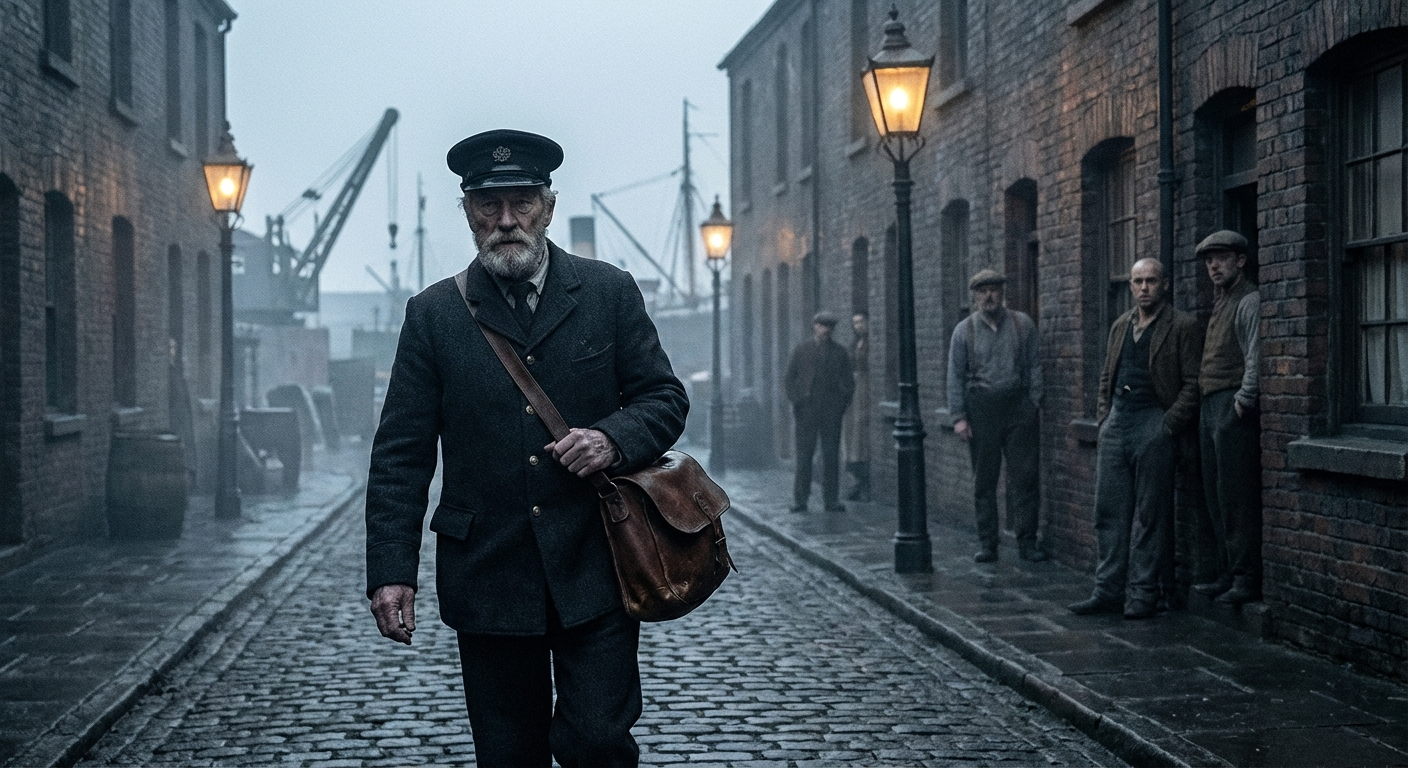
He left the Docklands Post Office at seven minutes past six, as he has done every working morning since the autumn of 1993. His postbag was full. His shoes were polished. The February air was cold and still and smelled, as it always does near the water, of salt and diesel and the first suggestion of the day’s bread from Helmsford’s on the corner.
Albie Finch did not make a speech. He did not pause at the threshold. He simply picked up his bag, nodded to Postmaster Gullick, and walked out into the dark.
“Same as every other morning,” Gullick said afterwards, his voice not entirely steady. “That’s Albie. He’d have been embarrassed by a fuss.”
There was a fuss anyway.
By the time Finch reached Chandler’s Row — the first leg of Round 14, the route he has walked some eight thousand times — there were people on their doorsteps. Not many. It was barely half past six. But enough. Mrs Carmody at number eleven had a tin of shortbread. Old Mr Pettigrew, who has not been downstairs since November, was at his window with a hand raised.
Finch delivered their letters, accepted the shortbread, returned the wave, and moved on.
“He knows every door on this round,” said Maisie Hollander, 24, who has been shadowing Finch since Monday and who walked beside him for the last time on Friday. “Not just the addresses. He knows which letterboxes stick. He knows which dogs bark. He knows who’s been ill and who’s had a baby and who hasn’t collected their post in a week.”
Hollander paused. “I’ve been writing it all down. I’ll never get it all.”
Thirty-Three Years
Albert Finch began walking Round 14 on the 4th of September 1993, the same week his son David started school. He was twenty-eight. The Docklands was rougher then — the wharf fires of the early nineties had left whole blocks vacant, and the postal service had considered merging Round 14 with adjacent routes for lack of addresses.
Finch argued against it. The people who remained, he said, needed their post more, not less.
In the decades since, he has delivered through snowstorms and dock strikes, through the floods of 2004 and the long hot summer of 2017 when the post office issued sun hats that no one wore. He has carried wedding invitations and condolence cards, tax demands and love letters, parcels from Caldwell and the occasional package from as far away as the Ashford Republic that smelled, unmistakably, of cheese.
He has never lost a letter. He has never taken a sick day, though his wife Joan once hid his shoes when he attempted to deliver post while delirious with pneumonia.
“She said she’d burn them,” Finch told this reporter, with the expression of a man who believed her. “I stayed home.”
The Doorsteps
Word had spread by mid-morning. When Finch reached Pilot’s Alley at half past nine, a small crowd had gathered at the junction — perhaps thirty people, some with children, some who had clearly left work to be there.
Patrick Seldon, the dockworkers’ foreman who had testified before the Copper Review Commission earlier this week, was among them. He shook Finch’s hand and said something that made the postman laugh. Neither would repeat it.
“Albie’s the one constant,” Seldon said. “Governments change, work comes and goes, buildings burn down. The post arrives.”
There were cards. A great many cards — a peculiarly appropriate tribute for a postman. A hand-drawn portrait from a child on Harbourfront Parade. A bottle of something from the chandler’s shop. A formal letter of thanks from the Docklands Residents’ Association, signed by forty-seven households.
Finch read none of them on the spot. He put them in his bag alongside the outgoing post and continued his round.
The Last Door
The final delivery was to number 9 Lower Harbourfront Parade, a boarding house run by a Mrs Tolliver, who has received her post from Finch for twenty-six years. She was waiting at the door.
“Just a circular today, Mrs Tolliver,” Finch said, handing her a leaflet for a furniture shop.
“That’ll do,” she said.
They stood for a moment in the particular silence of two people who have exchanged small courtesies across a threshold for a quarter of a century and now will not. Then Finch touched his cap and walked back to the post office with an empty bag.
Gullick was waiting. The staff — all seven carriers — had assembled in the sorting room. There was tea, and a cake that someone had ordered from Helmsford’s with “ROUND 14” iced across the top, and a presentation clock that Finch accepted with visible discomfort and genuine pleasure.
“Thirty-three years,” Gullick said. “The most reliable man I have ever worked with.”
Finch thanked them, drank his tea, washed his mug, hung his bag on its peg, and went home to Joan.
Maisie Hollander will begin Round 14 on Monday. She has a new pair of shoes and a notebook full of Finch’s instructions. She knows which letterboxes stick and which dogs bark.
The rest, she will learn by walking.