
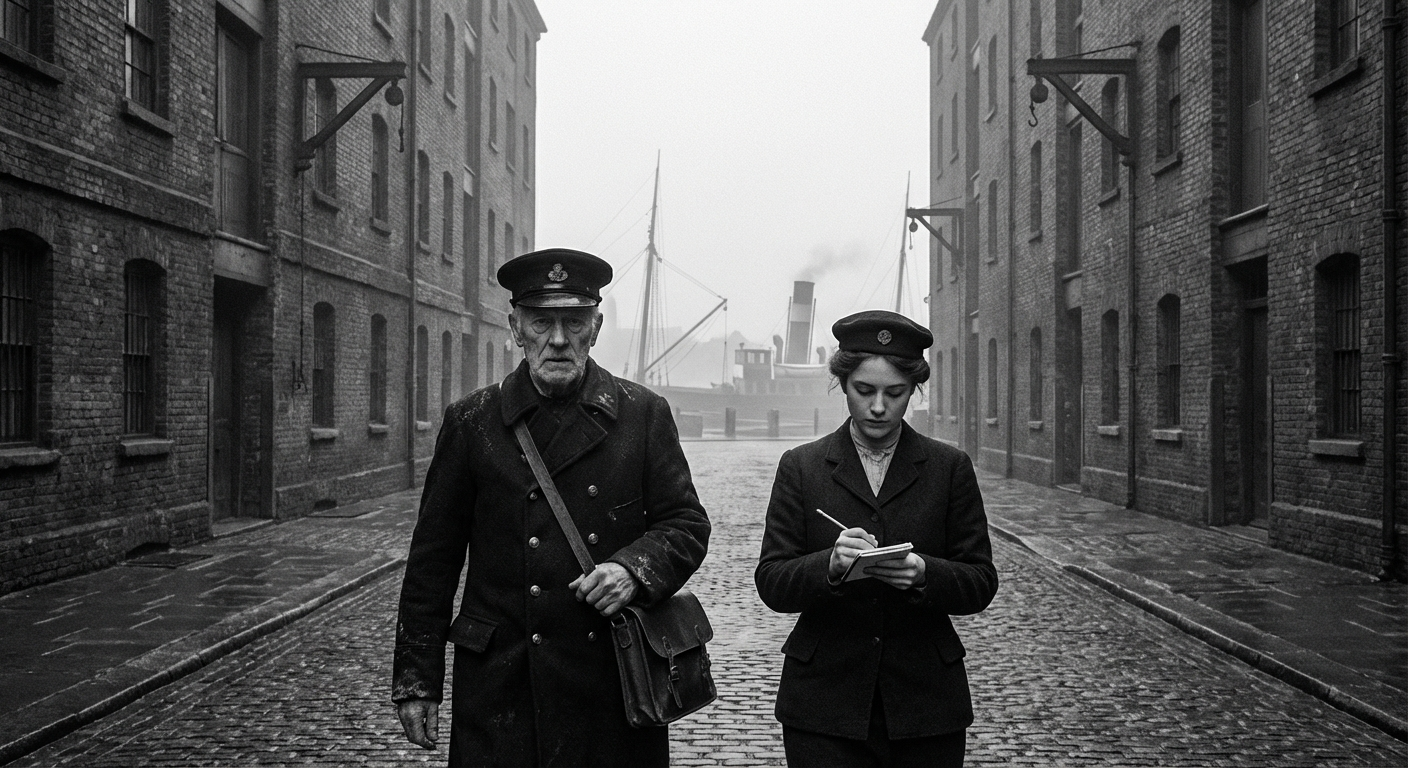
Albert Finch left the Docklands Post Office at twenty past seven on Wednesday morning, as he has done every working day since 1993. His satchel was full. His shoes were polished. His replacement walked beside him.
Maisie Hollander has been shadowing Finch since Monday. She is twenty-four years old, transferred from the Caldwell Central Sorting Office, and she carries a small notebook in her left coat pocket in which she writes things down.
On Monday, the notebook contained addresses and delivery sequences. By Wednesday, it contained something else entirely.
“Mrs Danbury, 14 Pilot’s Alley — gate sticks from the left, push from the right,” Hollander read aloud, consulting her notes as they approached the narrow turning. “Cat at Harrowgate Pier — grey, one ear, expects the crust from the roll at ten o’clock.”
“That’s the shape of it,” Finch said.
The Round
Docklands Round 14 covers Chandler’s Row, Pilot’s Alley, the lower stretch of Harbourfront Parade, and nineteen connecting streets, lanes, and alleyways between the river and the old warehouses. It is not the longest round — Round 9, which extends to Harrowgate Pier and back, covers more ground — but it is arguably the most intricate, threading through a district where streets change character every fifty yards and half the addresses are reached by routes that do not appear on any official map.
Finch has walked it 10,559 times. He has delivered, by his own careful estimate, approximately 1.2 million pieces of mail. He has never lost a letter. He has worn out thirty-one pairs of shoes, though he disputes the number (“Thirty. One pair was resoled, which doesn’t count”).
On Wednesday, his second-to-last day, he walked the round with the deliberation of a man showing someone the inside of a house he built himself.
What a Map Cannot Teach
At the corner of Chandler’s Row and the unnamed alley behind the sail loft, Finch stopped. “This is where you save four minutes,” he said, gesturing toward a narrow passage between two buildings. “The official route goes round by the Parade. But if you cut through here, you come out behind the Vesely stall, and you can do Pilot’s Alley from the top.”
Hollander peered into the passage. “Is it on the route guide?”
“It is not on the route guide,” Finch said. “It is on the round.”
At the Bramblegate Fish Market, Finch introduced Hollander to Orna Vesely, who has run the smoked-fish stall for twenty-eight years and whose post, by long-standing arrangement, is delivered first because she arrives before dawn.
“This is Maisie,” Finch said. “She’ll be looking after you from Saturday.”
Vesely looked Hollander up and down. “Does she know about the gate?”
“She knows about the gate.”
Vesely nodded and handed Hollander a piece of smoked mackerel wrapped in newspaper. “Welcome to Round 14.”
The Notebook
By midday, Hollander’s notebook contained thirty-seven entries. Some were practical: which letterboxes are stiff, which doorbells don’t work, which buildings have been subdivided since the Post Office last updated its records. Others were personal: which residents are elderly and live alone and appreciate a word through the door; which dogs are friendly; which dogs are not.
“You’ll add your own,” Finch told her. “Every postman’s round is different, even when it’s the same streets.”
Hollander, who is quiet and observant and appears to possess an exceptional memory, said the Docklands were different from the Caldwell sorting office. “In Caldwell, the mail is numbers,” she said. “Here, it’s people.”
Finch smiled — the first time this correspondent had seen him smile all morning. “Now you understand.”
The Last Days
Thursday will be Finch’s final full round. On Friday morning, there will be a small ceremony at the Docklands Post Office — Postmaster Arthur Gullick has arranged tea and cake, and several longtime residents of Round 14 have indicated they will attend.
Finch said he was not sentimental about it. His wife Joan, he noted, has already made plans for his retirement that do not involve lying in.
“She’s got a list,” he said. “Longer than Round 14.”
But as he turned the corner onto Harbourfront Parade on Wednesday afternoon, his satchel nearly empty, he paused for a moment and looked back the way they had come — down the narrow street, past the sail loft, past the fish market, toward the river.
Hollander waited. Finch adjusted his cap and walked on.
One more round.