
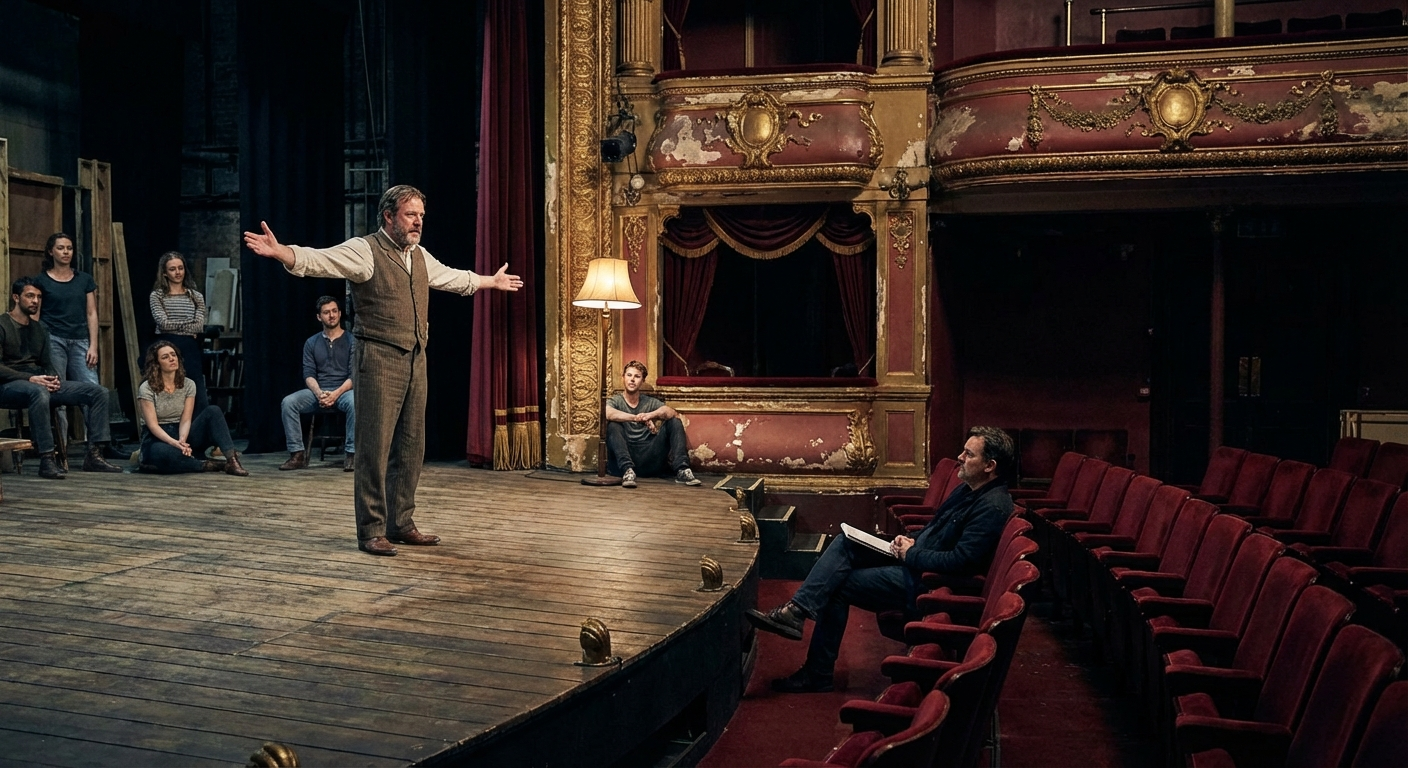
There is a moment in the second act of The Lamplighter’s Oath when Edmund Vale, Bobington’s first superintendent of lamps, stands before the City Council and asks them why light should stop at Caldecott Square. Why the gas mains run to the homes of merchants and aldermen but not to the streets where the people who clean those homes and serve those aldermen actually live. It is, in Augustin Fell’s script, the scene on which the entire play turns.
On Monday afternoon, Thomas Ashworth found it.
Not on the first attempt. Fell stopped the scene at the top of Vale’s speech three times. The first, Ashworth was too measured — the schoolteacher in him reaching for reasonableness when the character demanded something rawer. The second, he overcorrected, pushing toward theatrical rage that felt borrowed rather than earned.
The third time, Ashworth stood still for several seconds before speaking. When the words came, they were quiet. The anger was not in the volume but in the precision — each syllable placed like a man laying a charge he fully intends to detonate.
“There,” Fell said from the fourth row. “That’s him. That is Edmund Vale.”
The cast, scattered across the stage in their rehearsal positions, went very still. Nessa Holloway, who plays Vale’s daughter Clara, later said she forgot she was acting. “I just listened,” she said. “That’s the scene. That’s the whole play.”
The Second Week
Rehearsals for The Lamplighter’s Oath entered their second week on Monday with the cast working through the play’s central passages for the first time with full blocking. The production, which opens on 10 April, has the compressed schedule of a theatre that cannot afford leisurely preparation — Fell has six weeks between first read-through and opening night, which is tight by any standard and perilous by his own admission.
“We cannot be precious about process,” Fell said during a break. “We have to find the play by doing it. Every night, the actors go home knowing a little more about who these people are. That is the only method available to us.”
The Bellvue itself continues its parallel drama of survival. Fundraising stands at 95,000 florins of the 180,000 needed for fly tower repairs, with the 1 May deadline now nine weeks away. The Marchmont Street Traders’ Association has collected 4,200 florins through its door-to-door campaign, and private donations continue to arrive — several anonymous, one accompanied by a handwritten note that read only: “For the light.”
The Benefit Night
Tickets for the 15 March benefit night — at which former Bellvue alumnus Ruben Glass will appear in person for the first time since departing for Caldwell — went on sale Monday morning. Fell reported that by lunchtime, roughly half of the theatre’s 380 seats had been reserved.
Glass, now a fixture of the Caldwell stage, got his start at the Bellvue in 2011 with The Ferryman’s Wife. His return carries both nostalgia and practical significance: a full house at benefit prices would raise an estimated 6,000 to 8,000 florins, depending on the programme of readings and scenes Glass selects.
The Arts Council’s emergency heritage grant decision, which could provide a substantial portion of the remaining shortfall, remains pending. Fell said he had been told to expect a decision “this week or next.”
What Remains
The play is not yet whole. Monday’s breakthrough in the Council scene does not mean every scene has found its footing — the third act, in which Vale walks the newly lit streets of the Docklands for the first time, has yet to be rehearsed with the lighting effects that Fell envisions. And the ensemble scenes, involving all eleven cast members, will not be attempted until next week.
But something shifted on Monday afternoon. A character who existed on paper became a man standing in a room, asking a question that Bobington has been asking in various forms for a very long time: who gets the light, and who decides?
If Ashworth can hold that moment — if Fell can build a production around it — the Bellvue may have the play it needs.