
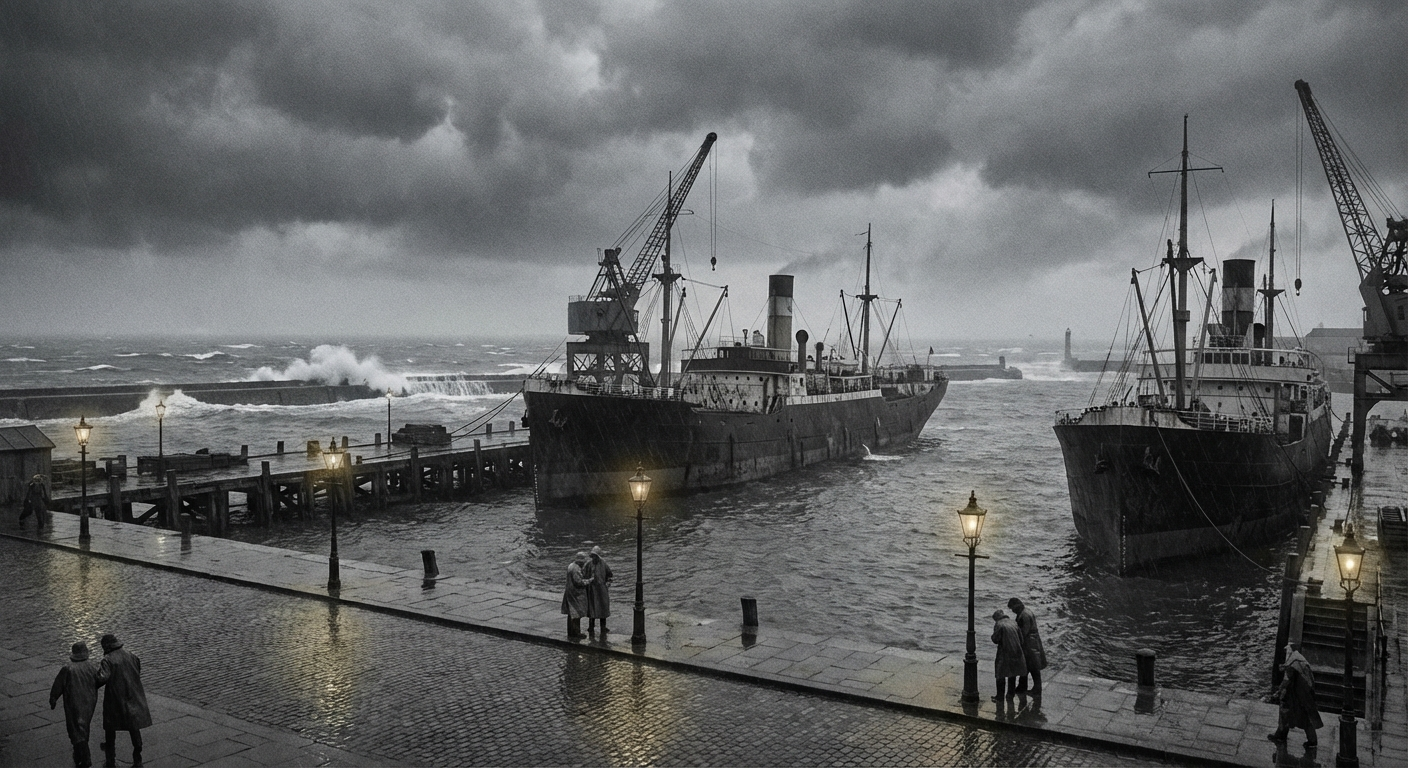
The wind arrived at half past six this morning, two days ahead of the original forecast, and by eight o’clock the harbour cranes had stopped moving.
Three cargo vessels — the Alderman Grey, the Compass Rose, and the Thessarine-registered Pelikan — postponed their departures and moved to sheltered berths in the inner harbour as gusts reached fifty knots across the exposed outer wharves. Harbour Master Cornelius Ashby extended the March gales advisory through Wednesday, upgrading the forecast from “moderate probability of gale-force conditions” to “sustained gale expected, all vessels advised to secure.”
The rain that accompanied the wind turned the Docklands into a study in grey. Tram lines along Harbourfront Parade ran slick with water. The canvas awnings on Ashbury Lane, which the spice merchants have been rolling out against the February sun for a fortnight, were hastily furled.
The Sarenne Complication
The gales’ timing is unfortunate for reasons that extend well beyond wet commuters.
Of the fourteen commercial vessels currently rerouting via the Cape of Sarenne to avoid the Kaelmar Strait, at least three are believed to be in the approaches to the Cape this week. The Sarenne passage, which adds twelve to fifteen days to eastern voyages in fair weather, becomes significantly more hazardous in March storm conditions.
Ashby, speaking from his third-floor office overlooking the harbour, was characteristically measured. “The March gales are annual. They are expected. They are not, in themselves, remarkable,” he said. “What is remarkable is that we have fourteen vessels on a route that no sensible master would choose voluntarily. The weather does not consult the diplomatic calendar.”
The Merchants’ Guild estimates that each additional day of delay costs the rerouted fleet approximately 130,000 florins in fuel, provisions, and lost scheduling. The Spice Crisis Committee, which met this morning at Guild Hall, identified the gales as a complicating factor in its supply projections.
Ferry Preparations
Gwen Alderly, managing director of Ashwater River Services, confirmed that Monday’s planned crew drills for the Thornhill Star were paused due to river conditions. The ferry, which is scheduled to begin passenger service on Friday between Thornhill Reach and Bramblegate Steps, is rated for river operations in moderate weather, but the pontoon at Bramblegate Steps — installed only on Saturday — was being checked for mooring integrity this afternoon.
“The river is not the open sea,” Alderly said. “We are confident in Friday’s launch. But we do not drill crews in conditions that serve no training purpose.”
The backup vessel, Bramblegate Belle, remained at Ashwater River Services’ depot on the Lower Ashwater.
Through Wednesday
Ashby’s extended advisory forecasts gale-force winds continuing through Tuesday night, moderating to strong breezes on Wednesday afternoon. A second system may develop offshore by late in the week, though forecasts beyond Wednesday carry less certainty.
For the Docklands, the gales are a familiar March companion — the Harbour Authority has issued this advisory every year since 1911, when an unpredicted March squall sank two coal barges in the outer harbour. The port knows how to weather a storm.
What it does not know is how to weather a storm while simultaneously running short on eastern spice, negotiating an international crisis, and waiting for a commission report that will determine the city’s infrastructure for a generation.
The wind, at least, is honest about what it is.