
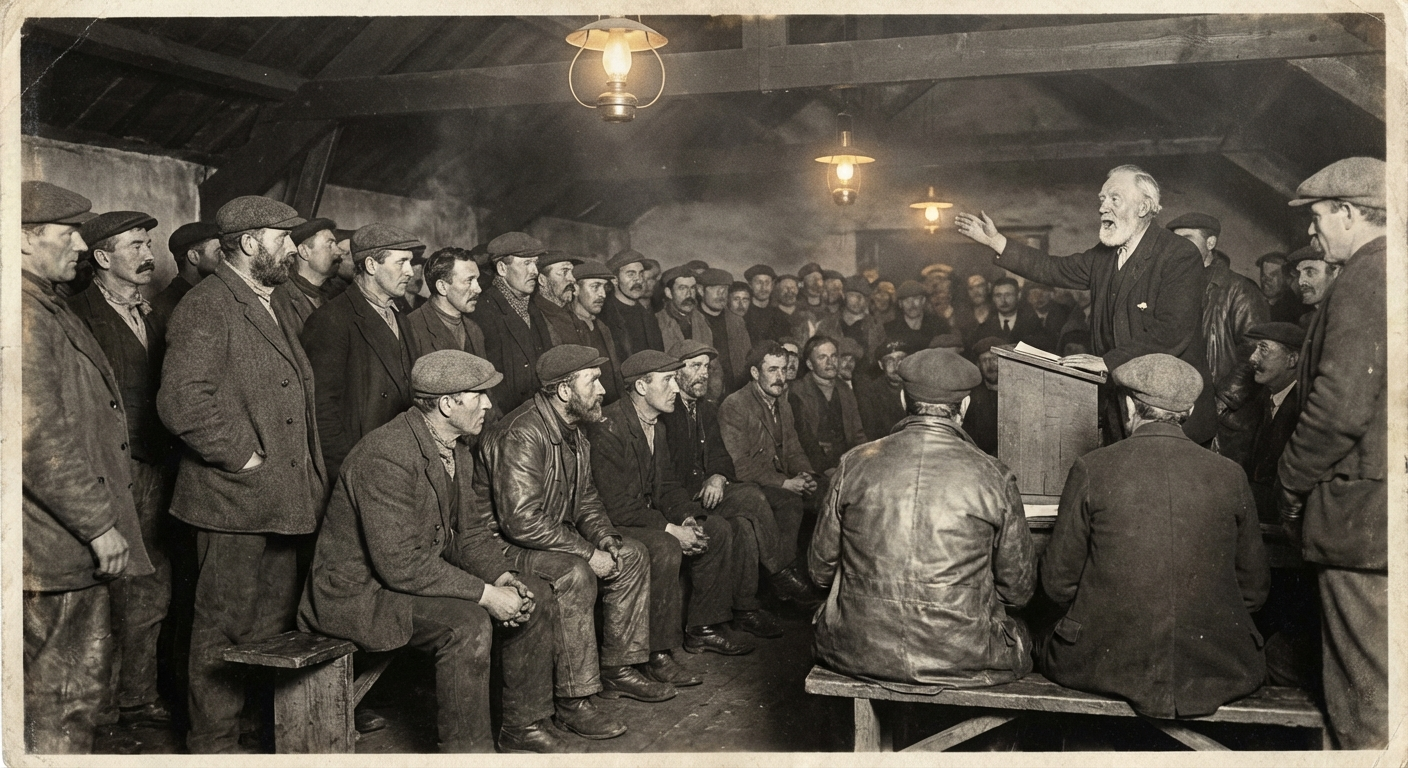
The Harbourfront Mission Hall has a capacity of sixty. On Thursday evening, forty-seven vessel masters stood or sat in every available space, and another dozen fishermen and their families crowded the corridor outside, listening through the open door.
The Fishermen’s Benevolent Association had called the emergency meeting for six o’clock. By ten past, Secretary Wilfred Poole had read the resolution. By quarter past, it had passed without a single dissenting voice.
The resolution demands that the Harbour Authority and City Council make position-reporting beacons mandatory on all fishing vessels under twenty metres operating from Bobington harbour — approximately ninety boats. The estimated cost is one hundred and eighty to two hundred and sixty florins per unit, depending on specification, for a total fleet-wide outlay of sixteen thousand to twenty-three thousand florins.
“This is not a request,” Poole told the meeting. “This is a demand. We have been writing letters for three years. We are done writing letters.”
Shale Speaks
Captain Dermot Shale arrived at the Mission Hall at ten minutes to six, walking slowly, his wife Bridget beside him. He had been released from St. Dunstan’s Hospital on Wednesday afternoon — barely thirty-six hours after the coastguard cutter Resolute found the Lady Maren drifting nineteen nautical miles northeast of the harbour with a fractured crankshaft and a broken radio aerial.
Shale spoke for four minutes. The room was silent.
“I have fished these waters for thirty years,” he said. “I built the Lady Maren with my own hands. I know what she can take. But when the aerial broke and the engine seized, I had nothing. No way to tell anyone where I was. No way to call for help. I rigged a sea anchor from my own nets. That is not a safety system. That is luck.”
He paused. “I have four men on that boat. Tobias Renn has a family. I will not take a crew to sea again without a beacon aboard.”
An Old Grief
Owen Pritchard spoke next. He is seventy-one years old, a retired trawlerman who fished from Bobington harbour for thirty-eight years before arthritis ended his career in 2009. He sat in the front row, wearing a heavy coat despite the warmth of the room.
“My nephew Daniel went out on the Bright Morning in November of 1994,” Pritchard said. “Four-man crew, same as Dermot’s. Engine trouble twelve miles out. No radio beacon, no position report, nothing. The coastguard searched for three days. They found the boat capsized off the outer banks. They never found Daniel.”
He looked at Poole. “If we’d had beacons then, my nephew would be fifty-three years old. He’d be sitting in this room. Instead I’m sitting here for him.”
The room was very quiet.
The Harbour Master Responds
Harbour Master Cornelius Ashby attended the meeting in person — an unusual step that several fishermen noted with approval. He sat at the back and listened for the first forty minutes before being invited to speak by Poole.
“I have said publicly that luck is not a safety policy,” Ashby told the meeting. “I meant it. The Harbour Authority supports the principle of mandatory position-reporting equipment for all vessels operating from this harbour. I cannot commit to a timeline tonight, but I can tell you that this resolution will be on the Authority Board’s agenda at its next meeting, and I will recommend adoption.”
He added: “The question is not whether we do this. The question is how quickly.”
Poole announced that the resolution would be formally presented to both the Harbour Authority Board and the City Council’s Maritime Affairs Committee within the week. He also disclosed that the Association had received preliminary quotes from two equipment suppliers — Harland Maritime Instruments of Port Caravel and Ashwater Signal Works, a Bobington firm — and that a bulk purchase for the fleet could reduce per-unit costs by fifteen to twenty per cent.
The meeting adjourned at twenty past seven. Several fishermen remained on the steps of the Mission Hall afterwards, talking in small groups. Shale and Bridget left quietly, walking along the Harbourfront toward the harbour.
The Lady Maren is still at the repair dock, her crankshaft awaiting replacement. She has no position-reporting beacon aboard. Ninety other boats in the harbour do not have one either.
For now.