
On Thursday evening, when the house lights of the Bellvue Theatre dim for the first time in front of a paying audience, a city will be watching a play about a man who believed that everyone — not just the wealthy, not just the well-connected — deserved to see where they were going.
Edmund Vale. Bobington’s first superintendent of lamps. The man who fought to extend gas lighting from Midtown into the working-class districts in the 1840s. And now the subject of The Lamplighter’s Oath, written and directed by Augustin Fell, the owner of the theatre that will either survive because of it or close in spite of it.
This newspaper has followed the Bellvue’s journey from the brink. The 180,000-florin fly tower repair — now fully funded, with Thurston Brothers of Caldwell scheduled to begin work on 2 May. The benefit night on 15 March, when Ruben Glass returned and Thomas Ashworth silenced 378 people. The biscuit tin from Marchmont Street Primary. The ferry crew’s collection. Desmond Quirke’s 500 florins.
Now comes the play itself.
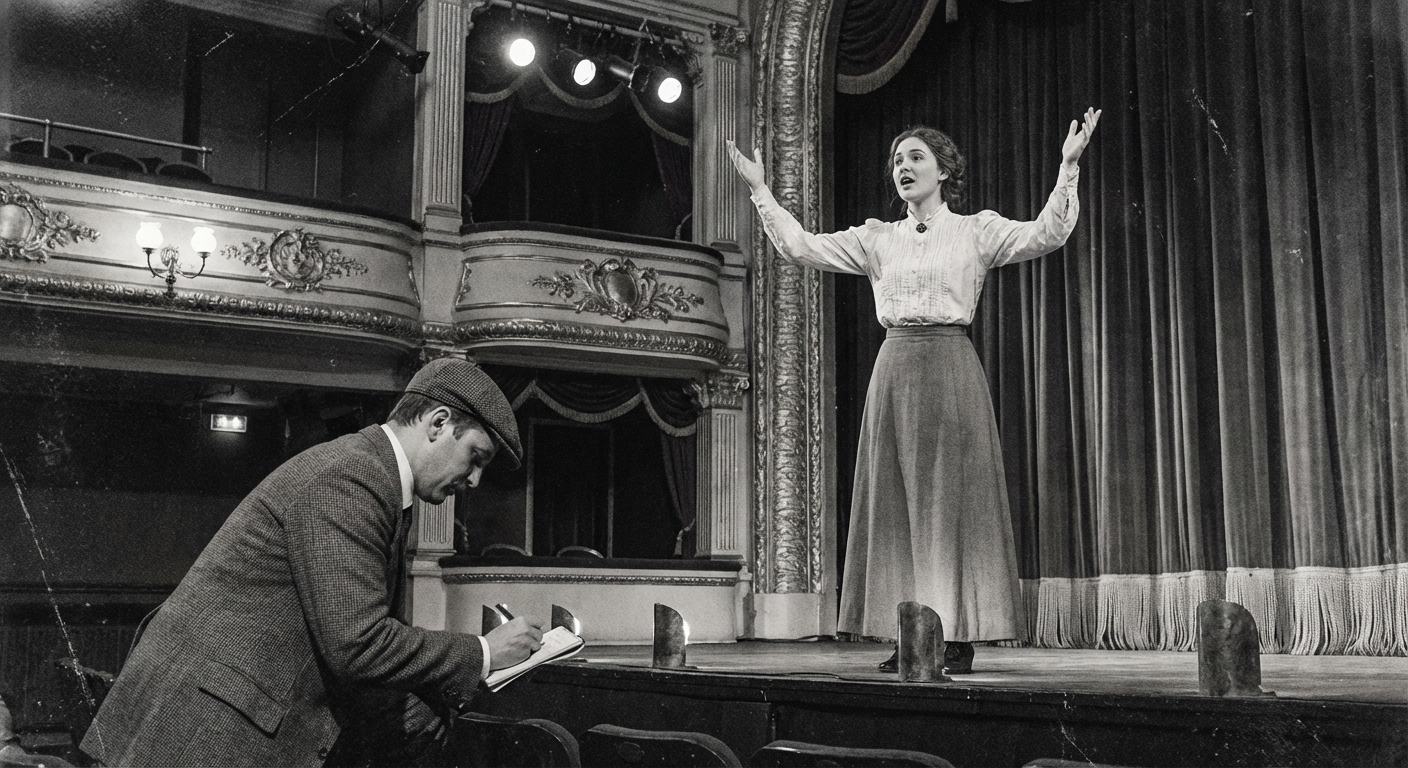
Rehearsals have entered their final week. Fell directs from row six, writing notes on programme margins in pencil so fine it is nearly illegible. Ashworth — who teaches secondary school by day and arrives at the theatre at four o’clock each afternoon — has honed Vale’s council address in Act III into something that reportedly stops the room. Nessa Holloway, in her first professional engagement, has transformed Clara from a daughter standing in her father’s shadow into a woman with her own convictions.
“She’s found the stubbornness,” said Fell. “Clara isn’t angry. She’s certain. That’s harder to play, and Nessa has it.”
Backstage, Felix Wainwright — the theatre’s lighting technician, age 34, who trained during the Glass era and has worked the Bellvue’s rig for eleven years — has spent the past fortnight rewiring the entire lighting system.
“The rig was adequate,” he said, adjusting a lamp in the flies. “But this is a play about a man who brought light to people who didn’t have it. The lighting has to mean something. Every scene change is a version of what Vale was fighting for.”
Wainwright has replaced fourteen of the theatre’s twenty-eight stage lanterns and reconfigured the colour filters. The Act II lamplighting sequence — in which Vale walks through a darkened stage, lighting model gas lamps one by one — will use no electrical effect. Each lamp is lit with a real flame.
“Fell insisted,” Wainwright said. “I tried to talk him out of it. But he was right.”
Ruth Kirby, the stage manager, has other concerns. Line seven of the fly tower — unreliable since 2019 — must operate flawlessly for the Act III council chamber scene. The counterweight system, which the retired stagehands’ letter described with knowing affection, has been serviced but not replaced. That repair awaits the Thurston Brothers in May.
“It will hold,” said Kirby. “It has held for six years of being temperamental. It can hold for one more month.”
Tickets: 352 of 380 sold. The remaining 28 are in the upper gallery. Fell has reserved the two front-row aisle seats — one for Glass, should he choose to attend, and one for his aunt Constance, who ran the Bellvue from 1971 until her death in 2006 and whose portrait hangs in the lobby.
“She would have had notes,” said Fell. “She always had notes.”