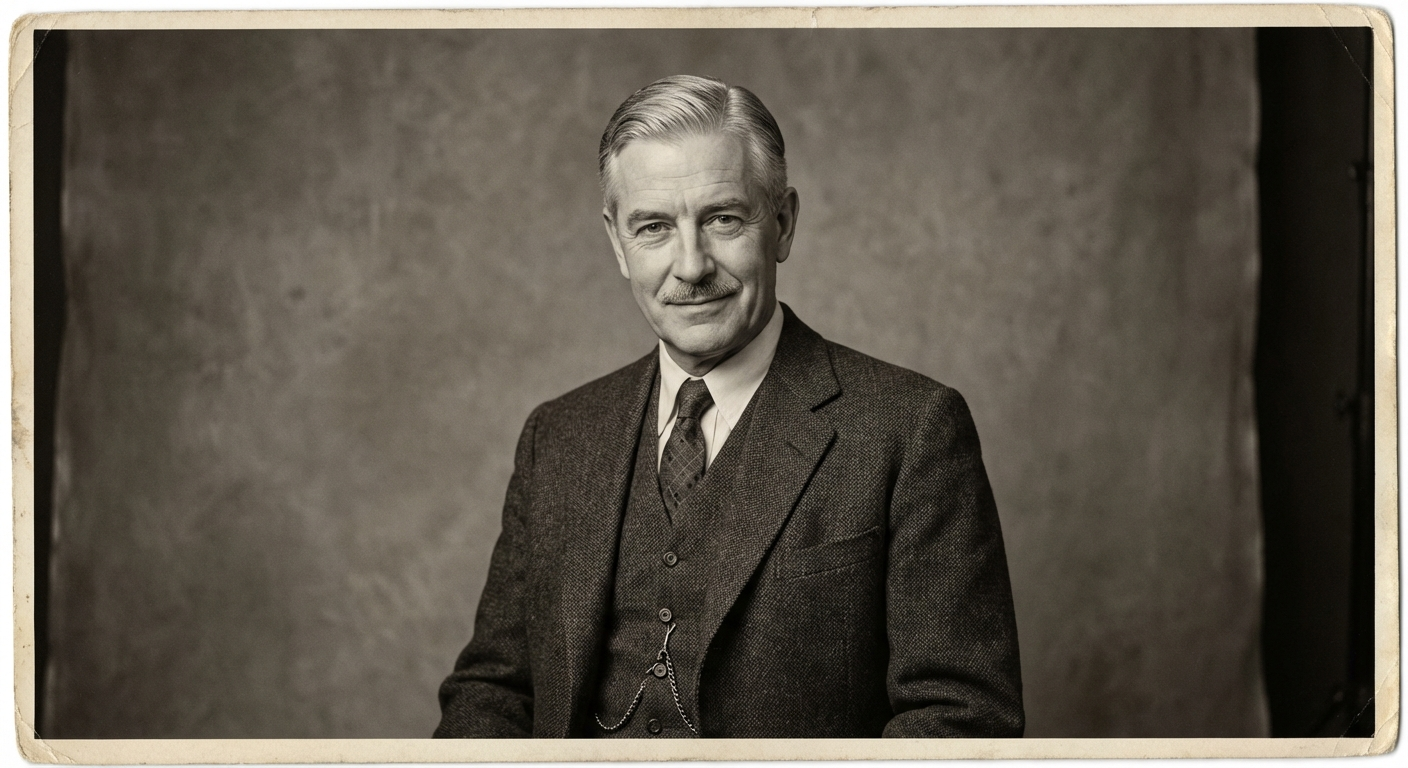
On Cartwright Lane, between a tobacconist and a shop that sells nothing but buttons, there is a door marked simply HALDANE & WEBB — TYPEWRITING MACHINES. Behind it, twelve people build typewriters by hand.
They have been doing so since 1908, when Arthur Haldane and Samuel Webb — a locksmith and a piano tuner, respectively — combined their talents and produced a machine that was, by all contemporary accounts, ugly, heavy, and extraordinarily reliable. The Haldane & Webb Standard Model has been in continuous production, with modest refinements, for 118 years. It weighs 14 pounds. It costs 42 florins. Every single component is machined, fitted, and adjusted by hand.
“We make about eighty a year,” said Clive Haldane, 56, the founder’s grandson and current managing director. “Some years seventy-five. Some years eighty-five. We don’t rush.”
Last month, Mr. Haldane received a letter from the Ashford Republic’s Ministry of Public Records. The Ministry, which is undergoing a vast programme to standardise its record-keeping across 340 regional offices, had tested seven manufacturers’ machines over a six-month trial period. The Haldane & Webb emerged, as the Ministry’s evaluation report states, as “the most durable, consistent, and repairable typewriting instrument assessed.”
The Ministry would like to order five hundred machines.
“I read the letter three times,” Mr. Haldane said, sitting at a workbench scarred by decades of filing and polishing. “Then I read it to my wife. Then I sat down.”
Five hundred machines is six and a quarter times Haldane & Webb’s annual output. At 42 florins per machine, the order is worth 21,000 florins — roughly triple the workshop’s typical annual revenue. The Ministry has proposed a delivery schedule of eighteen months, with the first batch of fifty machines due by August.
The mathematics, as Mr. Haldane has discovered, are less triumphant than the headline suggests.
“To build five hundred machines in eighteen months, on top of our existing orders, we would need to roughly double our production,” he said. “That means more workers. And there aren’t any.”
The problem is not general labour. The problem is that a Haldane & Webb typewriter contains 2,400 individual parts, forty-seven of which are machined to tolerances that Mr. Haldane describes as “tighter than a watchmaker would bother with.” Training a new assembler takes, at minimum, fourteen months. A key-lever specialist — the most demanding role — takes two years.
“I can’t hire someone off the street and have them fitting escapement mechanisms by August,” Mr. Haldane said. “The machine won’t forgive it.”
The firm’s twelve employees — most of whom have been there for more than a decade — are divided into three assembly teams of four. Each team completes roughly one machine every six working days. To meet the Ministry’s schedule, Mr. Haldane estimates he would need at least eight additional assemblers, plus a second shift.
He currently has none.
“I’ve spoken to the Mechanics’ Guild,” he said. “They have three qualified toolmakers on their books. Three. In the whole city.”
The irony has not escaped Mr. Haldane. The Ministry chose his firm precisely because the machines are handmade — because human judgment governs every joint and spring. To fill the order, he would need to mechanise or simplify some processes, which would make the machines less like the ones the Ministry tested and admired.
“That’s the trap, isn’t it,” he said, without inflection.
Mr. Haldane has written to the Ministry requesting an extended delivery schedule of twenty-four months. He has also placed advertisements in the Times and the Caldwell Courier seeking experienced machinists willing to relocate. Dorothy Haldane, who manages the firm’s accounts, is cautiously optimistic.
“We’ve survived two wars, a factory fire in 1943, and thirty years of people telling us that typewriters are a dying trade,” she said. “We’ll manage.”
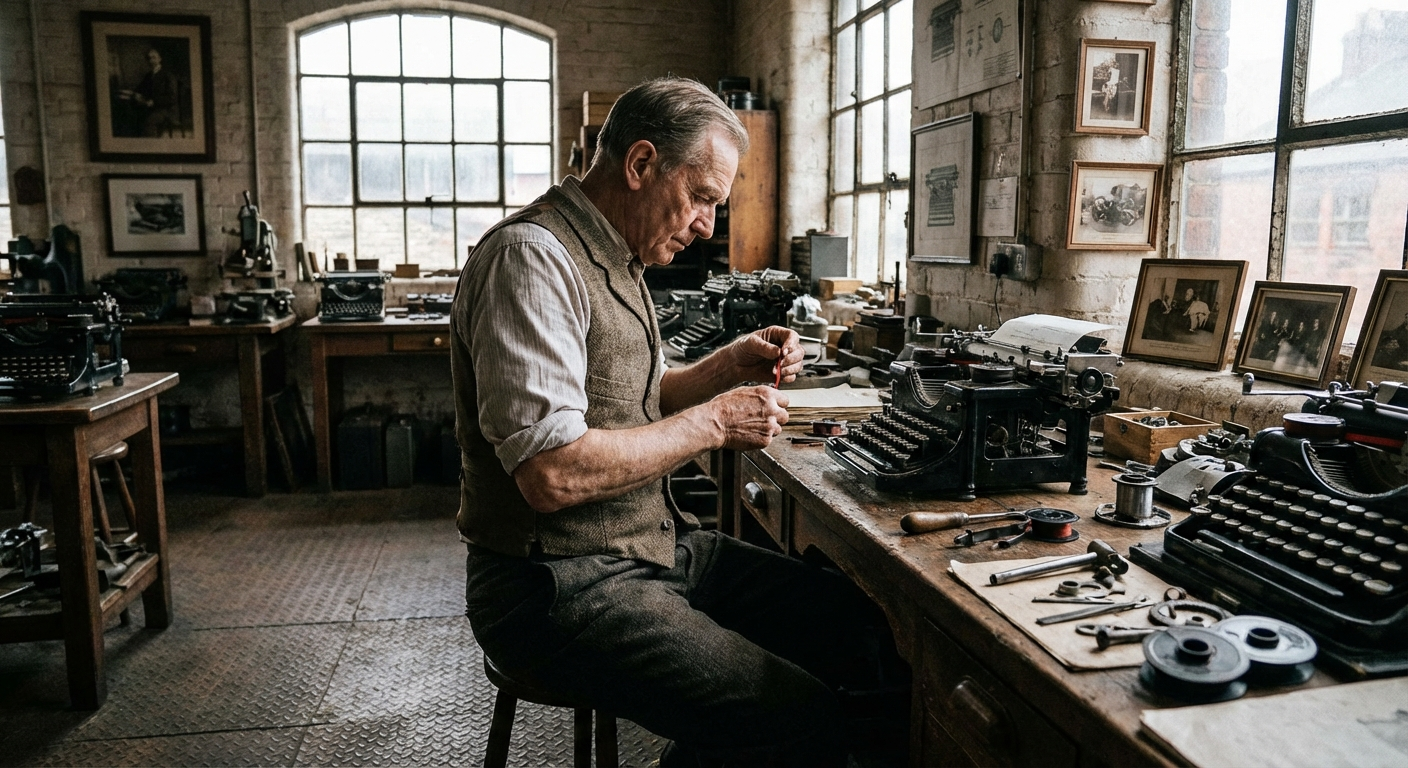
The oldest employee, Bernard Tull, 67, who has worked at Haldane & Webb for forty-two years, offered a more measured view. “We make eighty good typewriters a year,” he said, threading a ribbon spool with hands that moved without looking. “Five hundred good typewriters — that’s a different proposition.”
The workshop itself is a monument to continuity. Arthur Haldane’s original lathe still sits in the corner, though it is now used primarily as a shelf for tea mugs. Framed photographs of every Haldane & Webb model — there have been four, each an evolution rather than a replacement — line one wall. The light comes from the same high windows that illuminated the work in 1908. The floor is iron plate, worn smooth in paths between stations.
Three of the twelve current employees are over sixty. None of their children have entered the trade.
“That’s the real problem, isn’t it,” said Tull, not looking up from his work. “Not five hundred machines. It’s who builds the five hundred and first.”
Standing in the workshop, surrounded by the particular smell of machine oil, ink ribbon, and strong tea, one understands what Tull means. The Haldane & Webb Standard Model is not merely manufactured; it is, in some meaningful sense, grown — each machine acquiring its character through the specific pressure of specific hands.
Whether five hundred machines can be grown in eighteen months — or twenty-four — remains to be seen. Mr. Haldane, for his part, is not sleeping well.
“My grandfather would have known what to do,” he said. “He’d have said yes immediately and figured it out later. I suppose I’m more cautious.”
He paused. “But I did say yes.”