
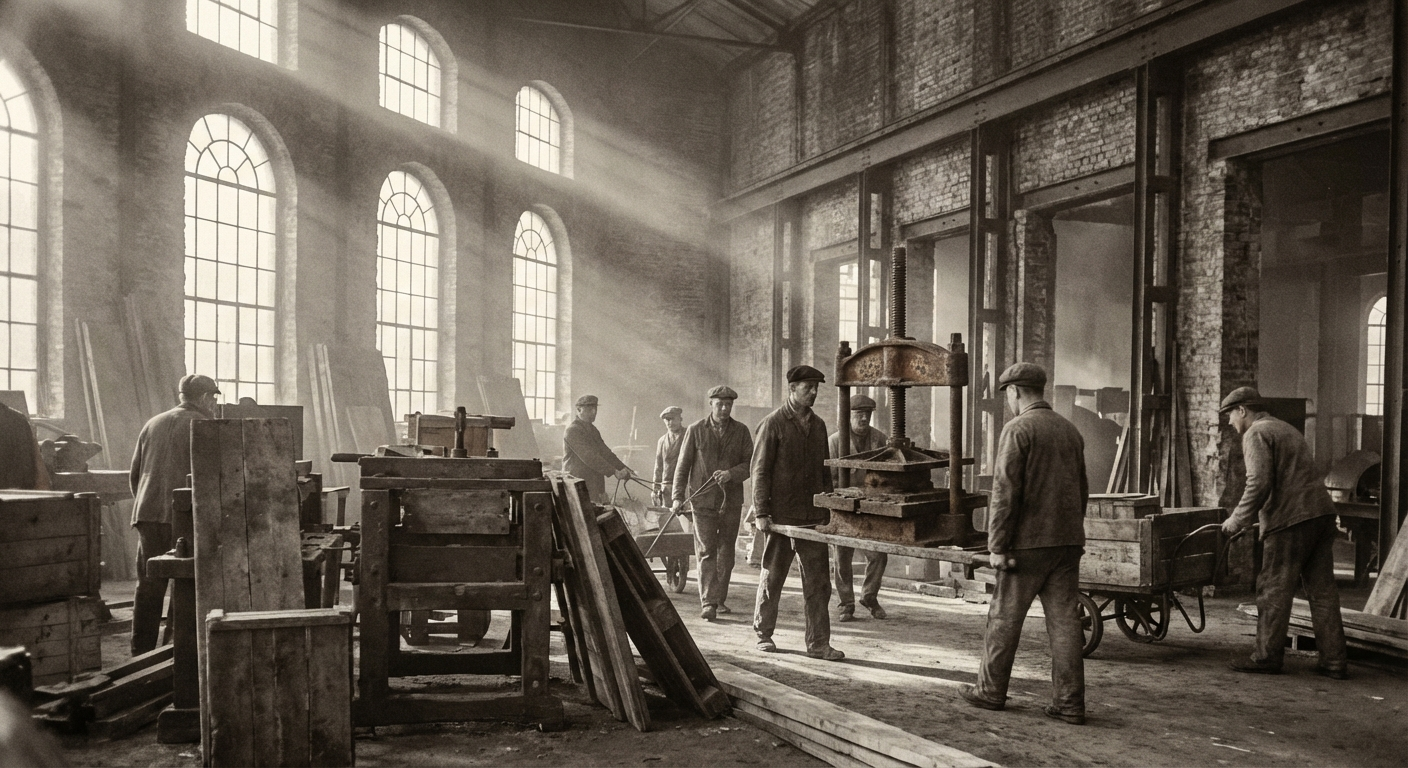
The first thing out of the Telford Granary on Saturday morning was a dead pigeon. The second was a grain hopper that had not moved since 1987. The third was Gideon Harkness, covered in dust and swearing cheerfully.
“It’s magnificent,” said Mr Harkness, brushing cobwebs from his coat. “Absolutely filthy and absolutely magnificent. The light through those arched windows — I could print in here for the rest of my life.”
Mr Harkness, who is fifty-one and makes linocuts and engravings of urban industrial scenes, is one of five artists who purchased the old granary on lower Harbourfront Parade earlier this month for 48,000 florins from Felix Telford, the retired chandler who was the last of the Telford family to run the building as a working storehouse. Mr Telford, who is seventy-eight, sold below market rate. “I’d rather have artists than pigeons,” he said at the time, a sentiment he has had no cause to revise.
The consortium is led by Maud Templeton, the ceramicist whose harbour-view tiles have been a fixture of Bramblegate market stalls and gift shops for two decades. She has spent the past three years working from her kitchen table in Bramblegate — a situation that, she noted on Saturday, had certain limitations.
“You cannot fire a kiln on a kitchen table,” Mrs Templeton said. “You cannot even think about firing a kiln on a kitchen table. My husband has been very patient, but patience has structural limits.”
The other members of the consortium are Claude Renaux, the photographer who has been operating a darkroom in his landlord’s cellar on Pilot’s Alley; Nesta Brookes, a metal sculptor who works in reclaimed dockyard iron and copper; and Elin Sayer, a textile artist whose handwoven tapestries have been exhibited at the Bobington Academy of Fine Arts.
Miss Brookes, who is thirty-eight, arrived on Saturday with a crowbar and an expression of concentrated purpose. She had been working from a rented shed near Harrowgate Pier that she described, without elaboration, as “inadequate.”
“I need a forge,” she said. “I need ceiling height. I need a floor that won’t collapse if I drop an anvil on it. This building has all three.”
Miss Sayer, who is thirty-three and the youngest of the group, was quieter about her requirements. She stood for some time in the long central hall, watching dust motes turn in the light from the fourteen arched windows.
“A loom needs a steady floor and even light,” she said. “This has both. I’ve been looking for a space like this for four years.”
The conversion plan calls for five individual studios arranged along the building’s length, with a shared exhibition room at the eastern end and a communal workshop — including Mrs Templeton’s kiln and Miss Brookes’s forge — in the former loading bay at the rear. The budget is 12,000 to 15,000 florins, covering roof repairs, rewiring, kiln flue installation, and ventilation. An Arts Council grant application is pending.
The clearing work continued through the weekend. By Sunday evening, the building’s interior was visible for the first time in years: a long, high-ceilinged space of exposed brick and timber, with the pitched slate roof intact above and the remains of grain chutes and iron fittings along the walls.
“The bones are extraordinary,” said Mr Renaux, who had been photographing the clearing process. “Aldous Telford built this to last. We just have to put new organs in it.”
Mrs Templeton expects the studios to be functional by May. Whether the kiln will be operational by then depends on the flue installation, which depends on the Arts Council grant, which depends on the Council’s spring allocation round in early April.
“We have waited this long,” Mrs Templeton said. “A few more weeks will not break us.”
She looked around the dusty hall with an expression that combined satisfaction and the beginnings of alarm.
“Though we may need more brooms.”