
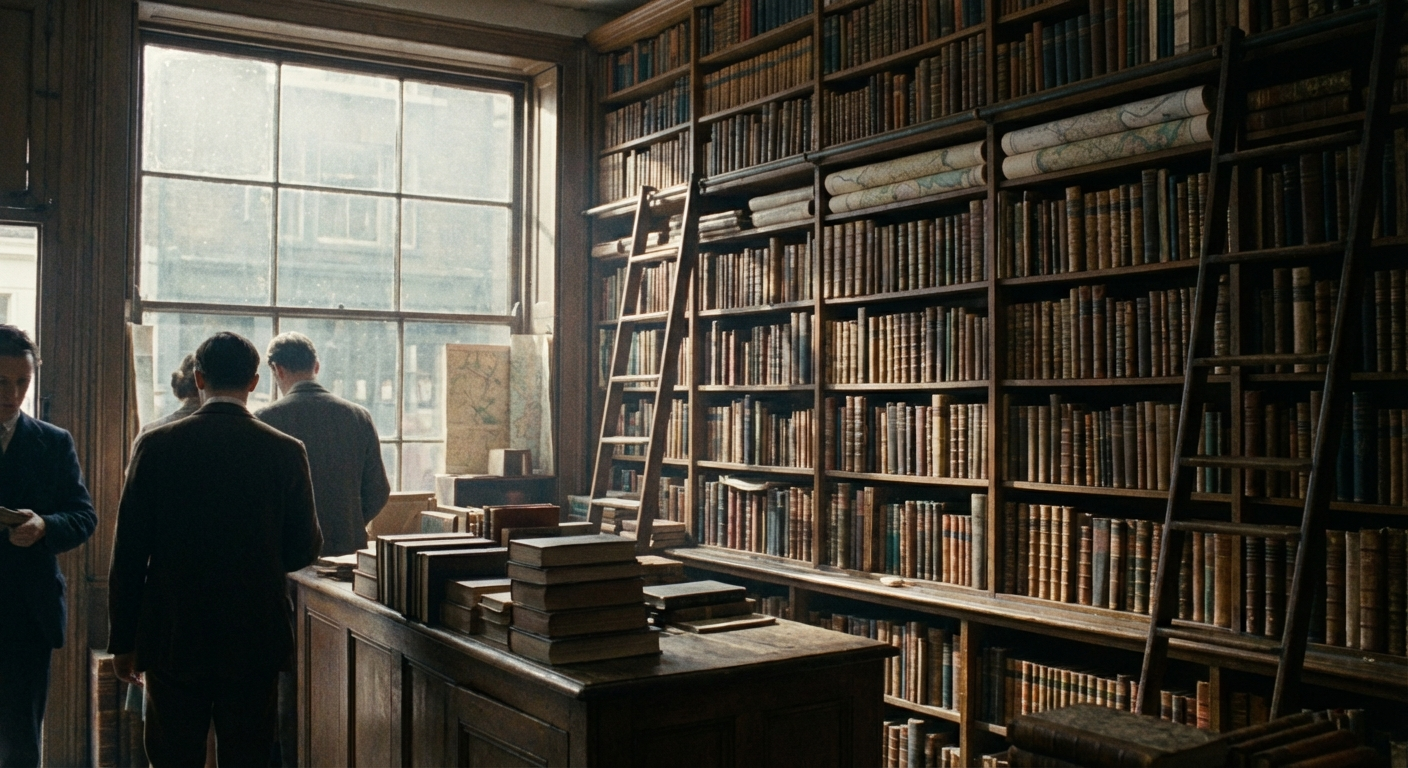
On Monday evening, forty-three people arrived at Fowler’s Books bearing pencils, notebooks, and — in the case of one elderly gentleman from Thornhill — a magnifying glass on a brass chain. They had come to catalogue fourteen thousand books before the end of April.
Cedric Fowler, who has run the shop at 12 Threadneedle Street for forty years and whose father opened it in 1954, stood behind the counter and watched them file in. He had not asked for help. He had mentioned, in this newspaper two days ago, that the shop was closing because Cresswell Properties had doubled the lease, and that he had fourteen thousand volumes to disperse.
Bobington did the rest.
“I suppose I underestimated the city’s appetite for maps,” Mr Fowler said, with the quiet, owlish humour that has sustained him through four decades of bookselling. “Or perhaps for lost causes. The two may be related.”
The Catalogue Begins
The volunteers, organised by a retired librarian named Dorothy Cresswell-Hume — “no relation to the landlord, I assure you, and if there were, I would have words” — have divided the shop into twelve sections. Each volunteer takes a shelf, records every title, and assigns it to one of four categories: institutional interest, collector interest, general stock, and ephemera.
The work is expected to take two weeks.
The Polytechnic Library, through its head of special collections, has made a formal offer to house the maps and natural history section — approximately three thousand volumes that constitute, according to Deputy Librarian Sylvia Hatch, “the most comprehensive privately held collection of Greymoor and Ashwater Valley cartography in the country.”
“Some of these maps exist nowhere else,” Mrs Hatch said, examining a hand-drawn survey of the Greymoor ridge from 1847. “The Polytechnic would be honoured to preserve them.”
The Bobington Historical Preservation Society has expressed interest in the architectural and local history volumes. And Millicent Graves, whose lending library on Cooperage Lane operates from a handcart, asked whether she might have the fiction.
“I have room for another two hundred,” Mrs Graves said. “I may need a larger handcart.”
A Bookshop Empties
Mr Fowler, for his part, has received the attention with a mixture of gratitude and bewilderment.
“A woman came in yesterday and bought eleven books about rivers,” he said. “She doesn’t live near a river. She lives in Thornhill. I asked her why. She said, ‘Because you’re closing, and someone should have them.’ That is not how bookselling is supposed to work, but I’ll take it.”
Pella Strand, the municipal surveyor who has spent the past six weeks mapping the Lower Conduit beneath the city’s streets, visited on Tuesday and purchased a hand-coloured plan of the Cooperage Lane brewery district from 1808.
“It shows three wells that I’ve been looking for,” she said. “I found two of them underground. The third is under a coal merchant’s yard. Mr Fowler had the only copy of this map. It cost me four florins.”
The shop will close at the end of April. The building’s future use has not been announced by Cresswell Properties, which declined to comment.
Mr Fowler intends to remain until the last book is sold, catalogued, or claimed. His father, Oswald, who died in 1986 at his desk with a Greymoor geological survey open in front of him, would perhaps have approved of the manner of the shop’s ending — not in silence, but in a sudden, improbable rush of attention.
“He always said the best books find their readers eventually,” Mr Fowler said. “I think he was right. They just needed a deadline.”