
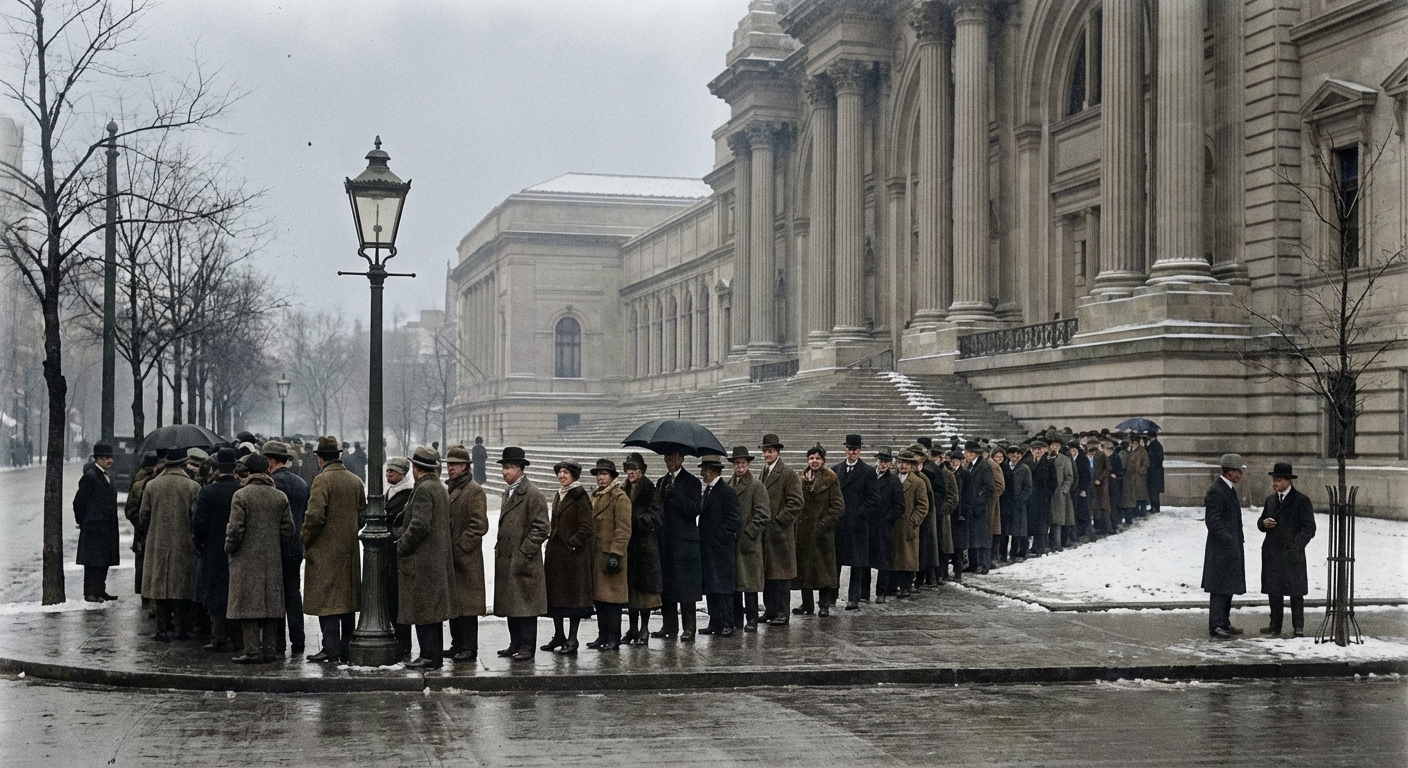
I have been visiting the Royal Bobington Gallery for the better part of twenty-five years, and I have never seen anything quite like Saturday afternoon in Meridian Hall.
The queue began at the gallery steps and wound along Arundel Crescent, past the Royal Institute, around the corner onto Mercer Street, and very nearly to the tram stop. Families, couples, elderly gentlemen in overcoats, students with sketchbooks, a woman carrying a small child on her hip — all of them waiting, in the thin February light, to see the paintings of a seventy-four-year-old recluse who would rather they all stayed home.
The numbers are extraordinary. An estimated 14,000 visitors attended over Saturday and Sunday — nearly double the 8,000 who came on opening weekend. Total attendance since the exhibition opened on 14 February has surpassed 30,000. Director Simone Aldair confirmed on Saturday evening that “Light Through Glass” has become the most-visited exhibition at the Royal Bobington Gallery since the Matthias Crane memorial retrospective of 2009, and at its current pace will surpass that record within the fortnight.
“We are gratified and, frankly, slightly overwhelmed,” Aldair said. “The Gallery was not designed for this volume of visitors on a single weekend. We owe it to both the art and the audience to manage the experience more carefully.”
Timed Entry
Beginning Monday, the Gallery will implement a timed entry system for the Hargrove retrospective. Visitors will be assigned thirty-minute entry windows, available in advance through the Gallery’s booking office or at the door on the day, subject to availability. The system is intended to reduce queuing times and ensure that visitors can engage with the paintings rather than simply being carried past them by the current of bodies.
Free Wednesday admissions will be preserved under the new system, though Aldair cautioned that demand for Wednesday slots is expected to be “extremely high.” The extended Friday and Saturday evening openings, announced last week, will continue through March.
The Hargrove Effect
What is driving the numbers? The paintings, certainly — one hundred and twenty works spanning five decades, from the luminous early landscapes to the unflinching late portraits, represent the most comprehensive survey of Hargrove’s career ever assembled. But the paintings have been known, if not always fully appreciated, for years.
What has changed is the story around them. The art market frenzy — private sales at record prices, auction houses circling, the sense that Hargrove’s work is suddenly, absurdly valuable — created the initial wave of attention. And then Hargrove herself, with her handwritten letter decrying the “carnival of auction-house arithmetic,” performed an act of sincerity so striking that it became its own kind of spectacle.
People are coming because the paintings are beautiful. But they are also coming because a woman who could have said nothing chose to say something real, and in a world where that is increasingly rare, it has the force of revelation.
I watched a man — sixties, tweed jacket, reading glasses on a chain — stand before “Estuary at Low Tide” (1993) for what must have been ten minutes without moving. When he finally stepped away, he removed his glasses, wiped his eyes, and said to no one in particular: “Well. There it is.”
There it is, indeed. The painting — a wide, still estuary under a pearl-grey sky, the mud flats shining, a single figure in the distance — has become the unexpected centrepiece of the exhibition. Visitors queue specifically to stand before it. It is not the largest work, nor the most technically ambitious. But it possesses a quality that resists analysis: a stillness, a patience, an absolute attention to the way light falls on wet earth. Standing before it, one has the unsettling feeling that the painting is looking at you.
The Crowd as Subject
There is something to be said about the experience of viewing art in a crowd this size, and not all of it is complimentary. The smaller works — the portraits, the intimate studio studies — are difficult to appreciate when one is shoulder to shoulder with strangers. The Gallery’s beautiful natural light is competed with by the warmth of too many bodies in an enclosed space.
And yet. There is also something moving about it. The collective hush that descends in the landscape gallery. The way strangers make eye contact after looking at the same painting, as if to confirm: you saw that too? The child who pointed at “Morning, Ashford Bay” and said, “The water is moving,” and was not entirely wrong.
Hargrove would hate this. She would find the crowds intrusive, the attention exhausting, the fuss entirely beside the point. She said as much in her letter: she painted the Greymoor hills because the light demanded to be seen. She did not paint for auction catalogues, and she certainly did not paint for queues around the block.
But here we are. Thirty thousand and counting. The light demanded to be seen, and Bobington, it seems, is finally seeing it.
“Light Through Glass” continues at the Royal Bobington Gallery through 30 June. Admission 8 florins; concessions 4 florins. Free Wednesdays (timed entry from Monday). Advance bookings at the Gallery booking office.