
On Thursday afternoon, a man will step off the Caldwell express and walk through the station concourse into a city that remembers him younger, thinner, and less certain of his lines.
Ruben Glass was twenty-three when Augustin Fell cast him in The Ferryman’s Wife at the Bellvue Theatre in 2011. He was, by all accounts including his own, not very good. He forgot his entrance in the second act on opening night. He delivered his final monologue to the wrong side of the stage. The audience of ninety-four gave him a standing ovation anyway, because the Bellvue’s audiences have always understood that what matters is not perfection but the willingness to stand in the light and try.
Fourteen years later, Glass is one of the finest actors on the Caldwell stage. He has won the Caldwell Theatre Critics’ Award twice. He has played kings and cowards and the kind of quiet, ordinary men whose silences carry more weight than other actors’ soliloquies.
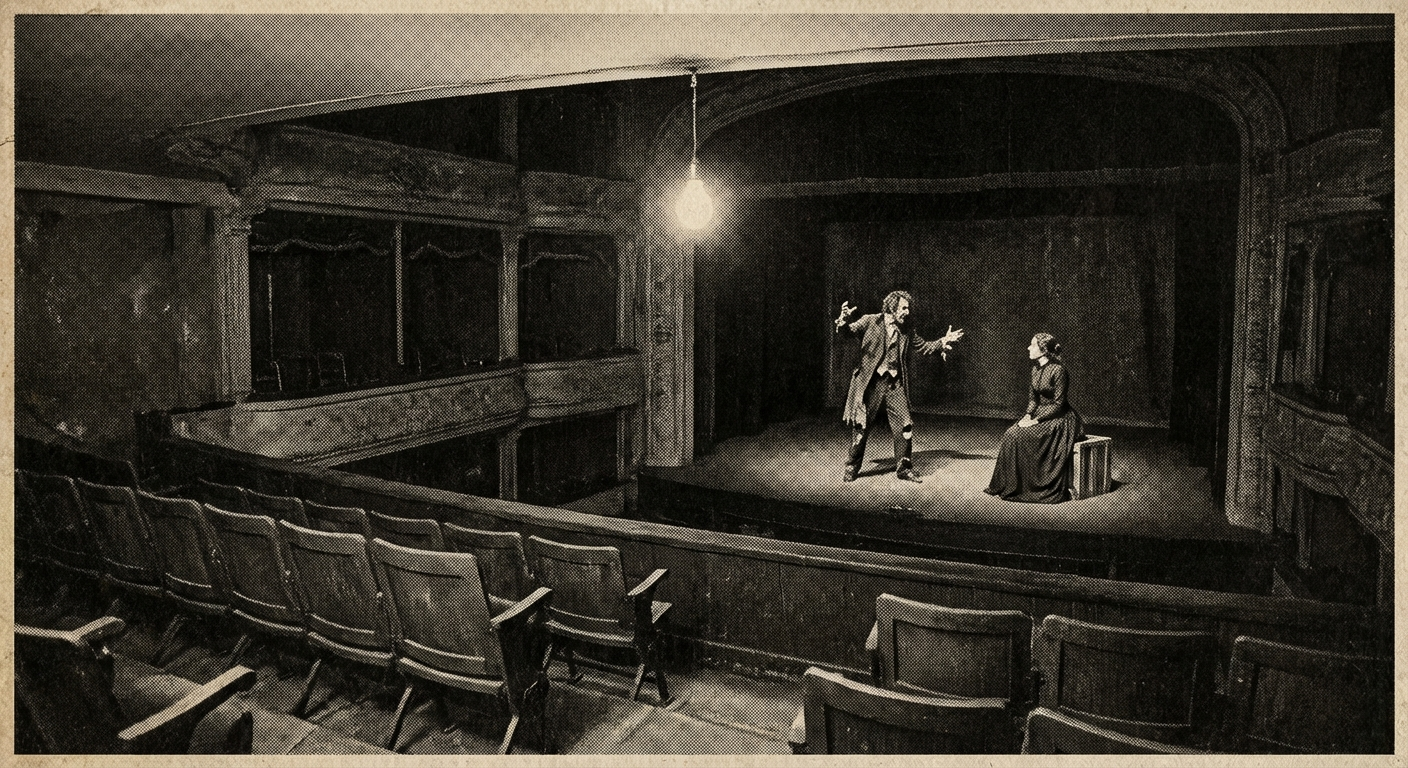
And on Saturday night, he will sit in the second row of the theatre that made him, and watch a schoolteacher and a twenty-three-year-old recent graduate perform a play written by the man who gave him his first chance.
“I owe that building more than I can calculate,” Glass wrote in a telegram to Fell last month, now framed in the Bellvue lobby. “If there is anything I can do, I will.”
Saturday’s benefit night — a performance of the third act of The Lamplighter’s Oath, followed by a reception with Glass as guest of honour — has now sold 340 of 380 seats, with the remaining forty expected to go by Thursday. Ticket prices range from 5 to 25 florins, with a small number of premium seats at 50. The event is expected to raise between 8,000 and 12,000 florins directly, with additional pledges anticipated from Glass’s presence and the associated publicity.
The fundraising total stands at approximately 118,000 florins — two-thirds of the 180,000 needed for the fly tower repairs. The deficit of 62,000 florins, with fifty-two days remaining before the 1 May deadline, is significant but not insurmountable. The Arts Council emergency heritage grant of 35,000 florins, the Marchmont Street traders’ collection of 4,200, and a steady accumulation of private donations have brought the total further than many thought possible when Fell announced the crisis in February.
Inside the theatre, the atmosphere has shifted in recent days from determination to something closer to belief.
Thomas Ashworth, who teaches history at Thornhill Secondary School and has performed at the Bellvue for fifteen years, has found a register for Edmund Vale that this critic had not anticipated. His Vale is not the bronze-statue civic hero of popular imagination but a man of stubborn, awkward conviction — a lamplighter who believed that the poor deserved to see their streets at night, and who spent eight years arguing with aldermen who disagreed.
“He’s stopped performing the part,” Fell said on Monday evening, watching rehearsals from the back of the stalls. “He’s started living in it. That’s when you know.”
Nessa Holloway, twenty-three, in her first professional engagement, has grown more commanding with each week. Her Clara — Vale’s daughter, who carries the second act — has acquired a stubborn tenderness that serves the play beautifully.
The Hargrove retrospective at the Royal Bobington Gallery — now past 44,000 visitors — has contributed to a broader civic mood that Fell describes, with characteristic understatement, as “people caring about old things.”
Whether that mood translates to sixty-two thousand florins in fifty-two days remains to be seen. But on Thursday, Glass arrives. On Saturday, the lights go up. And the Bellvue, which has been standing on Marchmont Street since 1897, stands still.