
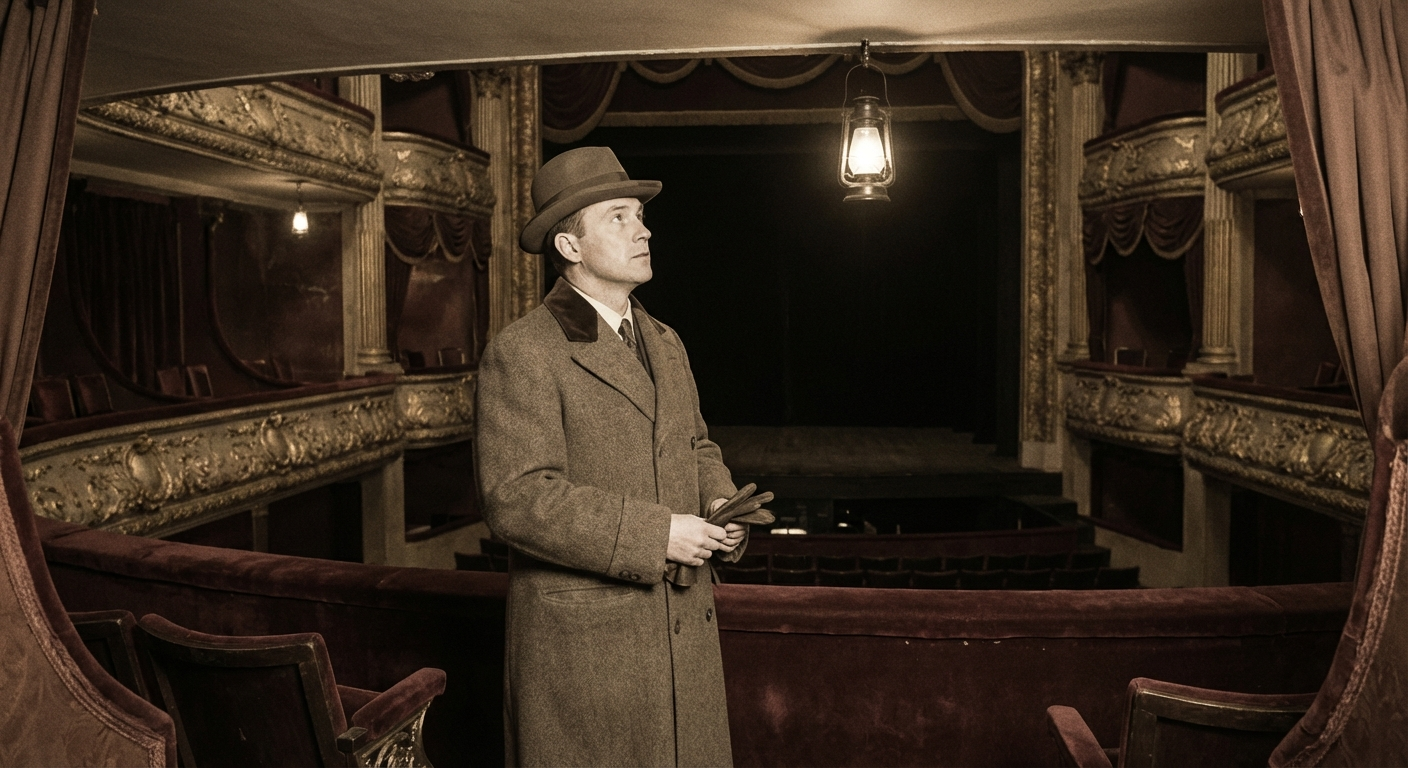
He came by the afternoon express from Caldwell, and Augustin Fell was waiting on the platform.
It had been fourteen years since Ruben Glass last stood inside the Bellvue Theatre. He left Bobington in 2012, after three seasons that included the role of the ferryman in The Ferryman’s Wife — the performance that caught the attention of the Caldwell stage and launched a career that has made him one of the most recognisable actors in the country. He has not been back.
“I kept meaning to,” Glass said, standing in the theatre’s narrow lobby on Thursday afternoon, looking at the framed telegram he sent Fell when the repair crisis became public. “I kept meaning to, and I kept not doing it. That’s the worst kind of failure — the failure of simply not showing up.”
He showed up.
The Rehearsal
Fell led Glass into the auditorium at half past four, while the company was running the third act of The Lamplighter’s Oath. The house lights were down. The stage was lit by a single lantern — Edmund Vale’s lantern, the prop that anchors the play’s final scene, in which Vale walks alone through the Docklands, lighting the lamps that the city council had voted to deny his district.
Thomas Ashworth was on stage. Nessa Holloway was waiting in the wings.
Glass sat in the fourth row, in the aisle seat, and said nothing.
Ashworth performed Vale’s final monologue — seven minutes of a man arguing with a city that cannot hear him, spoken to an empty street. Holloway entered as Clara, Vale’s daughter, and delivered the play’s closing lines: a quiet, stubborn assertion that the lights will stay on because someone has to light them, and it might as well be us.
Glass did not move for twenty minutes after the scene ended. Then he stood, walked to the stage, and shook Ashworth’s hand.
“You don’t need me,” he said. “You need the audience to see what I just saw.”
The Numbers
Saturday’s benefit night is now all but sold out. Three hundred and sixty of three hundred and eighty seats have been purchased, at prices ranging from ten to fifty florins. The remaining twenty seats are expected to sell by Friday evening.
The theatre’s fundraising total stands at approximately one hundred and twenty-two thousand florins — sixty-eight per cent of the one hundred and eighty thousand needed for the fly tower repairs by the 1 May deadline. The benefit night alone could raise between eight and twelve thousand florins, depending on the programme auction and donations.
The gap remains substantial: fifty-eight thousand florins in seven weeks. But the trajectory is different now than it was a month ago, when the total stood at sixty-five thousand and the deadline felt like a sentence.
“We’re not there,” Fell said. “We’re not close to there. But we’re closer than we were, and Saturday will help. Ruben’s presence will help. Not because he’s famous — because he’s proof that this place matters. That what happens on this stage travels.”
Glass and the Bellvue
Glass will attend Saturday’s benefit night as a guest, not a performer. He will introduce the evening and speak briefly about his time at the Bellvue. He is expected to make a personal donation, the amount of which has not been disclosed.
He spent Thursday evening at the theatre, watching the full run-through from the back of the house. He was observed in conversation with Holloway during a break, gesturing toward the stage. Holloway was taking notes.
“She reminds me of myself,” Glass said later. “Not the talent — the talent is her own. The stubbornness. This is her first professional role, in a theatre that might not exist in two months, in a play written by the man who runs the building. She could have found something safer. She chose this.”
He paused. “That’s what the Bellvue does. It makes you choose the difficult thing.”
The Hargrove retrospective at the Royal Bobington Gallery, which has directed significant public attention toward the arts in recent weeks, has now exceeded forty-five thousand visitors. The Bellvue’s fight is smaller, quieter, and more precarious — a theatre of three hundred and eighty seats against a gallery that draws thousands.
But on Saturday evening, in the gilt-and-crimson auditorium on Marchmont Street, three hundred and sixty people will sit in the dark and watch a schoolteacher play a lamplighter, and an actor who left will have come home, and the fly tower will still need fifty-eight thousand florins.
The lamps, for now, remain lit.