
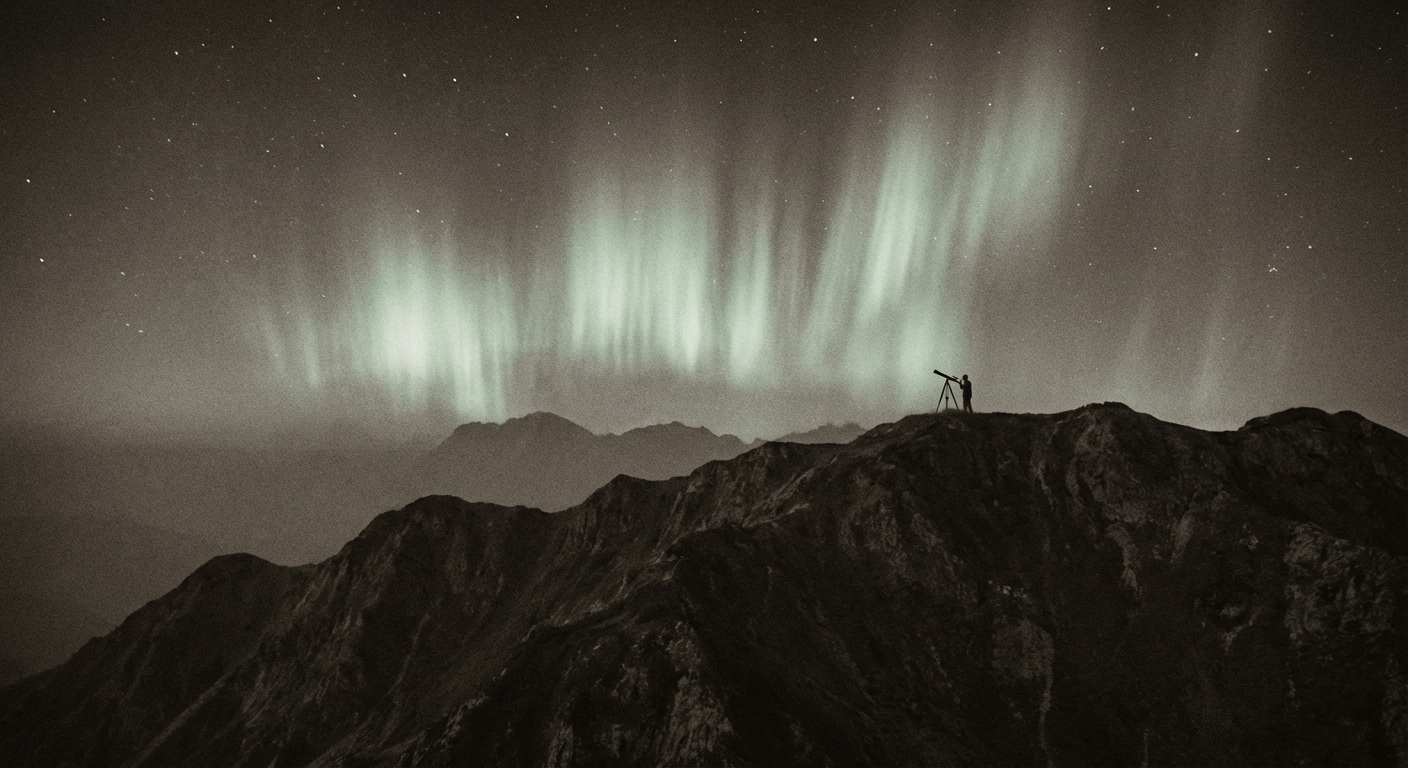
On her thirty-second consecutive night of observation, Dr Odette Collis noticed something she had not seen before. The glow was brighter.
Not dramatically brighter. Not the kind of change that announces itself. But her photometric readings over the past week, recorded with the same instrument from the same position along the ridge above Dunvale, show a trend that she says is “difficult to attribute to atmospheric variation.”
“It is not a flare,” said Dr Collis, who retired from teaching mathematics at Bramblegate Grammar School in 2020 and has maintained observation notebooks since 2015. “It is not a surge. But the central emission point is measurably more luminous than it was a week ago, and the readings are consistent night to night.”
The spectral signature — ionised nitrogen and trace sulphur dioxide, characteristic of geothermal venting — remains unchanged. Whatever is producing the glow appears to be doing so more vigorously.
Instruments on the Way
The brightening adds a note of urgency to the monitoring station project approved by the Royal Institute panel earlier this month. Equipment tenders were issued on Friday, calling for three broadband seismometers capable of continuous recording to fifteen metres depth, two atmospheric gas sampling units sensitive to sulphur dioxide, hydrogen sulphide, and carbon dioxide at parts-per-million levels, a meteorological mast with instruments at three heights, and a photometric array for continuous glow measurement.
The station will be sited approximately 800 metres northwest of the old meteorological outpost abandoned in the 1950s, above the central emission zone. It will be the first permanent scientific presence on the Greymoor ridge in over seventy years.
Tenders close on 21 March. Construction is expected to begin in April, with the station operational by mid-May — in time for the deep geological survey to 250 metres that the commission’s report mandated. The survey, estimated at 1.65 million florins, will assess both mineral deposits and the geothermal system that Dr Collis’s observations have revealed.
“We need instrumental data before we can say what the brightening means,” said Professor Elara Whitstone, who chairs the Royal Institute panel overseeing the project. “A human observer with a notebook has brought us this far. The instruments will take us the rest of the way.”
What It Could Mean
The Greymoor luminous phenomenon has been observed on every clear night since 3 February. Spectroscopic analysis has confirmed it as geothermal in origin — superheated gases venting through a three-kilometre fracture zone that runs roughly north-northeast to south-southwest along the ridgeline. At least four discrete emission points have been identified, all sharing the same spectral signature, suggesting a single connected subsurface thermal system.
The fracture zone runs through the areas containing the most promising deep copper deposits. This is the complication that has transformed the glow from a scientific curiosity into a matter of civic consequence: any expansion of Greymoor copper mining — the phased approach’s long-term hedge against Kaelmar dependency — must now account for a geothermal system whose depth, extent, and behaviour are unknown.
The brightening, if it continues, could indicate increased thermal activity at depth. Whether that represents a stable, long-term process or something more dynamic is precisely the question the monitoring station is designed to answer.
“The ridge is alive,” Dr Collis said last month, in a phrase that has since been quoted in every discussion of the Greymoor survey. She stands by it.
“What I would add now,” she said on Saturday, adjusting her spectacles against the late-afternoon light, “is that it may be waking up.”