
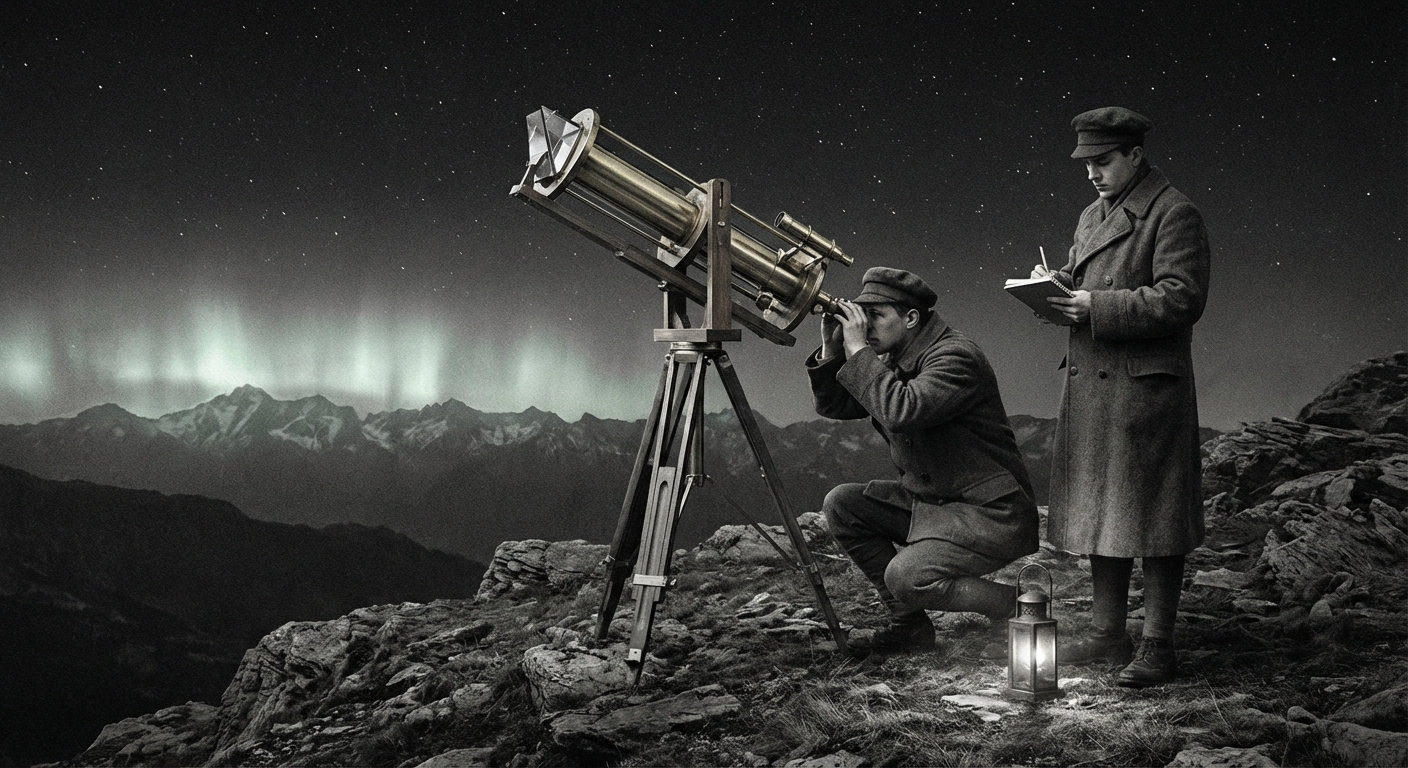
For twenty-three consecutive nights, the faint greenish-white glow above the Greymoor Highlands has been visible to anyone willing to stand on a hill and look east. For twenty-three nights, it has resisted explanation.
On Wednesday evening, Dr Odette Collis and Dr Maren Ilkley of the Royal Institute aimed a portable spectrometer at it and began to take it apart.
The observations were conducted from a ridgeline above the old mining settlement of Dunvale, approximately 800 metres above sea level, between 10:15 PM and 2:30 AM. Conditions were ideal: clear skies, no moon until after midnight, and temperatures hovering at two degrees — cold enough to keep the instrument steady, warm enough to keep the operators functional.
Dr Ilkley, a spectroscopist of 30 who joined the Royal Institute’s physical sciences division last year, operated the instrument. Dr Collis — the retired mathematics teacher who first documented the phenomenon on 3 February from the Cartwright Observatory — directed the observation sequence, consulting her notebooks to identify the precise azimuth and elevation where the glow was brightest.
What the Light Is Made Of
The preliminary spectral analysis, communicated to this newspaper by Dr Ilkley early Thursday morning, reveals a distinctive emission profile.
The dominant lines correspond to ionised nitrogen — specifically the same wavelengths produced when nitrogen gas is energised by intense heat or electrical discharge. Secondary lines indicate trace amounts of sulphur dioxide.
The combination is not characteristic of any known atmospheric optical phenomenon, nor of industrial emissions, nor of the aurora-like displays occasionally observed at northern latitudes.
It is, however, consistent with volcanic or geothermal venting — the kind of emission produced when superheated gases escape through fractured rock and interact with the atmosphere above.
Professor Elara Whitstone, president of the Royal Institute and the nation’s foremost volcanologist, had spent Wednesday afternoon testifying before the Copper Review Commission about Greymoor geology. Reached by telegram at her hotel, she responded with uncharacteristic brevity: “The emission profile suggests a subsurface thermal source. Something beneath the Greymoor ridge is venting gas through the rock. This is geologically significant.”
Not Cause and Effect
The immediate temptation is to link the glow to the seismic tremor that rattled the Greymoor Highlands on Sunday 23 February — the first such event in eleven years. Both phenomena originate from roughly the same area, and both suggest activity deep beneath the surface.
But Dr Collis, whose observational discipline has been the backbone of this investigation, cautioned against a simple narrative. “I first observed the glow on the third of February,” she said. “The tremor occurred on the twenty-third. The glow predates the tremor by three weeks. Whatever is happening, it is not a simple sequence of cause and effect.”
This leaves open the possibility that the glow and the tremor are both symptoms of the same underlying process — a deep geothermal system that has been active for weeks or longer, of which the surface manifestations are merely the most visible evidence.
Whitstone’s geological team, which has been deploying portable seismometers across the Greymoor Highlands since Monday, is now coordinating with Dr Ilkley on further spectroscopic observations. A second night of observation is planned for Thursday, weather permitting, focusing on the spatial distribution of the glow — whether it emanates from a single point or from a broader zone along the ridge.
Implications for Mining
The finding adds complexity to an already fraught debate about Greymoor copper. Whitstone told the commission earlier on Wednesday that core samples show declining ore grades at current depths, and that any expansion of mining would require a four-month geological survey.
The discovery of a previously unknown geothermal system beneath the same highlands where the Miners’ Cooperative operates three active shafts will inevitably factor into that assessment. Geothermal activity does not preclude mining — indeed, in some geological contexts, hydrothermal fluids are responsible for depositing copper ore in the first place. But it complicates the picture considerably, and it reinforces Whitstone’s insistence on a comprehensive survey before any new shafts are sunk.
Nils Haversten, chairman of the Miners’ Cooperative, could not be reached for comment on Wednesday evening. His testimony on Monday — “The earth has opinions of her own” — now carries a rather different weight.
Twenty-Three Nights
Dr Collis, who has filled forty-three observation notebooks in her years as a volunteer astronomer at the Cartwright Observatory, said she planned to continue her own visual monitoring alongside the spectroscopic programme.
“I have watched this light for twenty-three nights,” she said, cleaning her spectacles with a handkerchief in the cold pre-dawn air. “Now I know what it is made of. I still don’t know why it is there.”
Further spectroscopic results are expected within 48 hours. The glow, presumably, will continue regardless.