
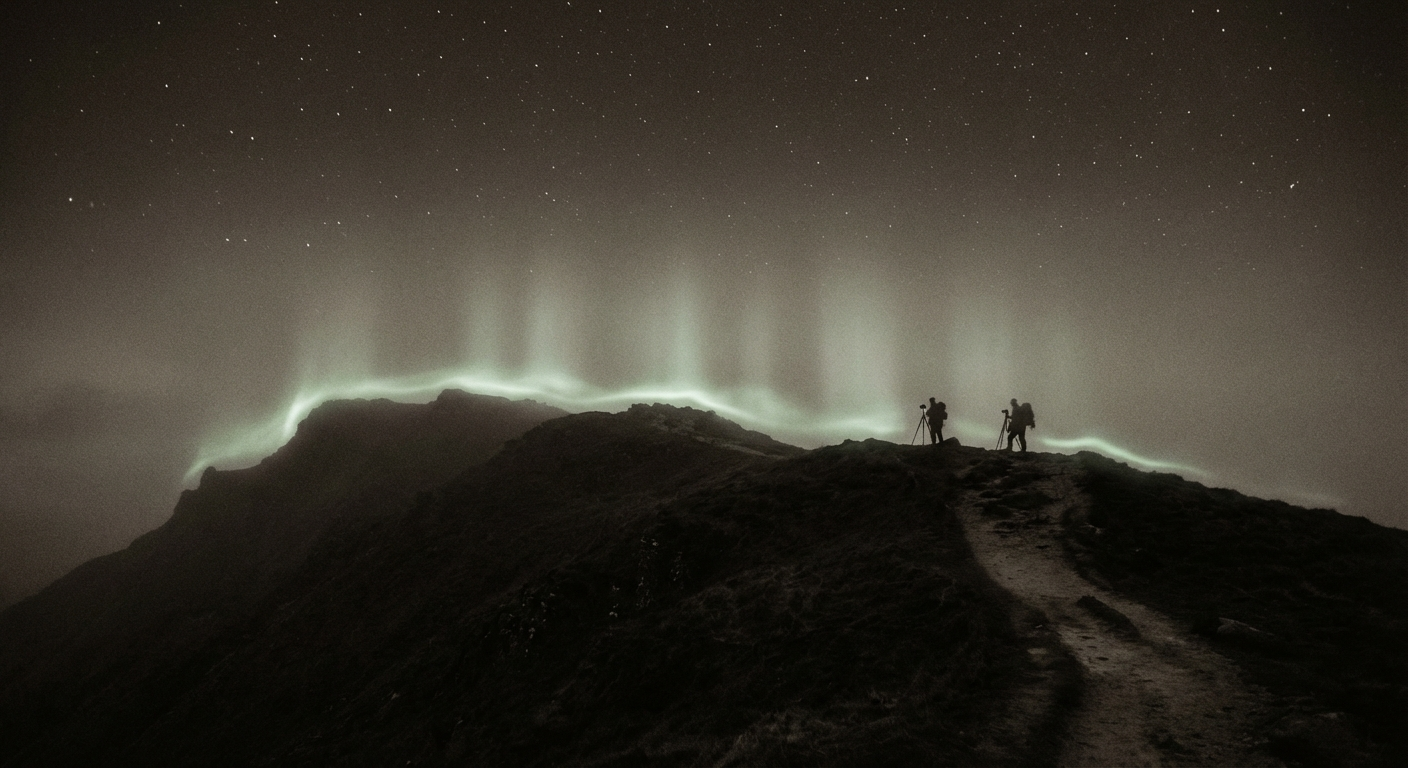
The glow above the Greymoor Highlands is not a point. It is a line.
Thursday night’s second spectroscopic observation — conducted by Dr Odette Collis and Dr Maren Ilkley of the Royal Institute, operating the portable spectrometer from three successive positions along the ridge above Dunvale — has revealed that the luminous phenomenon first documented on the 3rd of February extends along a roughly three-kilometre stretch of the main ridgeline, running north-north-east to south-south-west.
At least four discrete emission points were identified, each producing the same spectral signature recorded on Wednesday night: ionised nitrogen with trace sulphur dioxide, consistent with superheated gases escaping through fractured rock.
“This is not a single vent,” said Professor Elara Whitstone, president of the Royal Institute, who reviewed the data on Friday morning. “It is a system. The fracture zone through which these gases are rising appears to extend along the spine of the ridge for a considerable distance.”
The Observations
Dr Collis and Dr Ilkley established their first position at 9:45 on Thursday evening, approximately 800 metres north of their Wednesday night station. Conditions were favourable: clear skies, no moon until after midnight, temperatures just above freezing.
The spectrometer was aligned with the brightest section of the glow — a diffuse, greenish-white band visible to the naked eye approximately two degrees above the ridgeline. Emission readings were recorded at twenty-minute intervals as the observers relocated southward along a footpath that follows the ridge crest.
By 2:15 on Friday morning, they had recorded spectra at three stations and identified four distinct emission peaks. The southernmost was nearly three kilometres from the northernmost, with the two brightest points clustered near the centre of the line.
“The intensity varies,” Dr Collis told this newspaper. “The central emissions are strongest — that is where we observed on Wednesday. But the northern and southern extents are unmistakable. The spectrometer does not lie.”
Dr Ilkley, who at thirty is among the youngest researchers in the Royal Institute’s physical sciences division, noted that the emission line ratios remained consistent across all four points, suggesting a common subsurface source.
“The chemistry is identical at every station,” she said. “Whatever is producing this gas, it is a single connected process, not separate phenomena.”
Implications for Mining
The mapped extent of the vent system runs directly through the zones identified in the 1970s geological surveys as containing the most promising deep copper deposits — the very deposits that the Copper Review Commission has heard could, with investment, increase Greymoor output to 3,500 tonnes annually.
Professor Whitstone, who testified before the commission on Wednesday about declining ore grades and the unmapped north-south fault revealed by seismometer data from the 23rd of February tremor, said the new findings add a further layer of complexity.
“The fault and the venting are almost certainly related,” Whitstone said. “Gas from a geothermal source at depth is migrating upward through fractured rock along that fault. Any mining expansion into the deeper deposits would need to account for elevated temperatures, gas intrusion, and the possibility of encountering the thermal source itself.”
She added that the four-month geological survey she had recommended to the commission — costed at 1.2 million florins — would now need to include a geothermal assessment component.
“The survey I described on Wednesday was already necessary,” she said. “It is now, I would say, urgent.”
Nils Haversten, chairman of the Miners’ Cooperative of Greymoor, was not immediately available for comment. The cooperative’s existing shafts, which reach depths of 40 to 80 metres, are well above the estimated thermal source, but the deeper shafts that would be required for expansion — 150 metres and beyond — would enter the zone where geothermal effects are likely to be significant.
The Royal Institute Responds
The Institute will convene an emergency meeting of its geology and geophysics sections early next week to review the combined evidence — the seismometer data, the spectroscopic results, and the spatial mapping.
Professor Whitstone described the Greymoor situation as “the most significant geoscientific development in the Highlands in decades,” and said the Institute would consider recommending a permanent monitoring station on the ridge.
“We are looking at a natural system that has been active, unobserved, for years — possibly decades,” she said. “The glow was documented only because Dr Collis was patient enough to notice it and rigorous enough to record it. We owe her a considerable debt.”
Dr Collis, who has now spent three consecutive nights on the ridge in near-freezing conditions, was characteristically understated.
“I am a retired schoolteacher with a spectrometer that is not mine,” she said. “But I can tell you this: the ridge is alive. And we had better understand what that means before anyone puts a shaft into it.”