
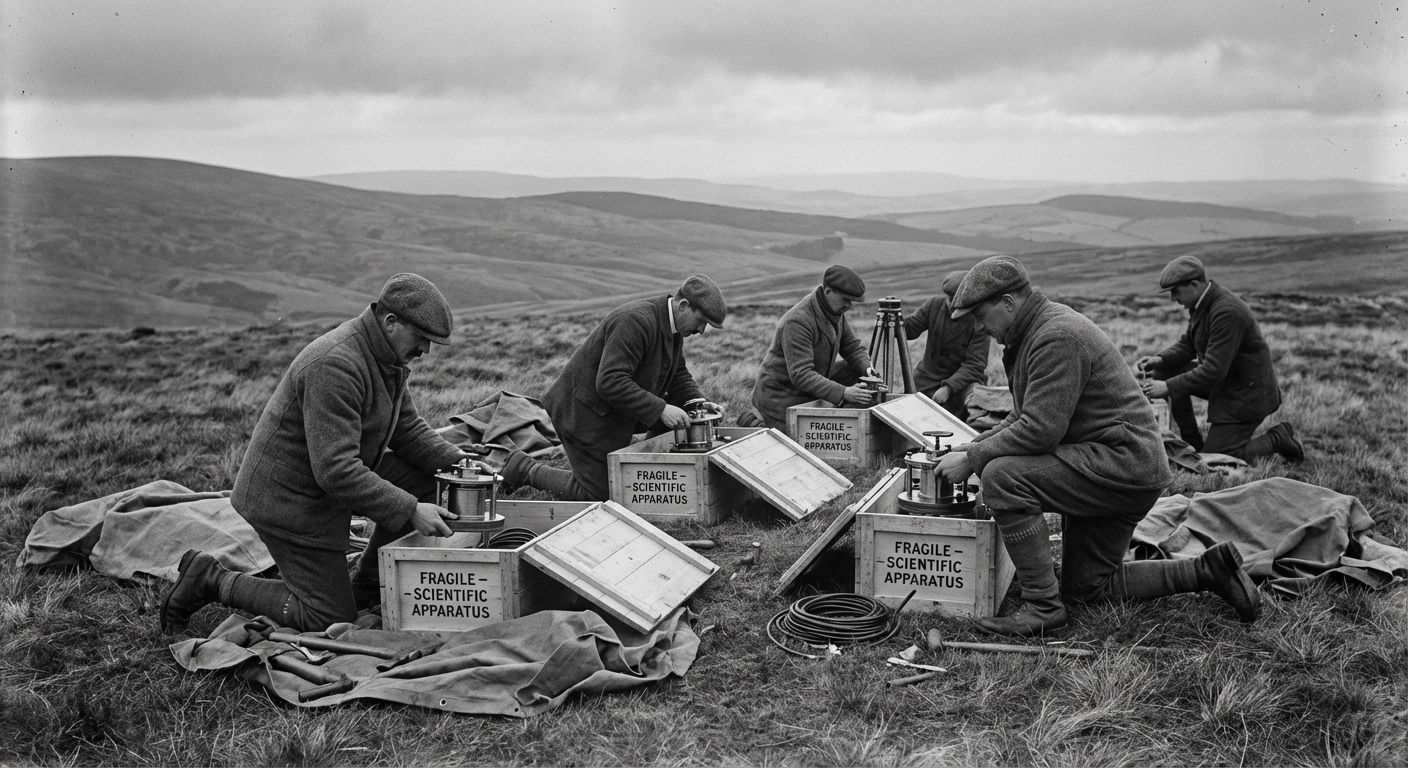
The shopping list for a monitoring station on a geothermally active ridge in the Greymoor Highlands is not long, but it is specific.
Three broadband seismometers capable of continuous recording at depths of up to fifteen metres. Two atmospheric gas sampling units, one portable and one fixed, calibrated for sulphur dioxide, hydrogen sulphide, and carbon dioxide at parts-per-million sensitivity. A meteorological mast with anemometer, barometer, and temperature sensors at three heights. A photometric array for continuous measurement of the luminous phenomenon. Battery banks sufficient for forty-eight hours of autonomous operation. And a shelter — insulated, wind-rated, bolted to bedrock — capable of housing the equipment and, periodically, the scientists who operate it.
The Royal Institute issued the first procurement tenders on Friday. Professor Elara Whitstone, who chairs the six-member panel overseeing the Greymoor investigation, confirmed that the tenders cover the seismometers and gas sampling units — the two systems considered most critical to the geological survey that begins in mid-May.
“We are not building an observatory,” Whitstone said. “We are building a listening post. The ridge is telling us something. We need the instruments to understand what it is saying.”
The Station
The approved budget — 195,000 florins for construction and initial equipment, plus 48,000 per year in operating costs — represents the most significant scientific investment in the Greymoor Highlands since the national geological survey of the 1970s. The 1950s meteorological outpost, a small stone hut built by the national weather service, was abandoned after seven years when funding was redirected to lowland stations. Its foundation stones are still visible on the southeastern ridge, half-buried in heather.
The new station will be built on a different site — approximately 800 metres northwest, above the central emission zone identified by Collis and Whitstone’s team. The location was selected for its proximity to the brightest point of the glow, its accessibility by pack track from the Dunvale road, and its distance from the active copper workings of the Miners’ Cooperative.
Nils Haversten, chairman of the Cooperative and a member of the panel, raised no objection to the site selection. “We’ve been digging in these hills for forty years,” he said. “If someone wants to tell us what’s underneath, I’ll carry the equipment up myself.”
Construction is expected to begin in April, with the station operational in time for the deep geological survey in mid-May. The survey itself — a comprehensive assessment to 250 metres depth, budgeted at 1.65 million florins — will determine both the extent of the geothermal system and the viability of expanded copper mining.
Thirty-Two Nights
While the instruments are procured and the station planned, the phenomenon itself continues.
Dr. Odette Collis has now observed the Greymoor glow on thirty-two consecutive clear nights — every night since she first documented it on 3 February. She has filled four and a half observation notebooks. Her routine is unvarying: she arrives at the ridge above Dunvale at 9:30 PM, sets up her telescope and photometer, and records observations until 2:30 AM or until cloud cover intervenes.
On Thursday night — her most recent clear observation — Collis noted what she described as a “marginal but consistent” increase in brightness at the central emission point. The brightening, she emphasised, is not dramatic — “not a flare, not a surge” — but her photometric readings over the past week show a trend that is “difficult to attribute to atmospheric variation.”
“Something may be changing,” Collis said, with the measured caution of a woman who has spent sixty-four years refusing to state more than her evidence supports. “Or I may be seeing variations within normal range. That is why we need the instruments. My telescope and my notebooks have brought us this far. They cannot take us further.”
Dr. Maren Ilkley, the Royal Institute spectroscopist who has worked alongside Collis on the ridge, confirmed that the spectral signature remains consistent — ionised nitrogen and trace sulphur dioxide, characteristic of geothermal venting. Whether the possible brightening reflects increased gas emission, changes in atmospheric conditions, or the accumulated wishful thinking of a retired schoolteacher with a telescope is precisely what the monitoring station is designed to determine.
The tenders close on 21 March. The ridge waits.