
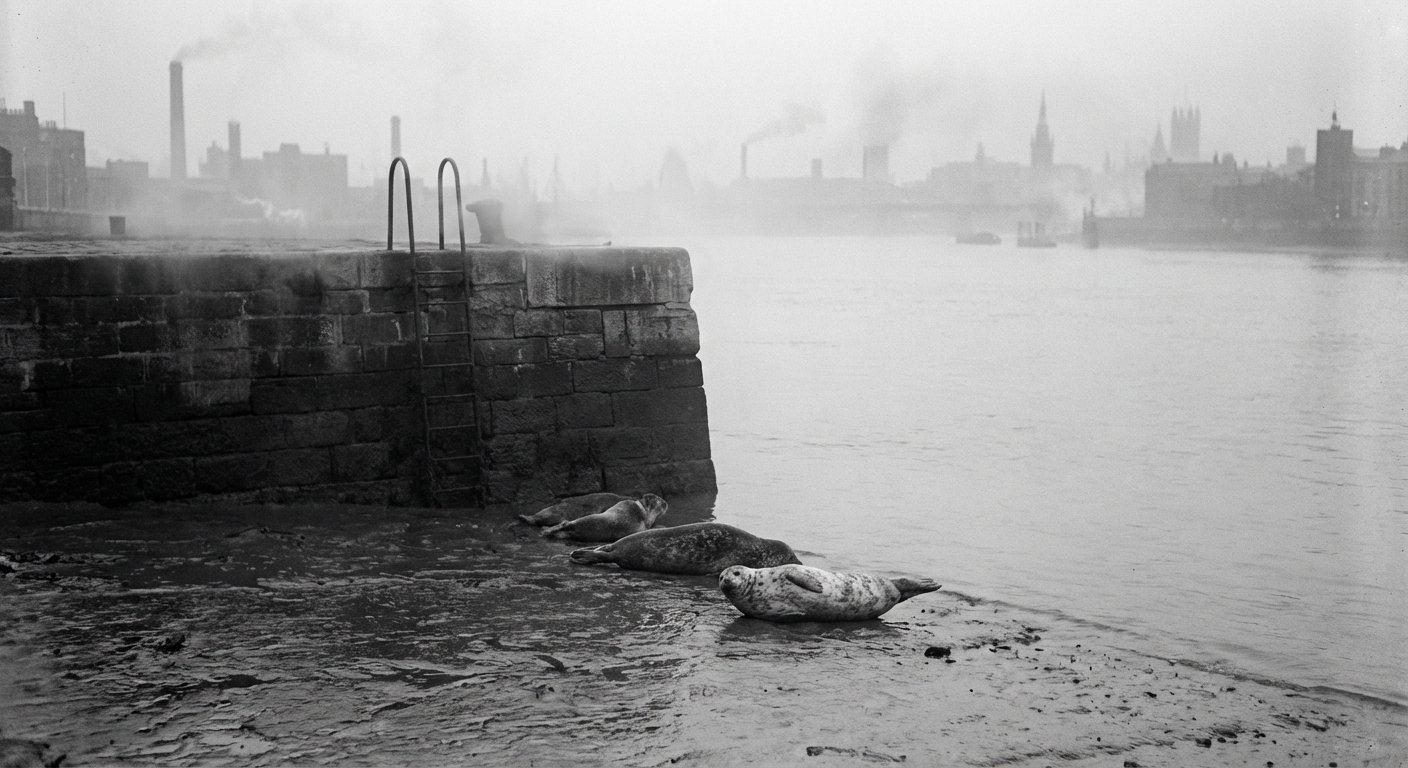
Reg Garside has sat on the same bench on Harbourfront Parade every morning since he retired from harbour piloting in 2009. He watches the tide, the ferry traffic, and the gulls. He knows the moods of the river. He knows when something is different.
“Tuesday morning,” Garside said. “Half six. Tide was out. I looked down at the mud below the Steps and there were these shapes. Grey, rounded. At first I thought someone had dumped something. Then one of them moved.”
What Garside, seventy-four, had seen was a group of harbour seals — Phoca vitulina — hauled out on the exposed mudflats between Bramblegate Steps and the Lower Ashwater footbridge. He counted seven. By Wednesday morning, he counted nine.
“I haven’t seen a seal in this river in my life,” Garside said. “And I’ve been on this water since 1971.”
The Confirmation
Dr Annalise Fenn-Coulthard, marine biologist at the Bobington Institute of Natural Sciences, visited the site on Thursday afternoon at low tide and confirmed the colony.
“There are seven to nine individuals,” Dr Fenn-Coulthard said. “Adults and at least two juveniles, which suggests this is not a transient group. They are establishing territory. They are comfortable.”
The last recorded seal colony in the lower Ashwater was documented in 1891 by the naturalist Clement Birch, who noted “a company of harbour seals, eight or ten in number, basking upon the river mud below the old quay.” Industrial discharge from the Docklands throughout the early twentieth century degraded water quality sufficiently to drive the animals downstream and eventually out of the river entirely.
“For a hundred and thirty-five years, the seals have stayed away,” Dr Fenn-Coulthard said. “Something has changed.”
The Conduit Connection
Dr Fenn-Coulthard believes two factors may explain the colony’s return. The first is a gradual improvement in water quality in the lower Ashwater over the past two decades, following the closure of several Docklands industrial operations and improved municipal sewage treatment.
The second is more speculative but intriguing. The recently discovered Lower Conduit — the buried eighteenth-century waterway traced beneath the Docklands by municipal surveyor Pella Strand — has its outfall directly below the old commercial wharf at Bramblegate Steps. The conduit carries clean flowing water from an as-yet-undetermined source, and its discharge creates a localised zone of fresher, cooler water on the mudflats — precisely the conditions that harbour seals prefer.
“I’m not saying the conduit brought the seals back,” Dr Fenn-Coulthard said. “But the outfall is creating a micro-habitat that they clearly find attractive. The mudflat there is different from elsewhere on the river — cooler, cleaner, with better drainage at low tide.”
Strand, the surveyor who discovered the conduit in February, said she was “astonished and delighted” by the news. “I went looking for pipes. I found a river. And the river, apparently, has found some friends.”
What Now
Dr Fenn-Coulthard has requested that the Harbour Authority designate the mudflat as a temporary wildlife protection zone while she conducts a full survey of the colony over the coming weeks. She has also asked the ferry service to reduce speed when passing Bramblegate Steps at low tide.
“They are wild animals,” she said. “They chose to come here. Our job is to not give them a reason to leave.”
Harbour Master Cornelius Ashby said the request was “under consideration” and that ferry operations would not be disrupted.
Garside, who has appointed himself the colony’s unofficial guardian, was on his bench at six o’clock on Friday morning.
“Nine again today,” he reported. “One of the little ones was sleeping on its back. Whiskers in the air.” He smiled. “Best thing I’ve seen on this river in fifteen years.”