
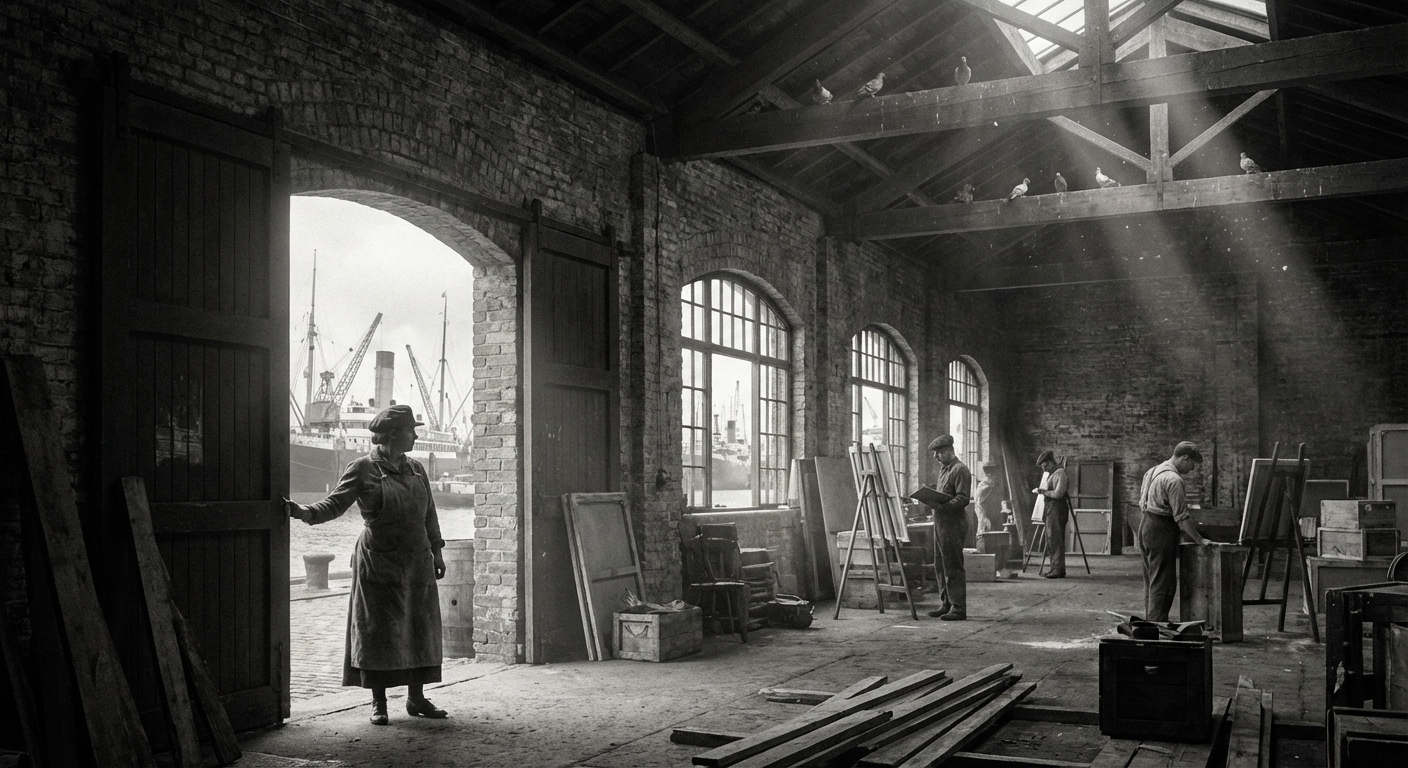
The Telford Granary is a long, low building on lower Harbourfront Parade with a pitched slate roof, fourteen arched windows, and a pigeon problem. It was built in 1889 by Aldous Telford as a grain store for his chandlery business, served three generations of Telfords, and has stood vacant since 2019, when Telford & Sons consolidated its operations to the new Port Sovereign facilities. For six years, the pigeons have had it to themselves.
That is about to change.
A consortium of five artists has purchased the building for 48,000 florins — well below the estimated market value of 65,000 to 70,000 florins for a waterfront commercial property of its size — with the intention of converting it into shared workshops, a small exhibition space, and, in the words of its organiser, “a place where people actually make things.”
The organiser is Maud Templeton, a ceramicist of forty-four who has spent the past three years throwing pots on her kitchen table in Bramblegate while her family eats around her. She is direct, practical, and visibly tired of working in a space she shares with a bread bin.
“I’ve been making ceramics for twenty years,” Templeton said, standing in the granary’s main hall on Tuesday, where dust motes drifted through the arched windows and a pigeon watched from a rafter. “For the last three, I’ve been making them between the toaster and the sugar bowl. Every serious ceramicist needs a kiln. I have an oven that goes to two hundred and twenty degrees. It’s not the same.”
The consortium comprises Templeton, photographer Claude Renaux (37, who currently operates a darkroom in his landlord’s cellar on Pilot’s Alley and specialises in harbour and maritime subjects), a printmaker, a metal sculptor, and a textile artist. Each contributed to the purchase price. The plan calls for five individual studios, a shared exhibition room on the ground floor, and a communal workshop for larger pieces.
”I’d Rather Have Artists Than Pigeons”
The building’s sale was made possible by Felix Telford, seventy-eight, the last of the Telford family to run the chandlery. He retired in 2019 and has spent the intervening years watching the granary gather dust and droppings while estate agents proposed converting it into storage units, a fitness hall, or flats.
“I had three offers above sixty thousand,” Telford said. “Storage, storage, and more storage. The Docklands has enough storage. My grandfather built that building to hold grain. Grain feeds people. I wanted someone who’d put something alive in it.”
Templeton approached Telford in January after learning the building was still unsold. She brought photographs of her ceramics — bowls, vessels, and a series of harbour-view tiles that she has been producing in frustrating small batches from her kitchen.
“She showed me the tiles,” Telford said. “The harbour in winter. The cranes. The light on the water at five in the morning. I recognised every one of them. I told her she could have the building for forty-eight thousand, and she nearly fell off her chair.”
The conversion will require roof work — several slates are cracked, and there is a persistent leak above what will become Renaux’s darkroom — along with new electrical wiring, a flue for Templeton’s kiln, and ventilation for the metalwork studio. The total cost is estimated at twelve to fifteen thousand florins, which the group intends to raise through a combination of savings, an Arts Council small-venues grant (application pending), and an exhibition of members’ work planned for the opening in May.
A Place on the Water
Renaux, whose photographs of the working harbour have been exhibited at the Bobington Academy of Fine Arts and the annual Docklands Heritage show, said the location was as important as the space.
“I’ve been photographing this waterfront for nine years from a cellar with no natural light,” he said. “Fourteen arched windows overlooking the harbour. I nearly wept when I saw them.”
Montrose, who walked the empty granary on Tuesday afternoon, observed that the building has the proportions and the light of a space that was designed for looking at things — wide bays, high ceilings, and a southern exposure that fills the main hall with the kind of honest, flat, waterfront light that makes both pots and photographs tell the truth.
Whether the exhibition space will become something worth visiting regularly is another question. Shared studio ventures have a mixed history in Bobington — the Millgate Workshops closed in 2014 after four years, undone by rising rents and internal disagreements. Templeton, asked about this, said she was aware of the precedent.
“We own the building,” she said. “That’s the difference. Nobody can raise our rent. We can argue about the washing-up rota, but we can’t be evicted.”
The pigeons, it should be noted, will need to be relocated. Templeton said arrangements were being made.