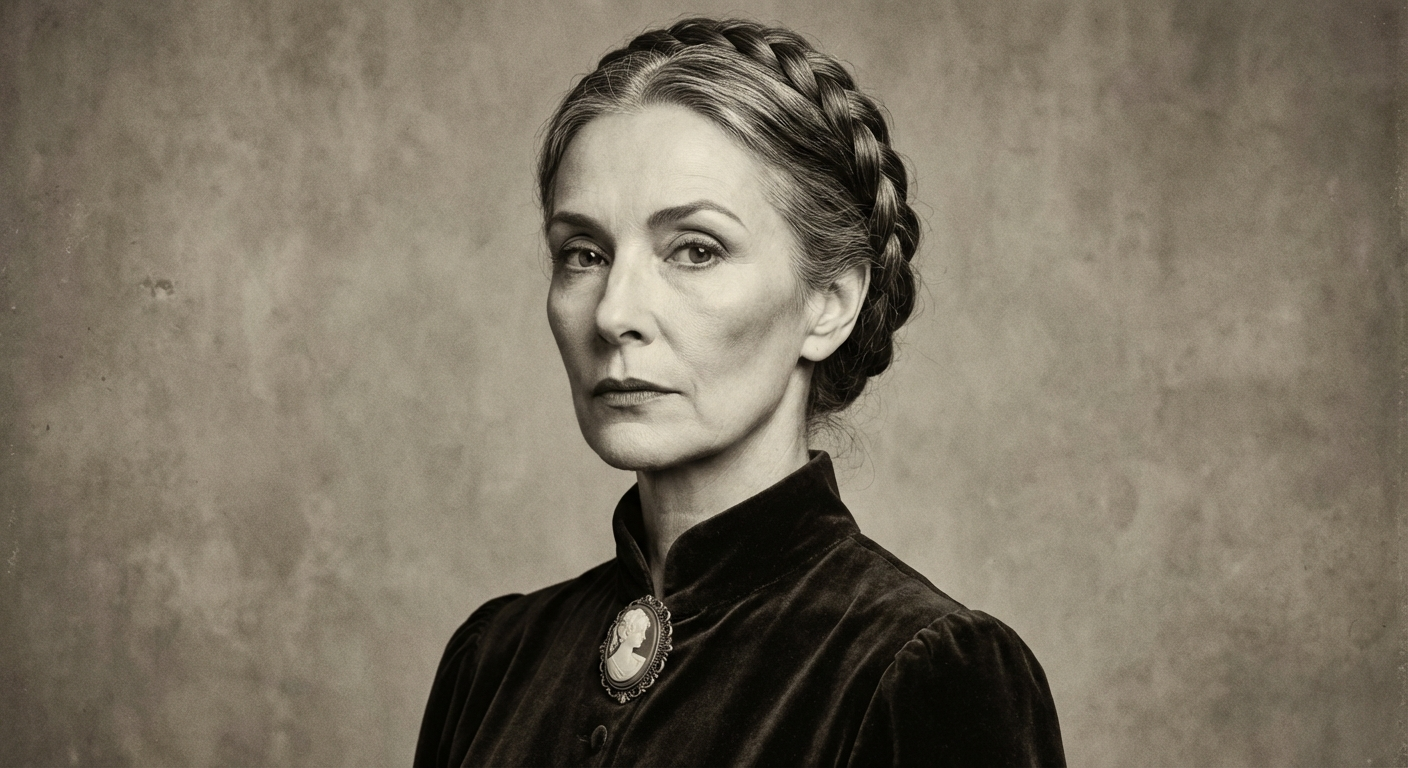
I have now visited “Light Through Glass” three times since its opening on Thursday evening, and I find that I am running out of adequate words — which is, I suspect, precisely the reaction Isolde Hargrove would prefer. She has always maintained that painting exists to say what language cannot, and after three circuits of the Royal Bobington Gallery’s Meridian Hall, I am inclined to agree with her.
Let me try, nonetheless.
The Early Work
The exhibition is arranged chronologically, beginning with Hargrove’s student work at the Bobington Academy of Fine Arts in the early 1970s. These are instructive rather than thrilling — competent still lifes and figure studies that show a young artist learning the grammar of her craft under the formidable Matthias Crane, whose brooding seascapes dominated Bobington’s art world for decades.
But even here, there are hints of what is to come. A small oil study of a glass of water on a windowsill, painted when Hargrove was perhaps twenty, catches the light with a subtlety that none of her contemporaries could match. The water is not merely transparent; it seems to contain the light, to hold it and release it slowly, as though the glass were breathing.
It is, in miniature, the quality that would come to define her entire body of work.
The Greymoor Paintings
The heart of the retrospective — and, I would argue, the heart of Hargrove’s achievement — occupies the gallery’s central rooms: the Greymoor Highland landscapes painted between 1985 and 2005. These are the paintings that made her reputation, and seeing them gathered together for the first time is a genuinely overwhelming experience.
The largest, “Granite and Cloud” (1991), measures nearly four metres across and depicts a valley in the Highlands at the precise moment when a break in the overcast sky sends a single shaft of sunlight across the moorland. The effect is not dramatic in the way that Crane’s seascapes are dramatic. It is quiet, almost tentative — the light seems uncertain of itself, as though it might withdraw at any moment. And yet it illuminates everything it touches with an intensity that makes the surrounding shadow feel not dark but merely patient.
I watched a man stand before this painting for eleven minutes on my second visit. He did not move. When he finally turned away, I saw that his eyes were wet.
The Portraits
Less discussed but no less remarkable are Hargrove’s portraits, which occupy the exhibition’s final rooms. These are not society portraits or exercises in flattery. They are, without exception, paintings of people Hargrove knows well — friends, neighbours in Millhaven, the woman who runs the post office, an elderly farmer whose name the wall text gives as Tobias Renn.
What distinguishes them is Hargrove’s refusal to idealise or sentimentalise her subjects. Renn, in a painting dated 2018, is depicted sitting at a kitchen table with a cup of tea. His hands are large and weathered. His expression is not cheerful, not melancholy — it is simply present. He is a man sitting at a table. And yet the painting insists, with quiet authority, that this is enough. That a person, seen truly, is sufficient subject for any canvas.
The Crowd
It must be said that “Light Through Glass” has attracted an audience that the Royal Bobington Gallery has not seen in years. Director Simone Aldair confirmed that opening weekend attendance exceeded 8,000 visitors — a figure that would be respectable for an entire month in the gallery’s recent history.
The crowd is notably diverse. On my Saturday visit, I observed art students with sketchbooks, families with children, elderly couples moving slowly from painting to painting, and a significant number of people who appeared to have wandered in off the street with no prior intention of visiting a gallery — drawn, perhaps, by the word of mouth that has turned this exhibition into a civic event.
“I don’t usually go to galleries,” confessed Marta Selwyn, a tram conductor from the Docklands who was visiting with her teenage daughter. “But my neighbour said you have to see these paintings, and she was right. That one of the valley — I felt like I was standing there.”
A Reckoning
There will be, in the coming weeks, a great deal of critical writing about this exhibition — much of it, I suspect, from colleagues who have spent years dismissing Hargrove as a mere landscapist, a painter of pretty views for people who find abstraction disagreeable. I have been guilty of underestimating her myself.
“Light Through Glass” makes such dismissals impossible. What Hargrove has been doing, patiently and without fanfare, for half a century is something far more radical than any avant-garde gesture: she has been looking at the world — truly looking — and painting what she sees with a fidelity that borders on the spiritual.
The exhibition runs through June. Go. Go twice. Take someone who says they don’t like art. They will leave unable to explain why their chest feels tight, which is, I think, the whole point.
“Light Through Glass: The Art of Isolde Hargrove” is at the Royal Bobington Gallery, Meridian Hall, through 30 June. Admission: 8 florins; concessions 4 florins. Free on Wednesdays.