
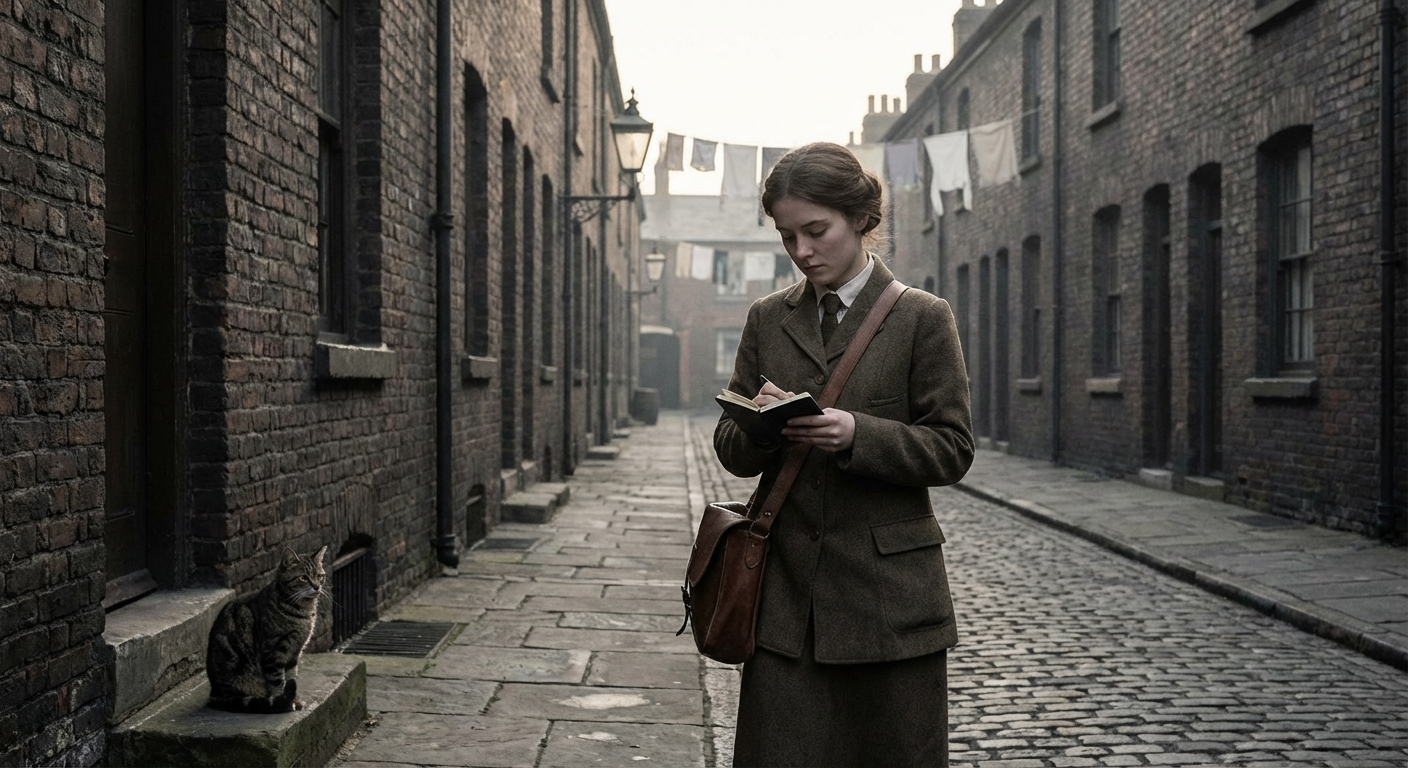
At ten past seven on Saturday morning, Maisie Hollander stepped out of the Docklands Post Office with a mailbag over her left shoulder, a mental map drawn from four days of shadowing, and the particular expression of a person who is trying very hard not to look lost.
She was not, in fact, lost. Albie Finch had been thorough in his handover — the short cuts through the courtyards behind Pilot’s Alley, the gate at number 14 that sticks unless you lift the latch while pushing, the order of the odd-numbered houses on Chandler’s Row that doesn’t match the even-numbered side because the street was renumbered in 1938. Hollander had written it all down in a small blue notebook that she carried in her coat pocket and consulted, by her own estimate, approximately forty times during the round.
“Albie warned me about the notebook,” she said afterwards, sitting in the sorting room with a cup of tea and the look of someone who has completed a marathon. “He said eventually I’d know the round in my feet, not my head. Today it was definitely still in my head.”
The Route
Round 14 covers Chandler’s Row, Pilot’s Alley, lower Harbourfront Parade, and nineteen connecting streets — roughly two and a half miles of daily walking, 211 delivery points, and what Finch once estimated as approximately 47 cats with opinions about postal workers.
Hollander completed the round in two hours and thirty-five minutes, which is forty minutes slower than Finch’s customary pace but well within the Post Office’s allocated time. She expects to shave the margin as she learns the route.
“The streets aren’t the hard part,” she said. “It’s the people. Albie knew everyone. He knew which doors to knock on and which to leave alone. He knew who was ill, who’d moved, who’d had a baby. I know the addresses. I don’t know the stories yet.”
Mrs Carmody’s Shortbread
The residents of Chandler’s Row were, by all accounts, welcoming — if occasionally wistful.
Mrs Carmody, at number 11, who had given Finch shortbread on his final round on Friday, gave Hollander shortbread on Saturday as well. “Different batch,” she said, as if this required clarification. “The ones yesterday were oat. These are plain.”
Hollander accepted with appropriate gravity. Mrs Carmody watched her walk away with the expression of a woman who has decided to reserve judgment.
“She seems a nice girl,” Mrs Carmody said. “Quick. She’ll learn.”
Mr Pettigrew, the elderly resident who had waved to Finch from his first-floor window, was at the window again on Saturday. He waved to Hollander. She waved back.
At 9 Lower Harbourfront Parade, Mrs Tolliver — who had received Finch’s final delivery, a furniture shop circular — accepted a gas bill from Hollander and told her about the boarding house’s door buzzer, which requires three short presses and one long.
“Albie never needed the buzzer,” Mrs Tolliver noted. “But then Albie never needed to be told anything twice.”
A Different Generation
Hollander is twenty-four years old, a transfer from the Caldwell Central Sorting Office, where she worked the overnight shift for two years. She applied for the Docklands posting specifically.
“I wanted a walking round,” she said. “In Caldwell, I sorted letters in a warehouse. I never saw where they went. I wanted to be the person who actually puts them through the door.”
Her appointment was not without mild controversy within the Docklands Post Office. Arthur Gullick, the postmaster, acknowledged that several more experienced carriers had expressed interest in Round 14 — a round considered, despite its unglamorous geography, one of the most desirable in the district for its compact route and distinctive character.
“Maisie was the best candidate,” Gullick said simply. “She’s quick, she’s careful, and she wanted it. Experience will come.”
Finch himself, who had recommended that the Post Office assign someone with “patience and good shoes,” is understood to be spending Saturday morning at home in the Docklands with his wife Joan. He has reportedly been seen walking around the house with an expression of mild bewilderment, as if uncertain what to do with a morning that does not begin with a mailbag.
The Notebook
At the end of her first solo round, Hollander sat in the sorting room and added several entries to her blue notebook. She would not show its contents to this reporter but confirmed that it now contains, in addition to route directions and gate quirks, a running list of residents’ names, their particular preferences, and the location of what she described as “at least twelve cats who have very strong feelings about the mail.”
“Albie gave me the map,” she said. “The rest, I’ll have to earn.”
Saturday’s mail on Round 14 consisted of 83 items: 29 bills, 18 circulars, 14 personal letters, and 22 parcels. None were lost.