
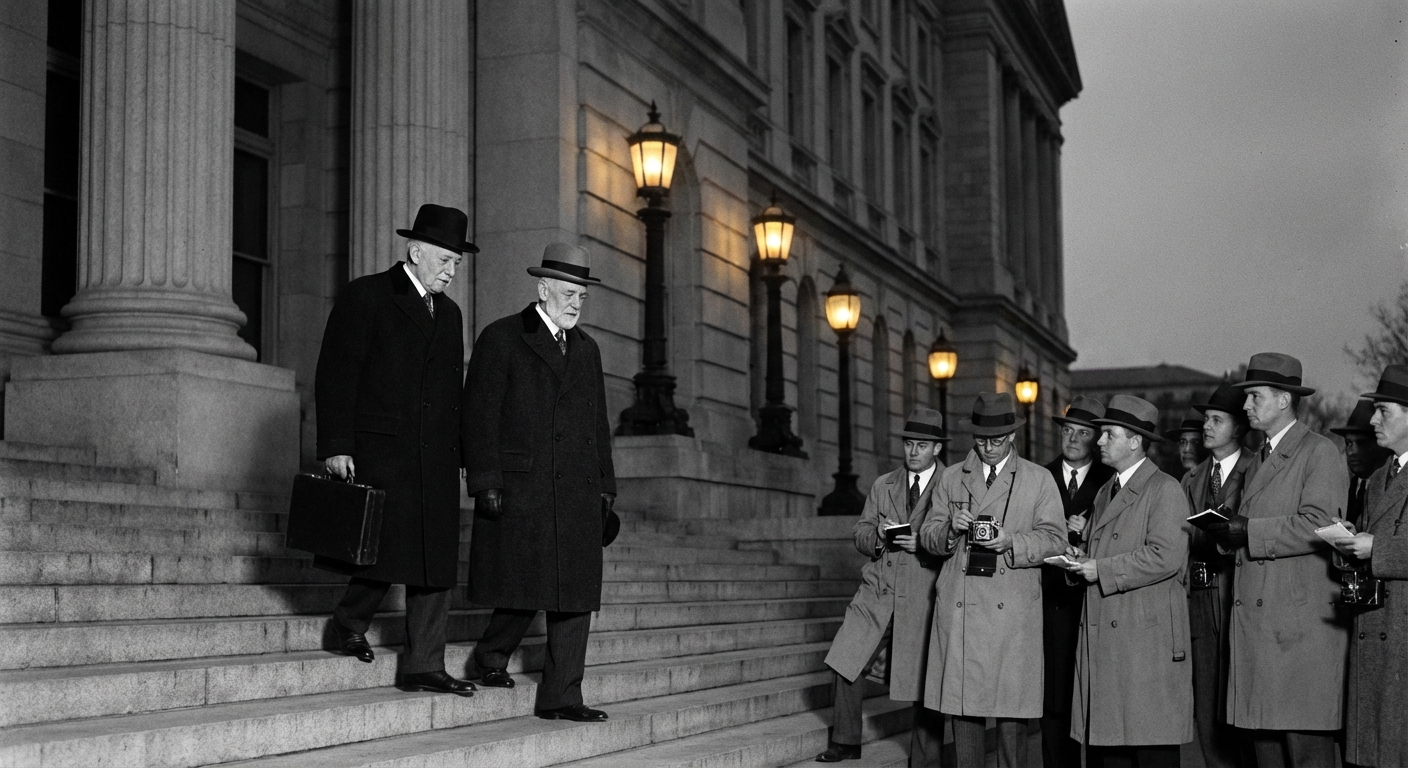
They walked out together.
That was the first thing the waiting reporters noticed — Sir Duncan Hale and Count Viktor Soren emerging from the Foreign Office not through separate doors, as they had after each previous session, but side by side through the main entrance on Chancery Row. Hale was carrying a leather portfolio. Soren was not carrying anything at all.
The joint statement, read by Undersecretary Helena Marchetti from the Foreign Office steps at 7:14 PM, was the longest of the process — 127 words, precisely measured, each one the product of nine hours of negotiation that began at ten o’clock that morning and paused only once, for forty minutes, at half past two.
“Thursday’s session produced substantive agreement in principle on all four pillars of the Transit Corridor Framework for the Kaelmar Strait. Both parties have agreed to a designated transit corridor, an inspection protocol, an insurance framework, and a review mechanism. Technical annexes will be completed in a further session. Both parties express their satisfaction with the progress achieved and their commitment to the timely implementation of the framework.”
The word “satisfaction” has not appeared in any previous statement. Neither has “implementation.”
The Four Pillars
The Transit Corridor Framework, as agreed in principle, establishes:
A designated transit corridor through the northern channel of the Kaelmar Strait, with defined routing, speed limits, and signalling protocols for civilian commercial vessels.
An inspection protocol administered by a joint Maritime Inspection Commission comprising three Delvarian officials, three Thessarine officials, and one neutral observer from the Ashford Republic. Vessels will submit cargo manifests forty-eight hours in advance. Inspections will be conducted on a random basis, determined by vessel class and cargo type. Any vessel refusing inspection will be subject to a seventy-two-hour review and possible barring from the corridor.
An insurance framework providing a joint underwriting guarantee, funded equally by both parties, for the three-month trial period. Transit premiums will be capped at one hundred and forty per cent of pre-crisis rates. Claims will be adjudicated by a neutral panel seated in Fenmouth.
A review mechanism establishing a three-month trial period, with a bilateral assessment at six weeks and a formal review at ninety days.
“This is not a treaty,” said Professor Elias Thornbury of the Bobington Institute for Foreign Affairs, reached by telephone on Thursday evening. “It is something more practical than a treaty. It is a set of instructions for how ships move through water. And that is precisely what was needed.”
What Remains
The agreement is in principle. It is not yet in ink.
Technical annexes — vessel classification tables, insurance premium schedules, signalling protocols, and the procedural rules for the Maritime Inspection Commission — must be completed before the framework can be formally signed. A fifth session has been scheduled for next Thursday, 19 March, at Chancery Row.
Sources close to the talks described the annexes as “detailed but not contentious.” The substantive disputes — who inspects, who pays, who decides — have been resolved. What remains is administrative.
If the annexes are completed and the framework signed next week, the first commercial vessels could transit the strait within two to three weeks — by early April at the latest.
The Shape of Thursday
The session began at ten o’clock. For the first three hours, discussion centred on the inspection protocol — the question that Thornbury had identified as “the last ten per cent” and that sources described as the most difficult of the entire process.
The breakthrough came on the composition of the inspection body. Delvaria had insisted on unilateral inspection rights in the northern channel, citing sovereignty. The Thessarine side had demanded equal representation, citing the Treaty of Ashen Bluffs. The compromise — a joint commission with a neutral Ashford observer — was proposed, sources said, by Soren himself, drawing on his seven years as ambassador to the Ashford Republic.
“Soren understood that Delvaria needed to be seen as the authority in its own waters, and the Thessarines needed to be seen as equal partners in the process,” Thornbury said. “The Ashford observer gives the mechanism credibility without challenging either claim. It is elegant.”
The insurance framework was settled more quickly, in the afternoon session. The Fenmouth adjudication panel was reportedly a Thessarine proposal — a deliberate echo of the 1962 Maritime Accords, which established Fenmouth as neutral ground for maritime disputes.
The forty-minute break at half past two was, by all accounts, not a crisis. Both delegations were observed eating sandwiches.
The Consul’s Window
Consul Pehr Lindqvist was not present at the Foreign Office on Thursday. But the lights at the Delvarian consulate on Ashbury Lane were visible from the street by five o’clock — an hour before the session concluded. The Thessarine consulate, three doors down, was equally illuminated.
Consul Elara Miren was seen entering the Foreign Office through the east entrance at twenty minutes past seven — after the statement was read, but before the delegations departed.
The Kharstad Gazette has not yet published its account of Thursday’s events. Diplomatic observers will be watching page placement with particular interest.
What It Means
The Kaelmar Strait has been effectively closed to commercial shipping since 12 February — twenty-eight days. In that time, the Bobington Merchants’ Guild estimates that total fleet rerouting costs have exceeded two million florins. Fourteen vessels have taken the Cape of Sarenne at an additional twelve to fifteen days per voyage. The Eastern Spice Index, which peaked at 356 on 26 February, has fallen steadily but remains above pre-crisis levels.
Copper closed at 818 florins per tonne on Thursday — a fall of fourteen florins, the sharpest single-day decline since Count Soren’s designation as envoy on 26 February. The decline began during the afternoon, as word filtered from Chancery Row that the session was continuing past its expected duration — a sign, in the grammar of these talks, of progress rather than deadlock.
The Northern Fleet remains in position. The Thessarine garrisons remain reinforced. The military realities of the strait have not changed. But for the first time since the crisis began, there is a document — agreed in principle by both sides — that describes how the strait might function as a corridor of commerce rather than a line of confrontation.
“The framework echoes 1962 but improves upon it in two crucial respects,” Thornbury said. “It creates a standing inspection mechanism rather than relying on ad hoc arrangements, and it establishes insurance provisions that give shipowners a reason to use the corridor. The Maritime Accords assumed goodwill. This framework assumes self-interest. It is more likely to last.”
Hale and Soren departed the Foreign Office separately — Hale by motorcar, Soren on foot with Lindqvist, walking toward Ashbury Lane. Neither spoke to reporters. Neither needed to.
The framework spoke for them.