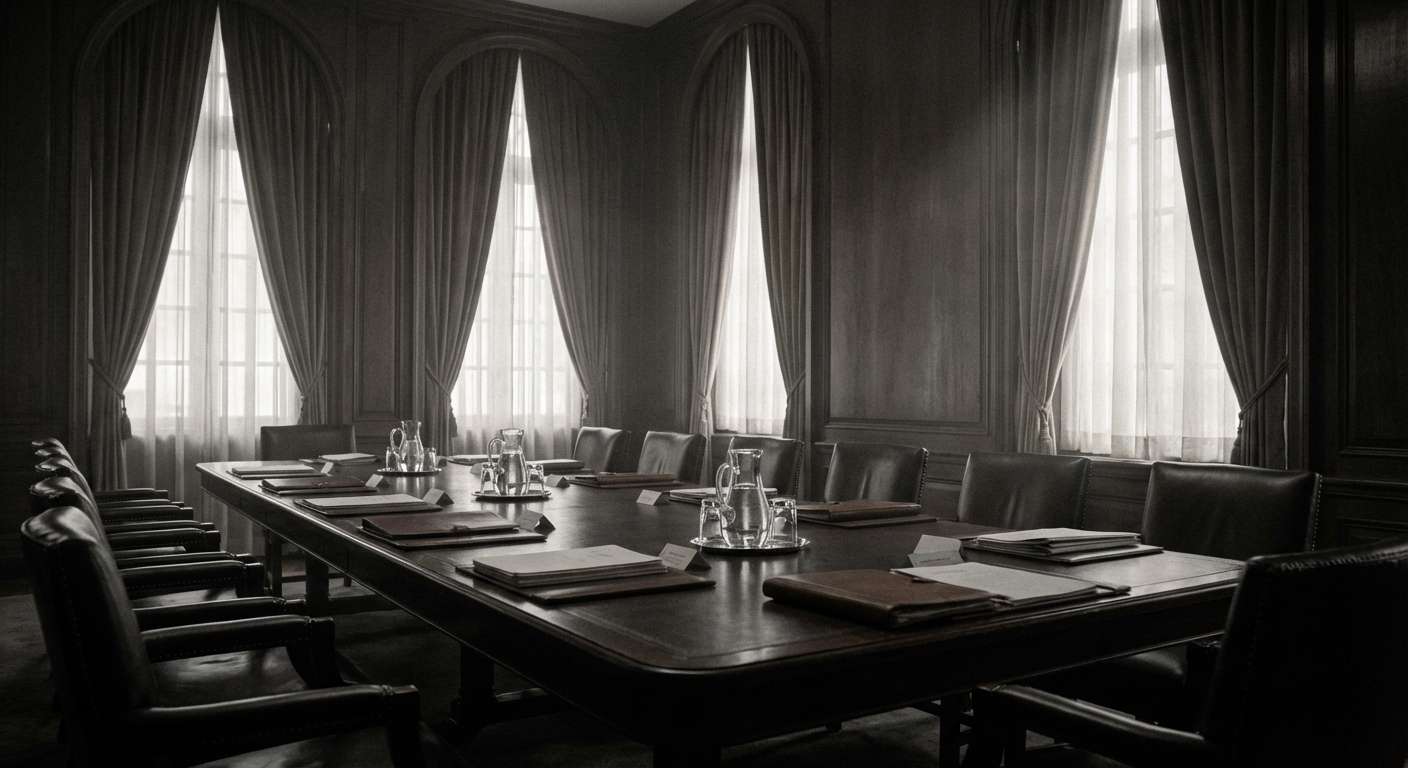
Two clocks will be running on Monday morning. At 9:30 AM, Count Viktor Soren and Sir Duncan Hale will sit down at the Foreign Office on Chancery Row for the third session of the quiet channel talks. At 10:00 AM, half a mile away, Mayor Blackthorne will rise in the Municipal Chamber to address a council that must decide how to build a tramway with copper that currently costs more than it should.
The two events are connected by a single metal and a single strait, and the timing is not accidental. Undersecretary Marchetti, who has managed the logistical choreography of the talks with characteristic precision, is understood to have suggested the Monday slot in full awareness of the council calendar. Whatever emerges from the third session will enter the political atmosphere at exactly the moment it matters most.
What “Commercial Substance” Means
The joint statement issued after Thursday’s five-hour second session — the longest of the three scheduled — was the first of its kind: a document agreed by both delegations and released simultaneously. Its twenty-three words were chosen carefully: “The discussions on Thursday were substantive and conducted in a spirit of mutual resolve. Both parties have agreed to a further session.”
The phrase “mutual resolve” is new and deliberate. Previous language — “constructive,” “tangible” — described the process. “Mutual resolve” implies direction. Something is being resolved toward.
Sources within the diplomatic community, speaking with the usual caveats about the quiet channel’s confidentiality, indicate that discussions have moved beyond procedural matters and into “matters of commercial substance.” In practical terms, this is understood to mean the framework under which commercial shipping might resume through the Kaelmar Strait.
The details of such a framework remain speculative, but diplomatic observers suggest several elements likely under discussion:
A commercial transit corridor through the northern channel, with agreed schedules and advance notification requirements. A mutual inspection protocol to address Thessarine security concerns without impeding traffic. An insurance framework that would allow underwriters to resume writing Kaelmar-route policies. And a review mechanism — some process by which the arrangement could be assessed and adjusted without requiring renegotiation.
None of this addresses the underlying military posture. The Delvarian Northern Fleet remains in position. Thessarine garrisons remain reinforced. But commercial reopening, even partial, would signal that the crisis has moved from confrontation to management — and the markets would respond accordingly.
Below 850
Copper closed Friday at 847 florins per tonne. The number matters.
Before the crisis, copper traded at approximately 740. It peaked at 891 on the first day of the commission hearings. It has been falling steadily for a week, driven by diplomatic optimism, the commission’s phased approach (which reduces immediate copper demand), and the general exhaustion of speculative buying.
But 850 was a line. Analysts at Fernwich Trading House had identified it as the point below which the market would begin pricing in a resolution — not a certainty, but a probability. Clement Varga, the senior commodities analyst, has been cautious throughout the crisis. On Friday, for the first time, he used the word “trajectory.”
“The trajectory is downward,” Varga said. “But trajectory is not destination. A failed session on Monday, a naval incident, a political reversal in Kharstad — any of these would reverse the trend in an afternoon.”
The Eastern Spice Index, which has been declining for six consecutive sessions, closed Friday at 328 — its lowest since before the crisis. The index is a lagging indicator, reflecting wholesale prices negotiated days or weeks earlier, but its sustained decline reinforces the broader mood.
The Thessarine Aide
A detail observed during Thursday’s session may prove significant. For the first time, a member of the Thessarine Foreign Secretary’s staff was seen entering the Foreign Office during an active session. The aide — whose name has not been disclosed — was observed arriving at 2:15 PM through the Chancery Row entrance normally reserved for Soren’s delegation.
The Thessarine participation in the quiet channel has, until now, been indirect. Hale serves as the primary interlocutor with Soren, and the Thessarine positions have been communicated through written briefs prepared before Hale’s return from Thessara. The physical presence of a Thessarine official during a session suggests either that the discussions have reached a level of detail requiring real-time consultation, or that the Thessarine side wishes to signal a deeper commitment to the process.
Professor Thornbury, at the Institute for Foreign Affairs, offered the more optimistic reading: “When a delegation sends someone into the room, it means they want to be in the room. That is not a small thing.”
Consul Miren’s lights at the Thessarine consulate on Ashbury Lane were observed burning past 8:00 PM on Thursday evening. The Kharstad Gazette ran no editorial comment on the session. Both silences are, in their way, eloquent.
Monday at 9:30. The quiet room on Chancery Row. The commerce of peace.