
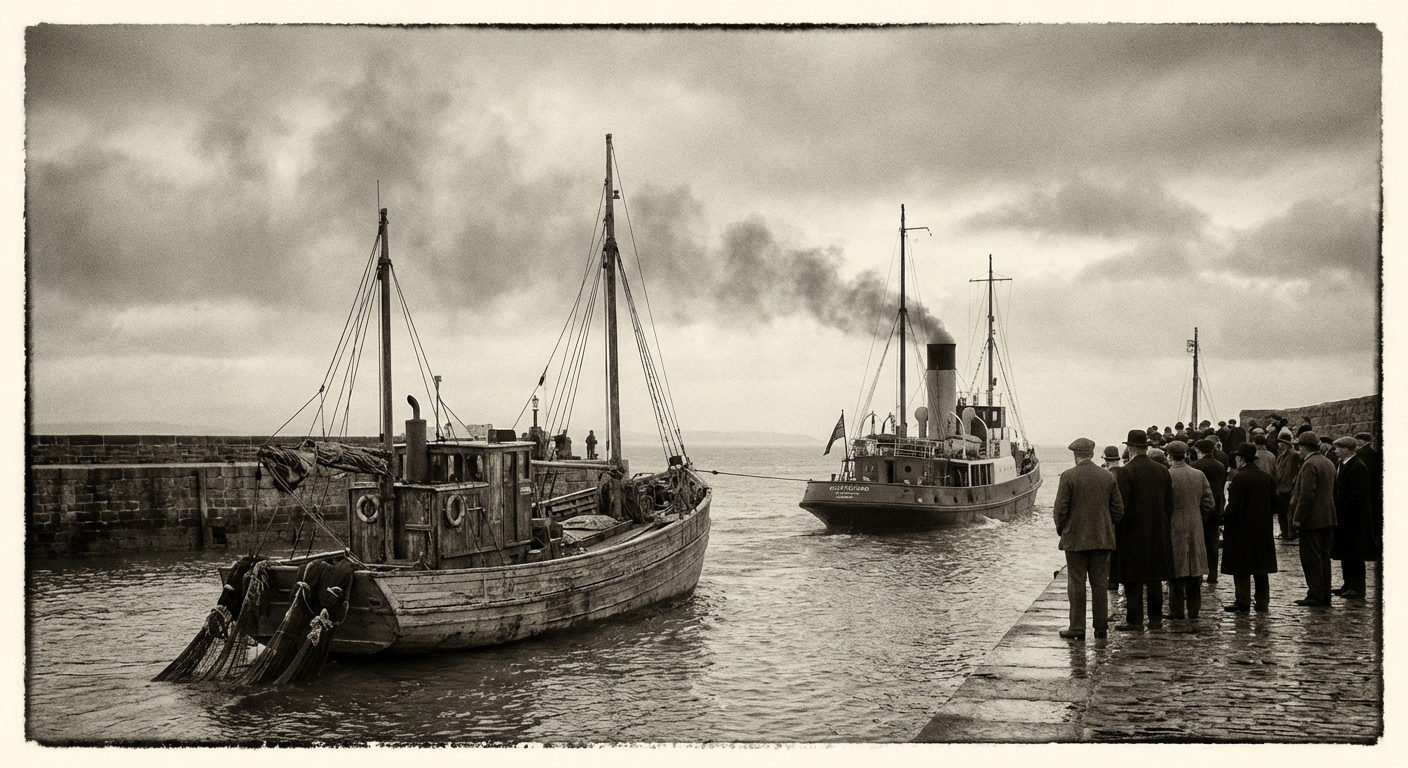
They found her at twenty past four in the morning, drifting broadside to a low swell with a jury-rigged sea anchor trailing from her stern.
The coastguard cutter Resolute, under Captain Anne Dalrymple, located the fishing trawler Lady Maren approximately nineteen nautical miles north-east of Bobington harbour at 4:20 AM on Tuesday, ending a search that had lasted since first light Monday. The vessel was disabled — her engine seized, her radio aerial snapped clean — and adrift in waters that had produced gusts of forty-five knots less than forty-eight hours earlier.
All four crew are alive.
Captain Dermot Shale, 58, his son-in-law and deckhand Tobias Renn, and two experienced hands were found cold, fatigued, and rationing the last of their drinking water, but without serious injury. Renn had sprained his left ankle in a fall on deck during Sunday night’s squall and was carried to the Resolute’s sick bay by two coastguard ratings. The others walked aboard under their own power.
“The crankshaft seized at approximately nine o’clock Sunday evening,” Captain Shale said from a cot at the harbour infirmary, where all four crew were taken for assessment. “We were making for home when the engine note changed. Twenty minutes later she was dead. The aerial went in the same blow — took the top three feet of the mast bracket with it.”
Without radio or engine, Shale did what thirty years of seamanship had taught him. He deployed the vessel’s fishing nets over the stern as a makeshift sea anchor to hold her head to the weather, set a watch rotation, and waited.
“You cannot signal what you cannot transmit,” he said. “So you stay afloat and you wait for someone with better equipment to come looking.”
The Resolute had departed Bobington harbour at first light Monday after Harbour Master Cornelius Ashby issued a maritime alert. The search covered a grid of approximately four hundred square nautical miles across the outer banks and northern approaches, complicated by intermittent squalls and reduced visibility. Three fishing vessels — the Endeavour, the Saltmarsh Queen, and the Blackwater Girl — joined the search voluntarily on Monday evening, extending coverage to the eastern approaches.
Captain Dalrymple located the Lady Maren at the northern edge of the search grid, further than expected — the current had carried the disabled vessel roughly eight miles from her last known position.
“She was sitting low and dark,” Dalrymple said. “No lights, no engine noise. We picked her up on the lamp sweep. When we came alongside, Captain Shale was standing at the rail. He said, ‘You took your time, Captain.’ That was when I knew they were all right.”
The Resolute took the Lady Maren under tow at 5:15 AM. The two vessels reached Bobington harbour at 11:40 AM on Tuesday to a crowd of approximately two hundred people lining the harbour wall — fishermen, harbour workers, and families.
Bridget Shale, who had maintained a vigil at the Port Authority building since Monday evening, was at the pier when the tow line was made fast. She did not speak to reporters. Neighbours said she had not slept since Sunday.
Tobias Renn’s wife — Captain Shale’s daughter — was among those waiting. She had travelled from Thornhill at dawn after receiving word by telephone from Ashby’s office.
The vessel herself is damaged but not beyond repair. A preliminary inspection by harbour engineers found the crankshaft fractured — not merely seized — suggesting a pre-existing fatigue crack. The hull is sound. Shale, asked about repairs, said: “She’ll fish again. I built her to last."
"Luck Is Not a Safety Policy”
The safe return of the Lady Maren’s crew has given fresh urgency to a question that the Fishermen’s Benevolent Association has raised for years: the absence of mandatory position-reporting equipment on small vessels.
The Lady Maren carried a standard marine radio and emergency flares. She did not carry a wireless position-reporting beacon — a device that transmits a vessel’s location at regular intervals to the Harbour Authority, regardless of whether the crew can operate the radio. Such equipment costs between 180 and 260 florins per unit and is standard on larger commercial vessels. The Harbour Authority recommends but does not require it for vessels under twenty metres.
Wilfred Poole, secretary of the Fishermen’s Benevolent Association, said the incident proved what the Association has argued since 2021.
“If Dermot Shale’s boat had carried a beacon, we’d have known where she was within the hour,” Poole said. “Instead it took thirty-one hours and half the fishing fleet. Every hour of that search cost money, sleep, and years off Bridget Shale’s life.”
Poole confirmed that the Association has called an emergency meeting for Thursday evening at the Harbourfront Mission Hall. He intends to table a formal resolution demanding that the Harbour Authority mandate position-reporting equipment on all registered vessels under twenty metres — an estimated fleet of approximately ninety boats.
“We’ve written three letters,” Poole said. “The fourth will not be a letter.”
Harbour Master Ashby, asked whether the Authority would support mandatory equipment, was measured but notably did not dismiss the proposal.
“We were fortunate,” Ashby said. “Captain Shale is an exceptionally capable seaman, and the weather, while rough, did not produce the worst that March can deliver. But luck is not a safety policy. I expect this will be discussed seriously and soon.”
The estimated cost of equipping all ninety vessels is between 16,200 and 23,400 florins — a fraction of the cost of a single coastguard search operation, which Poole estimates at approximately 8,000 florins per day.
Three of the four crew were discharged from the harbour infirmary by Tuesday evening. Renn was kept overnight for observation of his ankle but is expected to be released today.
Captain Shale, asked what he would do first, said: “Sleep. Then fix the engine. Then take Bridget somewhere that isn’t a boat.”